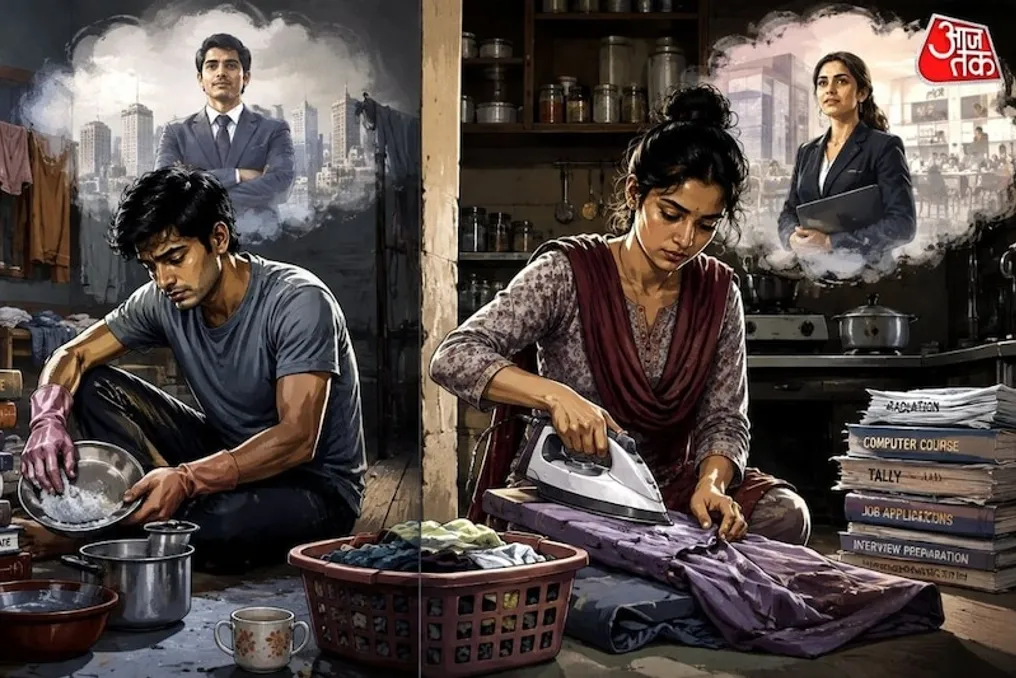
According to the new report 'Reimagining Skilling for Developed India @2047' by the National Council for Planning (NITI Aayog), the issue of skill development in India goes beyond simple unemployment rates. It was found that approximately 87 million young people aged 15 to 29 are neither studying, working, nor undergoing any form of training. This group is referred to as the NEET population.
Unemployed youth are included in this group. The report indicates that this number constitutes about 11% of the total population, although those actively seeking employment are not included in the count. More concerning is the fact that about 88% of individuals in this group are involved in performing household chores.
The report does not detail the gender distribution among these 87 million young people. However, an analysis conducted on women revealed that significant barriers to skill development exist in India, related to domestic responsibilities, mobility challenges, and limited access to job opportunities.
In the report, these young people are considered alongside four other main groups: school students, higher education students, people working in formal and informal sectors, and women. These five groups collectively represent about 60 million citizens. According to NITI Aayog, skill development should not be viewed solely as a process after securing a job. The entire human life cycle must be considered: from starting school, through higher education, employment, periods outside the labor market, and the potential for re-entry into work. Furthermore, recommendations are offered to those young people who have dropped out of school or are outside the system, suggesting ways to return.
For many people, problems begin even before they can reach educational centers. The report states that financial constraints, loss of income during study, prior educational expenses, and a lack of learning options tailored to individual needs can impede skill acquisition. These difficulties are exacerbated for women: family and domestic duties, childcare responsibilities, safety concerns, and transportation complexities make accessing education and employment more difficult.
Women are included in the report as a distinct and crucial category. In statistics pertaining to women, the role of domestic duties is particularly significant. NITI Aayog notes that only 3% of women are employed in the formal sector, while 71% either work in the informal sector or fall into the category of youth outside education, employment, and training. Barriers are not limited to the availability of training programs. In the survey, 68% of women prefer part-time skill training, and 30% wish to take short courses. The study also showed that the choices of many women are constrained by family caregiving, familial expectations, and safety issues. Even traveling to a training center located just a few kilometers from home can pose a problem for them.
An example of Sangita is provided, whose life illustrates these difficulties. She married early, had children, and wanted to acquire a skill for extra income, but due to family expectations, safety concerns, and caregiving duties, she could not travel long distances or attend all-day events.
This reveals the key idea of the report. NITI Aayog argues that education should not be a process that leads to the complete exclusion of an individual from the system after interrupting studies. Instead, there must be pathways for multiple connections, exits, and re-entries into the system between education, skill development, and work. Young people outside the system can return through short courses, micro-credentials, internships, or other recognized programs to gain new skills and reconnect with education or employment. Therefore, the issue is not just the quantity of training seats in India, but whether people can reach the training centers, afford the training, and find time to attend while managing domestic responsibilities.
The report mentions the case of a woman who dropped out of school due to domestic circumstances and early marriage, placing her in this category. Later, she managed to find a suitable training center, utilize a training voucher, complete a short course, and start working part-time before opening her own business.
However, the analysis does not end there. The core thesis of the report is that India's skill development system must recognize that people constantly move between education and work. An individual might drop out of school for family reasons, while another might leave work to care for family. Some may take short courses concurrently with work.