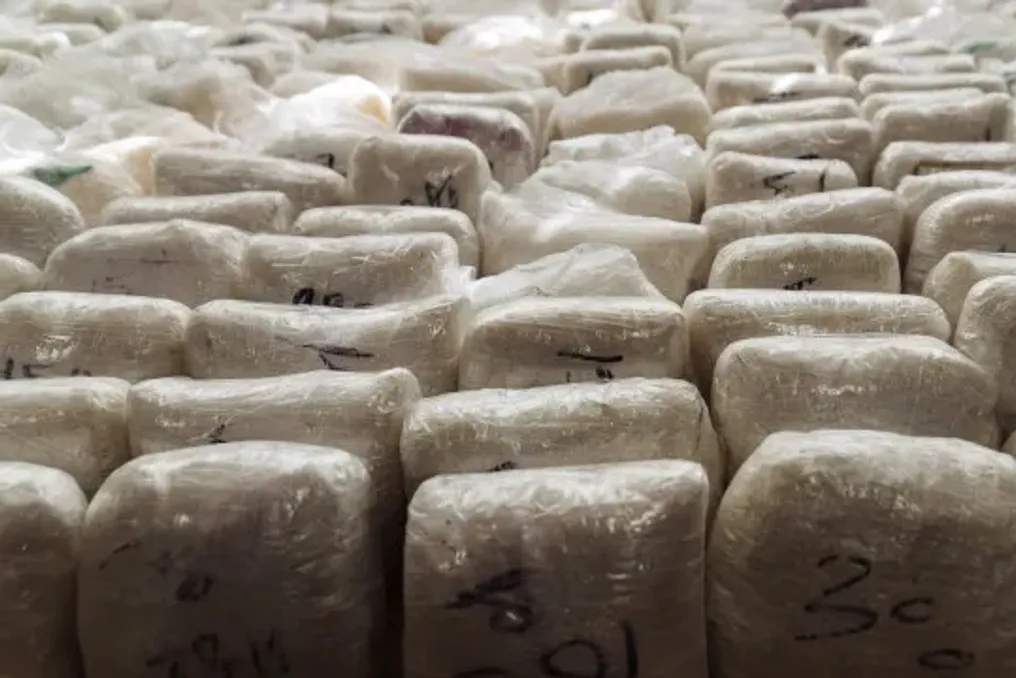
Meas Vyrith, Secretary-General of the National Authority for Drug Control of Cambodia, informed the Associated Press on Friday that his office seized approximately 7 million dollars (equivalent to 5.9 million euros) in cryptocurrencies. These funds were associated with the Sinaloa cartel, a criminal organization classified as a 'foreign terrorist organization' by the administration of U.S. President Donald Trump.
Cambodian anti-drug police, in collaboration with the United States Drug Enforcement Administration (DEA), conducted several arrests and seizures of narcotics laboratories and deposits. Additionally, over 200 kilograms of illicit substances and more than one ton of precursor chemicals used in their manufacture were confiscated.
The operations took place between August 1 and 5 in four locations, covering the capital, Phnom Penh, and the adjacent province of Kandal. The U.S. embassy issued a statement saying that 'joint efforts involving DEA offices in Phnom Penh and New Jersey allowed the discovery of a local network laundering cryptocurrencies on behalf of the Sinaloa cartel.'
The Sinaloa cartel has established itself as one of the largest producers of the synthetic opioid fentanyl, which is responsible for tens of thousands of annual overdose deaths in the United States. This group acquires chemical precursors, including from China, to produce fentanyl in Mexico and illegally introduce it into the U.S.
Cambodia primarily acts as a transit route for drugs such as methamphetamine, which originates from the 'Golden Triangle,' a border area shared by Thailand, Myanmar (formerly Burma), and Laos. In recent years, the country has also become a refuge for Chinese criminal groups, notorious for running fraud centers that have caused billions of dollars in losses to victims globally, using thousands of foreigners under conditions analogous to slavery.
Over the past year, Cambodia has reinforced repression against these activities, closing fraud centers and arresting various suspected leaders, including those who had established legitimate financial institutions.
A report released in July by the United Nations Office on Drugs and Crime (UNODC) indicated that several transnational organized crime groups from Southeast Asia are important actors in the region, especially in the trafficking of large volumes of cocaine and methamphetamine. According to this document, the participation of Latin American cartels 'seems to go beyond the supply of drugs and chemical precursors, functioning the region as a supply, financial management, and logistics hub for multiple Latin American criminal organizations.'
Furthermore, a Chinese citizen was sentenced this month in the U.S. state of North Carolina to 15 years in prison for participating in a network that laundered more than 92 million dollars (84.4 million euros) derived from drug trafficking by Mexican cartels. In 2024, U.S. federal prosecutors stated that the Sinaloa cartel collaborated with Chinese underground banking groups in the United States to launder more than 50 million dollars generated from the sale of fentanyl, cocaine, and other narcotics.