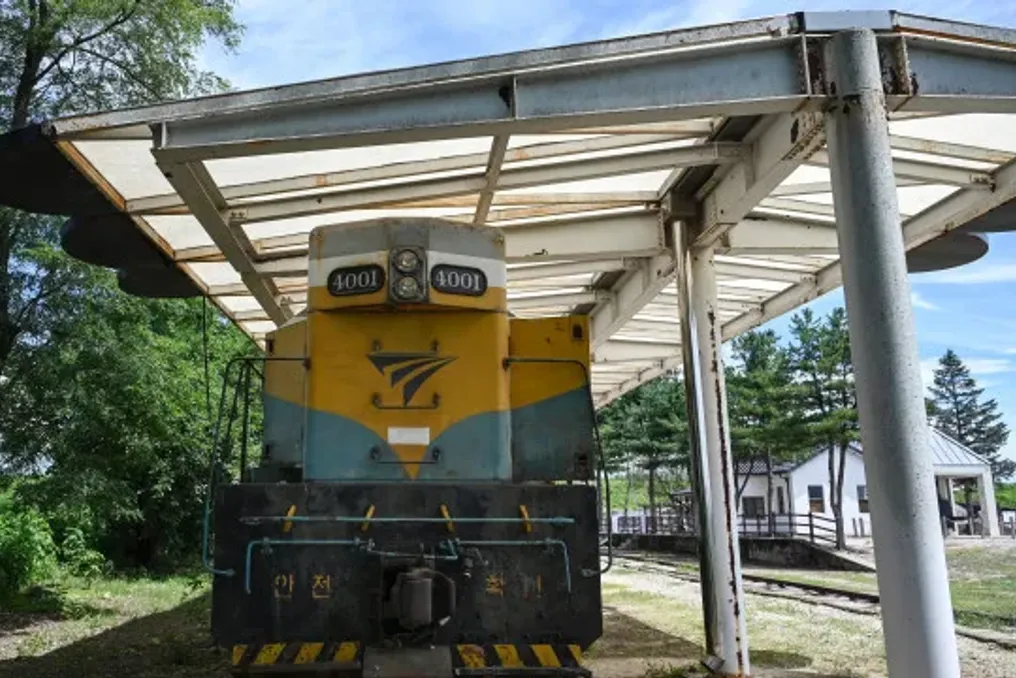
The South Korean government's project to restore a railway station located on the northernmost border of South Korea is in a difficult situation: Pyongyang ignores Seoul's proposals, while Washington, a key security ally of South Korea, pursues a policy of unilateral opening to the North.
Since taking office in June last year, South Korean President Lee Jae-myung has sent conciliatory signals to Pyongyang, which have been met with coldness. Meanwhile, US President Donald Trump suddenly decided to reduce joint military exercises with South Korea, believing that these annual drills send a 'completely inappropriate and hostile signal' to the North.
The US leader also criticized Seoul for refusing to support US forces in an offensive against Iran. Trump assured on Thursday that he would meet with Kim Jong Un this year, aiming to resume relations that, he said, he established with the North Korean leader during three meetings during his first term.
For its part, Pyongyang responded on Friday with the launch of a dozen short-range ballistic missiles. These events overshadowed the openness policy of the Lee administration, which was illustrated by the restoration of Woljong-ri station for potential rail connection with the North.
The small station once belonged to the line connecting Seoul with the northernmost tip of the peninsula but was abandoned during the Korean War (1950–1953). Today, it is a sight for visitors to the demilitarized zone, while the former terminus of the line—Wonsan—is located in North Korea.
South Korean authorities began the restoration in 2015, viewing it as a way to revitalize the economy of the border region and send a symbolic gesture to Pyongyang. Work was suspended after North Korea's fourth nuclear test in 2016.
Some residents of Ch'owon are skeptical about this project. Mun Jae-yong, a 70-year-old native of the border town, told the France-Presse agency: 'It seems they are always trying to reconcile with North Korea through a railway project, but from our point of view, it is unrealistic.'
The reconciliation program includes restoring railway links between the two Koreas. Lee also proposed negotiations without preconditions, including a formal end to the Korean War.
The Minister of Unification stated in July that Seoul prioritizes limiting Pyongyang's existing nuclear program rather than insisting on denuclearization. However, the North, which has repeatedly declared the 'irreversibility' of its nuclear potential, shows no signs of softening.
In trying to organize a new meeting with Kim Jong Un, Trump appears to be striving for success in foreign policy before the midterm elections, sidelining Seoul after the failure in the offensive against Iran.
Vladimir Tikhonov, a professor of Korean studies at the University of Oslo, told the France-Presse agency: 'South Korea fears being marginalized—China, Russia, and now the US are all involved in Pyongyang's affairs in different ways, and Seoul is not. Even if it can do little, besides trying to restart the railway project.'
Along the disused line between Woljong-ri and Paengmagokji, vegetation has swallowed the rails. A sign reads: 'The Iron Horse wants to run,' accompanied by the phrase 'We want to return to the tracks.'
The project is also aimed at stimulating tourism near the border. Near Woljong-ri station, a Korean War bomber locomotive has been preserved as a permanent reminder of the division between the North and South.
Restoring infrastructure in the South could save time if inter-Korean ties are ever resumed, explained Lim Ul-chul, a professor at Kyungnam University. 'But in reality, under current circumstances, this is practically impossible, and everyone knows that.'