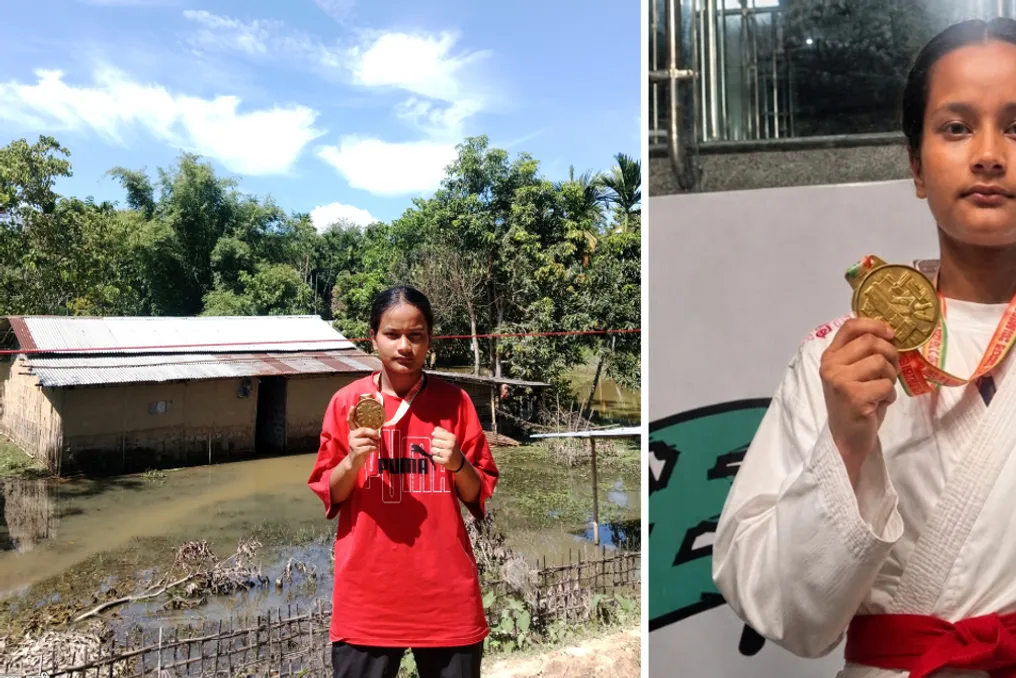
The internet signal was intermittent while The Better India contacted Yanmoni Konwar. The girl was preparing to travel to the Sports Authority of India (SAI). The seventeen-year-old karateka climbed to a spot where her phone could catch the network, and her coach, Susanta Das, helped coordinate the call. When Yanmoni appeared on screen, she smiled and said, 'Tomorrow I am going to SAI, so this is a special moment for me.'
This moment was joyful for the teenager who was about to take another step in her sporting career. However, Yanmoni's path to this point was far from easy. Just a few days earlier, she won a gold medal at the National Karate Championship held at the Talkatora Stadium in Delhi from August 7 to 9. Competing in the Ashihara category, Yanmoni traveled from a flooded village in Assam to the national arena and returned with the medal she had been preparing for for years.
When she returned home, the celebration took place against a completely different backdrop. Her family was still living under tarpaulins. Their house in the village of Bhogdipooria in the Jorhat district of Assam state had been washed away during last month's floods. The family's fish farm was also affected, and ducks and poultry were swept away, forcing buffaloes to be moved to a safer location.
For Yanmoni herself, the gold medal did not mark the end of the struggle; it became part of the family's efforts to recover from losing their home and reflected the young athlete's determination to pursue a dream that began at the age of five.
When the waters came
On July 19, floodwaters rushed into the village of Bhogdipooria. The embankment, located about 150 meters from Yanmoni's house, broke, allowing the water to flood the village. The family had to leave their home and move to the embankment.
Their losses extended beyond housing. For almost three years, the family had been engaged in aquaculture. They planned to sell the fish to fund Yanmoni's trip to Delhi for the National Karate Championship. The flood also disrupted this plan.
The family explained that 'the fish farm was linked to her competition,' as it was supposed to help pay for her travel. This was not the first time Yanmoni's family had rebuilt their lives for her sports pursuits; previously, they sold two buffaloes to cover the costs of her karate competitions.
Despite her house being underwater and the family being forced to stay in a relief camp, seventeen-year-old karateka Yanmoni Konwar from Holmora village in Jorhat district insisted on participating.
For families in remote parts of the country, sporting ambitions often come with expenses that are not directly related to training. These include travel to competitions, accommodation, registration fees, and equipment, as well as nutrition. For an athlete, food is also training.
Susanta Das, Yanmoni's coach, points to one of the most serious problems for young athletes in this region. He tells The Better India: 'In these remote places, some families can barely afford three meals a day, so proper nutrition and specialized diets become difficult.'
Yanmoni does not describe a complex diet plan; she states that her food is homemade and free of soft drinks. However, maintaining this routine becomes difficult when the family is forced to leave their residence due to flooding.
A dream that started at five
Yanmoni started practicing karate when she was five years old. The training halls were not air-conditioned, and facilities were limited. Sometimes circumstances forced her to train in places far removed from what most people would imagine for a national-level athlete.
Her coach recalls one quality above all others: consistency. Susanta Das notes: 'She is a diligent girl. I always think of how a lotus blooms in a swamp. It is the same with her.'
There were times when natural disasters and disruptions changed the place and manner of her training. Sometimes, he says, she practiced in the streets. He says, 'If I asked her to train for two or three hours, she did it without stopping. That is her quality.'
Results began to show: in 2023, Yanmoni won a bronze medal, and in 2025, a gold medal. This year, she was preparing for another national championship when the floods came.
The journey to Delhi
The family was forced to leave their home, the house was lost, and the source of planned income for the championship was affected. Railway transport was also disrupted. Getting to Delhi became a huge problem for Yanmoni and her team that needed to be solved.
Help arrived after Alakh Pandey, founder of Physics Wallah, learned about Yanmoni's situation while visiting flood-affected areas of Assam. He supported the team's trip to and from Delhi, arranged accommodation, and provided Yanmoni's family with 3 lakh rupees. State Minister for External Affairs Pabitra Margerita also provided financial assistance of 10,000 rupees.
When the trip finally became possible, Yanmoni traveled to Delhi. From the village where her family had recently been forced to leave their home due to floodwaters, she entered the Talkatora Stadium to participate in the National Karate Championship in the Ashihara category. Then came the long-awaited result—Gold.
This medal symbolized years of training, family sacrifices, and a journey that seemed uncertain shortly before the competition.
Return to the embankment
Yanmoni returned to Assam with the national gold medal. However, her family was still living under tarpaulins after their house was washed away. But Yanmoni does not suggest that the gold medal is the end of her story. The next journey awaits her. Yanmoni continued to smile on screen.
Her father tells her, 'You play for India.' This support means a great deal to Yanmoni. Her father was once a footballer himself. Her parents and brother continue to support her path, even if it required making difficult financial decisions. Selling two buffaloes was one such decision, and the fish farm was another hope. And now, as the family works on recovery after the flood, Yanmoni moves on to the next stage of her sporting life.
"They want to be like me"
Despite the attention that comes with winning nationally, Yanmoni is particularly happy to talk about something else. She also teaches younger children. 'You know, I also teach little kids,' she says, laughing. Most of her students are girls, although boys also train with her. 'They follow me closely. They also love martial arts and always want to imitate me.'
Perhaps this is where Yanmoni's story goes beyond one medal. In a village with limited training facilities, the teenager introduces younger children to the same sport. The girls watching her see not just someone practicing martial arts; they see someone from their community who went to Delhi and returned with a national gold medal.
Now heading to SAI
For a teenager who trained in difficult conditions, this opportunity marks a new chapter. It can give her access to a structured coaching staff and help her take the next steps toward competing at a higher level. There are still many trainings and competitions ahead, as well as younger students at home who are watching.