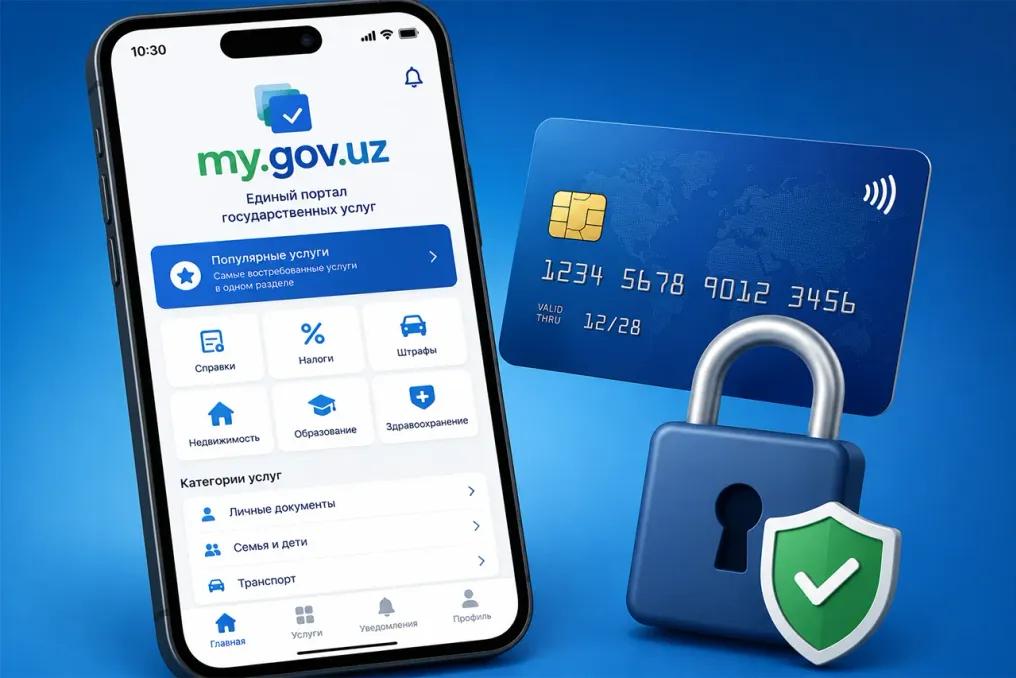
A free service for freezing access to loans has been launched in Uzbekistan, which prevents the issuance of new loans in a citizen's name. By July 2026, over 2.5 million people have used this function.
Citizens of Uzbekistan no longer need to fear fraud using stolen passports or carelessness from bank employees. Since June 2025, they have had the opportunity to independently eliminate the risk of receiving loans and microloans by voluntarily prohibiting such operations.
The mechanism was introduced by Law No. ZRU-1043 of March 4, 2025, and came into force on June 6, 2025. According to data from the Infokredit Bureau (Center for Analytical Credit Information, CATM), the adoption rate was high: around 33,100 people registered by July 1, 2025, approximately 149,500 by October 1, 2025, 438,300 by January 1, 2026, and exceeded 2.57 million by July 1, 2026 (including 1,497,389 men and 1,076,637 women), representing a growth of more than 77 times in one year.
Credit freezing is a voluntary prohibition that prevents banks and microfinance organizations (MFOs) from issuing new loans, microloans, or credit cards in your name. After activation, your data is added to a register of persons prohibited from entering into credit transactions, and any creditor connected to the credit bureau system is obliged to check this register before approving a loan.
This mechanism was established by Law No. ZRU-1043 of March 4, 2025, which added a new Article 16-1 to the Law 'On Credit Information Exchange,' regulating the inclusion of physical persons' data in the register of persons prohibited from credit operations. These amendments came into force on June 6, 2025. If a financial institution issues a loan after activation, bypassing the register, the liability will fall on the creditor, not on the person whose name was used.
The process involves the following steps: the citizen submits an application to activate the freeze; the credit bureau enters their data into the register; banks and MFOs are obliged to check the register before issuing a loan; if the person is listed in the register, their application is automatically rejected.
The simplest way to activate the freeze is through the my.gov.uz portal (in a browser or mobile application), where protection can be turned on and off. It is also possible to apply in person at a public service center or, only for activation, through the CATM credit bureau's own service.
The my.gov.uz portal is a universal option available from anywhere, as it offers the service 'Establishment or removal of a ban on concluding a credit agreement,' which covers both actions. This requires login via the OneID system. An additional option is the credit bureau LLC 'Center for Analytical Credit Information' (CIAC), operating under the name 'CATM,' which is available as a mobile application and on the website infokredit.uz. However, this resource only supports activation, and removal cannot be performed this way. There is also an offline option: in-person visit with a passport to a public service center or a CATM branch, where both procedures are available. This service is free regardless of the chosen method.
To enable credit freezing on my.gov.uz, you must log in via OneID, find the service 'Establishment or removal of a ban on concluding a credit agreement,' and select 'Get Service' $ ightarrow$ 'Activate.' The freeze takes effect automatically, without the need for further confirmation.
The user should open my.gov.uz in a browser or through the mobile application (available on Google Play and App Store). Authorization is done through the OneID system; if an account does not yet exist, it can be created at id.egov.uz using the passport series and number. In the portal's search bar, enter 'Establishment or removal of a ban on concluding a credit agreement' and navigate to the service page.
After clicking 'Get Service,' you must select 'Activate.' The system processes the request automatically and adds the data to the register, without requiring a digital signature or personal visit for identity confirmation. After activation, you can download an electronic confirmation document.
Credit freezing blocks new consumer loans, online loans, microloans from MFOs, credit cards, installment plans, and leasing from any creditor connected to the credit information exchange system. This protection does not extend to existing loans or loans arranged directly with friends or private individuals.
The freeze does not cancel existing obligations: payments on already taken loans, credit cards, and installments must continue as usual, as the protection applies only to new applications. It covers almost all official participants in the credit market, as connection to the credit information exchange system is mandatory for banks and MFOs.
Loans obtained outside official financial institutions, such as from friends or private individuals, are not protected by this measure because such transactions never pass through the credit bureau system.
Credit freezing can be lifted through my.gov.uz (browser or mobile application), as well as in person at a public service center or a CATM branch. It is important to note that the CATM application and website are intended only for activation, not for lifting the protection. According to the law, the credit bureau is obliged to enter the application into the register immediately upon receipt, and the legislation does not set limits on the number of activations or removals of the freeze.
To lift the protection via my.gov.uz, you need to open the same service 'Establishment or removal of a ban on concluding a credit agreement' and select the 'Deactivate' option. According to Article 16-1 of the Law 'On Credit Information Exchange,' the application to lift the freeze must be entered into the credit bureau's register immediately upon receipt. Although some early mentions of the service in 2025 indicated a processing time of up to two business days, the law clearly requires immediate action, which is a more reliable guideline.
The law defines both setting and lifting the freeze as voluntary and free actions, without limiting their frequency.
The law explicitly prohibits banks, non-bank credit organizations, and MFOs from entering into credit transactions without first checking the credit freeze register. If a creditor still issues a loan in violation of the ban, legal responsibility for that transaction falls on the creditor, not on the person whose data was used.
According to Article 16-1 of the Law 'On Credit Information Exchange,' banks, non-bank credit organizations, and payment organizations operating as MFOs do not have the right to enter into credit transactions without obtaining data from the register regarding a ban on this person. If a creditor violates this requirement and provides a loan without the knowledge or participation of the person listed in the register, the law imposes legal responsibility for the consequences of that transaction on the creditor.
It is worth noting that the law provides for a fine of up to 5,000 calculation units (approximately 1.875 billion sums), but this penalty is imposed by the Central Bank on the credit bureaus themselves for violations in their own activities (e.g., improper maintenance of the register or violation of the rights of their own clients), and not directly on the bank or MFO for a specific case of issuing a loan in violation of the freeze. For banks and MFOs, the law uses the more general term 'liability for legal consequences,' without setting a fixed fine specifically for this violation.
Credit freezing is particularly relevant for people living abroad or who travel frequently, have lost their passport, want to protect elderly relatives from fraudsters, or are focused on repaying current debt without taking on new obligations.
The application can be submitted from anywhere in the world via my.gov.uz, provided there is access to OneID. This is especially useful for those working abroad or traveling for an extended period and unable to constantly monitor their financial operations in Uzbekistan. Similarly, if a passport is lost or stolen, the freeze closes the possibility of obtaining a loan in your name until a new document is received.
Another group that should be noted is people seeking to protect older relatives from fraudsters posing as bank employees conducting account 'security checks,' as well as those repaying old debt who intentionally want to avoid the temptation to take out a new loan until the previous one is fully closed.