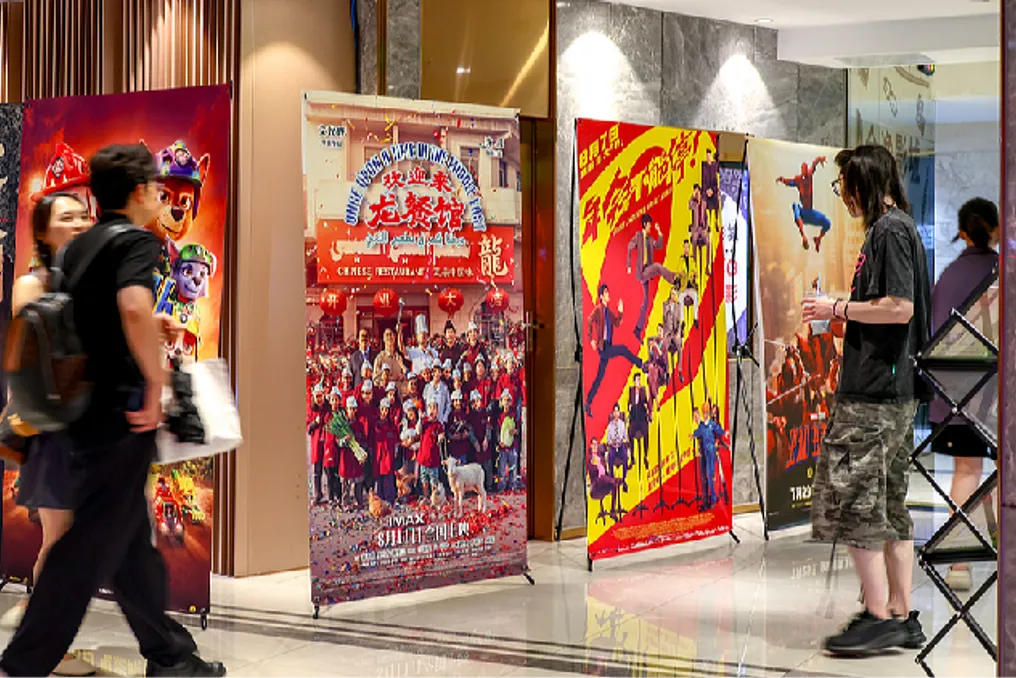
Chinese cinema screenings are gaining momentum during the summer season of 2026, reaching record figures in both revenue and audience attendance. According to an online ticket sales platform, China's total box office revenue for 2026 (including advance sales) exceeded 26.5 billion yuan (approximately 3.9 billion US dollars), with over 670 million visits recorded and more than 96 million screenings. More than 290 million moviegoers were attracted during the summer period alone, and the number of sessions surpassed 34.5 million, setting a seasonal record.
This boom in the film industry is having a positive economic impact on sectors such as tourism, retail, food service, and other forms of consumer spending.
Local hits attract viewers this summer
In the current summer season, the top earners have been the sports comedy 'Kung Fu Soccer', the animated film 'All Wishes Come True', and the Hollywood blockbuster 'Spider-Man: Brand New Day'. A significant factor in the growth of box office receipts has been the diverse lineup of domestic productions, as Chinese filmmakers presented a wide range of genres, stories, and creative approaches on the big screen.
Among them, 'All Wishes Come True', which earned 1.6 billion yuan (about 238.1 million US dollars), draws inspiration from a traditional Chinese legend. The film creates a mythical world stylized after the unique blue-green landscape painting style of China, showcasing the aesthetics of traditional Chinese art.
The film 'Once Upon a Time in the Middle East' is also gaining popularity; despite the variety of genres, it ranked fourth at the box office, earning over 1.2 billion yuan (about 178.6 million US dollars) in just ten days. The film is set in a war-affected city in the Middle East and tells the story of Xuifu, a Chinese chef who travels abroad in search of a better life. As bombs fall and chaos involves him in conflict, he uses food to bring warmth and humanity to the war-torn environment.
Cinemas are transforming beyond the screen
Parallel to the flourishing film market, significant changes are occurring that extend beyond the screen itself. As part of a nationwide initiative to strengthen the film economy, cinemas across China are implementing new business models. They are beginning to offer visitors services such as dining, board games, virtual reality, temporary exhibitions, and even live performances within their premises. This trend is turning cinemas into public cultural centers, social hubs for youth, and leisure spots for the general public.
For example, a cinema in Hangzhou, Zhejiang Province in eastern China, adopted a 'cinema plus dining' model. It features five theaters with restaurants offering over 50 dishes, as well as themed buffet meals inspired by popular films like 'Spider-Man' and 'Kung Fu Soccer'. For the film 'All Wishes Come True', its aerial landscapes were partially inspired by the scenic areas of Qingcheng Mountain in Sichuan Province in southwestern China—a sacred Taoist site known for its misty peaks and ancient temples.
Capitalizing on the film's popularity, local authorities launched a series of cultural tourism routes that guide visitors to locations shown or mentioned in the film. To stimulate demand, the government issued consumer vouchers worth 48 million yuan (about 7.1 million US dollars), and dozens of participating attractions, hotels, and retailers now offer exclusive discounts to ticket holders.
Hands-on experience with cinematic technologies
Advanced technologies are also opening up new opportunities for audiences to engage with China's film industry, transforming moviegoers from passive observers into active participants and allowing the public to get a closer look at the potential of digital technologies in filmmaking. At the recent CMG Film Culture Carnival in Tianjin, visitors could participate in interactive film-related events while enjoying immersive viewing experiences.
Among the main events was a fully functional virtual production studio where actors interacted live with digital backdrops in real time—the same technology used in large-budget science fiction and fantasy projects. Practical sessions also included working with professional camera stabilizers, experimenting with 3D sound mixing consoles, and participating in motion capture sessions that projected participants' movements onto animated characters on screen.
By bringing the audience closer to both finished films and the technologies behind them, such events highlight how the convergence of technology and cinema creates new prospects for the film industry and new ways for audiences to interact with the world of cinema.