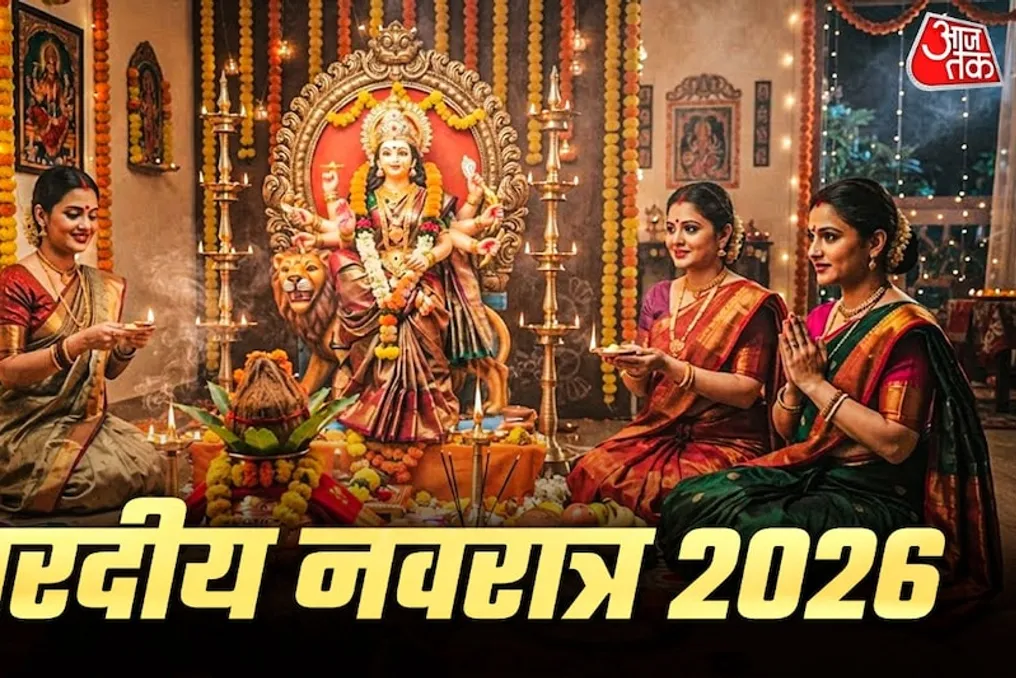
Sharadiya Navratri is considered a special festival in Hinduism dedicated to the worship of Goddess Durga. This nine-day period begins on the first lunar date of the Ashvin month, during which various religious rituals are performed, such as fasting, prayers, recitation of Durga Saptashati, and worship of young girls.
In 2026, Navratri will begin on October 11. Due to the change in the sequence of dates this year, Ashtami and Navami fall on the same day, which has generated increased interest among people regarding the celebration dates.
According to the Panchang, the date of Ashvin Shukla Pratipada falls on October 11, 2026. This is the day Navratri will commence along with Ghatasthapana. The Pratipada date will start on the evening of October 10 around 21:19 and last until 21:30 on October 11. According to the rising date rule, the first day of Navratri will be counted as October 11.
According to the Panchang data, the auspicious time for installing the kalash on October 11 is from 6:19 AM to 10:12 AM, which is approximately three hours and 52 minutes. Additionally, there is an Abhijit Muhurta, which will take place from 11:44 AM to 12:31 PM. It should be noted that due to differences in Panchang calculations and sunrise times in different cities, the timing may vary slightly.
During the nine days of Navratri, various forms of Goddess Durga are worshipped. On October 11, Maa Shailputri is worshipped; on October 12, Maa Brahmacharini; on October 13, Maa Chandraghanta; on October 14, Maa Kushmanda; on October 15, Maa Skandamata; on October 16, Maa Katyayani; on October 17, Maa Kalaratri; on October 18, Maa Mahagauri; and on October 19, Maa Siddhidatri.
Due to the change in dates this year, the main worship rituals for both Ashtami and Navami will be conducted on October 19.
Since Durga Ashtami and Mahanavami fall on October 19, Monday, in 2026, devotees planning to perform worship, fasts, and other rituals related to Ashtami and Navami should consult their local Panchang. Sandhi Puja is also of special significance on this day.
To perform Kalash Sthapana, one must first thoroughly clean the place of worship. Red or yellow woven material is spread on the platform, and an image or statue of Goddess Durga is placed there. Then, barley is sown into an earthen pot. Water is poured into the kalash, along with akshat, a snack, and a coin. Leaves of Amu or Ashoka are placed on the neck of the kalash, and a coconut is placed on top.
After this, an intention is made by meditating on Goddess Durga, and the worship ritual is performed. In homes where the tradition of burning a continuous fire is observed, a lamp is placed in a safe spot and lit.
During Navratri, maintaining cleanliness at the place of worship is extremely important. According to religious beliefs, it is customary during these days to consume sattvic food and abstain from meat, alcohol, and tamasic food. Those observing a fast should do so according to their capabilities. If a continuous fire is burning, it must be placed in a location where there is no risk of fire.
After the completion of Navratri on October 20, 2026, Tuesday, Vijayadashami, or Dussehra, is celebrated. On this day, the nine-day worship of Navratri concludes. In many places, the tradition of immersing the statues of Durga in water is also observed.
Start of Navratri: October 11, 2026
Kalash Installation: October 11
Durga Ashtami: October 19
Mahanavami: October 19
Vijayadashami: October 20, 2026