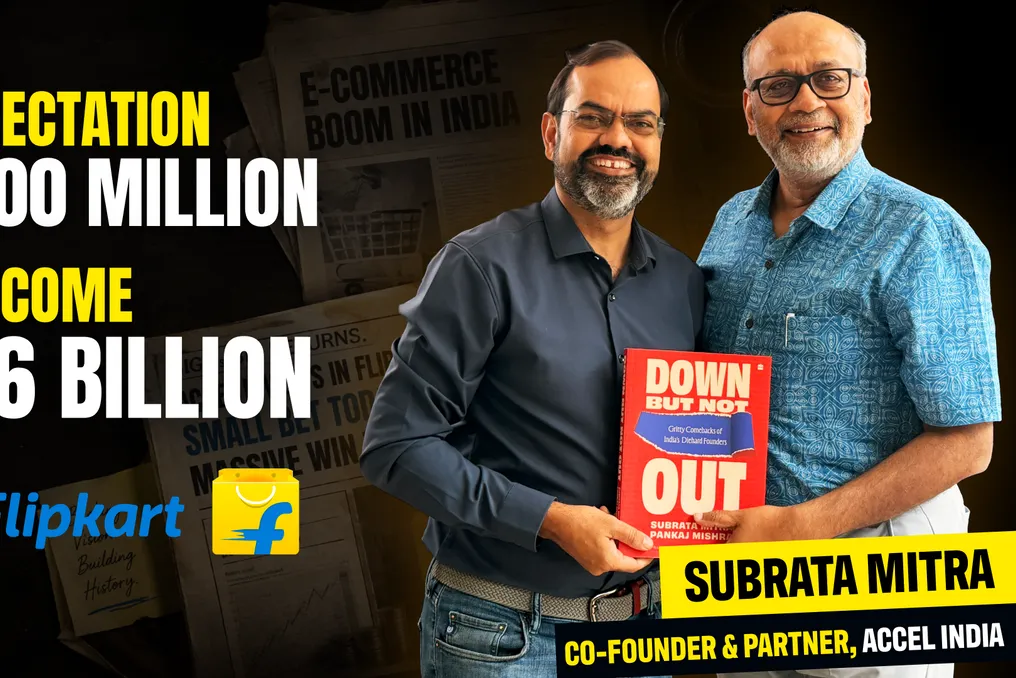
Subrata Mitra, co-founder of Accel India and early investor in Flipkart, Myntra, Mu Sigma, and Cult Fit, shared lessons learned from decades of supporting Indian startups regarding company building.
Mitra asserts that there is no single path for a startup's development that moves exclusively 'up and to the right.' As a co-founder of Accel India, which was originally Erasmic Venture Fund, he observed the evolution of entrepreneurship in India over more than two decades and supported companies like Flipkart and Myntra, as well as many founders whose paths to success were far more complex.
On the Prime Venture Partners podcast, Mitra stated: 'I have not seen a single company that went straight up. Up and to the right. Not one. If someone tells you that, they are probably lying.'
This idea is also the basis of the book 'Down But Not Out,' which Mitra co-authored with Pankaj Mishra and other colleagues. Instead of only describing the bright successes of startups, the book analyzes founders who experienced failures, course corrections, and periods when it seemed their companies had hit a dead end.
In Mitra's view, these life journeys reveal a fundamental truth about entrepreneurship: the founders who ultimately build lasting companies are not necessarily those who avoid failure. They are those who learn to stay in the game long enough to seize the opportunity when it finally appears.
When evaluating founders, Mitra pays attention to the ability to maintain activity over a long period, as most paths in India will be accompanied by ups and downs. However, perseverance alone is not enough; a founder also needs foresight to recognize an emerging opportunity and the resolve to execute it.
He illustrates this with a cricket example: 'You cannot defend all 50 overs,' he says. 'When you get the right ball, you must score a six or a four because the score matters too.'
The combination of these qualities is critical because startup outcomes can differ drastically from the initial expectations of founders and investors. Mitra recalls that when Accel first wrote a check to Flipkart founders Sachin and Binny Bansal, they would have been satisfied with a $200 million result. The company eventually reached that mark, and no one stopped to mark it as a final goal.
'We passed 200, and no one even looked back and said, you know, this is our milestone. It wasn't like that. It was just some marker on the road,' he notes.
Mitra uses the term 'long-term greed' to describe the ability to optimize processes over unusually long periods. This concept is partially related to the nature of venture capital itself. Although venture funds formally exist for about 10 or 11 years, Mitra believes that good funds in India can operate for 14, 15, or even 16 years.
He cites the 2008 Flipkart fund as an example, which is still active despite having already returned significant capital. Mitra emphasizes: 'Those who truly endure are those who understand that we are doing this for something other than greed.'
The book describes entrepreneurship as moving through fog. Founders rarely know what awaits them, but they still need to keep moving. According to Mitra, the 'compass' is alignment regarding goals, motivation, and people.
'Even if there is fog, you can probably look at the compass and say, I know I need to do these three things today, and that is the north star we are looking at,' he says.
The ability to evolve becomes particularly important because the skills needed at one stage of a company can become a liability at another. Mitra gives the example of Gaurav Singh Kushwaha, founder of BlueStone. When Mitra first worked with him, he saw a strong computer science specialist and problem solver who was not necessarily as strong in building and scaling teams. Years later, these responsibilities became inevitable.
At a difficult point in BlueStone's history, Kushwaha had to lay off several employees. Mitra recalls calling them into his office individually and starting with taking responsibility: 'We are doing this, but it is more our fault than yours,' Kushwaha told them.
Mitra notes that it may take eight or nine months of working with an early-stage team before he forms a well-founded opinion on whether they possess the necessary qualities. Even then, the company might fail due to market or product cycle.
'If you can interact with the right team with the right set of checks and then continue testing or challenging them for the next six to nine months, they can find something solid or pivot to a second, third, or fourth innings.'
Evolution also means knowing when to let go. In the beginning, founders are forced to be generalists. Three people might simultaneously handle product, hiring, marketing, research, and any crisis situation requiring resolution that day.
However, this model breaks down as the organization grows. 'The big problem arises when people stop letting go,' Mitra asserts. He stresses that a leader of a 100-person company cannot continue to operate as if they only have three employees. Instead, Mitra believes founders should shift their focus from solving every immediate problem to forecasting the next stage.
He uses a simple mental model: 'What will step 10 look like? What will step 100 look like?' he says. 'When we are at one, we start thinking about 10. When we are at 10, we must think about 100 and work backward from there.'
Complementary founders can facilitate this transition. Mitra recalls the early days of Erasmic when the team attracted a $10 million fund without having sufficient funds to hire a lawyer. After Mitra wrestled with about 20 pages of a private placement memorandum, co-founder Mahendran took on the issue.
'It is the complementarity of skill sets that you need in the initial team so that nothing falls apart,' Mitra concludes.
Accel now asks many founders if they want a mentor. A mentor can be chosen by the founder or offered by the firm. Mitra's conviction partly stems from Accel's own experience using mentors and navigating leadership changes in companies like Flipkart.
'I have seen many different ways of mentoring, but it is absolutely essential that most founders receive some form of coaching,' he states.
Mitra describes coaching as constantly returning to the problem with new energy. Today's success or failure does not determine what happens tomorrow. 'What you achieved or failed at today doesn't matter; come tomorrow, let's look at it with fresh eyes and just try again. Is it worth repeating?'
Nevertheless, endurance should not mean constant stress for 15 years. Mitra intentionally creates an environment at Accel where people can joke about mistakes, including their own. He recalls openly telling colleagues about investing $20 million in a company and questioning his own judgment.
In his view, this leads not just to a happier work environment. It improves the quality of discussions because people feel more comfortable challenging each other.
'Creating a slightly happy, friendly environment actually increases system productivity,' he says. When Amit Somani from Prime Venture Partners described entrepreneurship as 363 or 364 days of intense work interrupted by one or two days of joy, Mitra proposed a different phrasing: 'Add one such joyful 365th day every day.'
Because if entrepreneurship is truly a 10- or 15-year journey, waiting to acquire, IPO, or secure a large funding round before allowing oneself to enjoy the moment is an extremely long wait.
Mitra's final advice to young founders, therefore, is less about markets, fundraising, or strategy, and more about the personality managing the company. 'You will likely see many changes in your ideas, and in the end, you must maintain sanity and orchestrate this symphony well,' he says.
'Work on yourself to be better every day, instead of thinking about what you can change in the world.' For a career dedicated to finding companies that can change the world, this is unexpectedly an internal thought. But perhaps that is Mitra's point. Before founders can create something lasting, they must learn to withstand the trials themselves.
}, 2. {