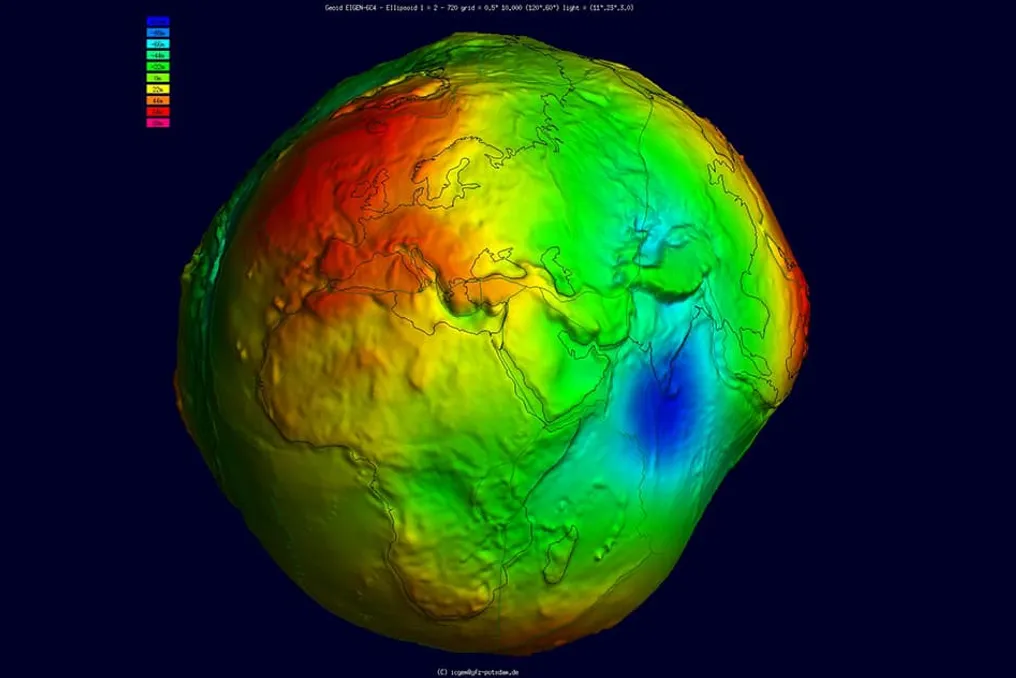
The idea that the gravitational hole in the Indian Ocean, measuring millions of kilometers, is the largest in the world is being questioned by a new finding: Antarctica has an even deeper anomaly.
This scenario is possible because the Earth does not have a perfectly spherical shape, presenting irregularities and deformations caused by gravity variations in different areas. Such deviations occur due to the non-uniformity of the planet's internal density, where the movement of rocks and structures generates distinct gravitational forces, defining what scientists call the geoid.
In the Indian Ocean, gravitational attraction shows notable drops, creating a vast depression known as the Indian Ocean Geoid Low, covering approximately three million square kilometers. Due to lower gravity, sea level in this area may be more than one hundred meters below the global average.
For years, the origin of this gravitational cavity was a mystery. However, a 2023 study by researchers from the Indian Institute of Science managed to reconstruct the tectonic history of this anomaly. The research indicated that the cause lies more than a thousand kilometers deep, dating back about 30 million years, when remnants of the ancient Tethys Sea sank under Africa, forcing hot and molten rocks to the surface.
Simulations from this work demonstrated that low-density magma plumes ascended through the Earth's mantle, altering local density and originating the gravitational depression in the Indian Ocean. Previously, this hole was considered the deepest on the planet.
However, a more recent article published in the journal Scientific Reports introduced a significant change in the understanding of the Earth's gravitational map. Scientists from the Institute of Physics of the Globe in Paris, France, and the University of Florida, in the United States, employed a renewed mapping method to identify another dimension of the phenomenon.
The researchers analyzed updated data from the GRACE satellites, in collaboration with NASA and the German Research Centre for Geosciences (GFZ), using a distinct reference frame. While traditional maps compare the Earth to a standard ellipsoid, which only corrects for polar flattening and rotation, this team used a 'hydrostatic ellipsoid,' which models gravity in an ideal state of rest. By eliminating these factors, a completely new view of the Earth's mantle emerged.
In this new reference frame, the Antarctic Geoid Low, located on the western side of the icy continent, proved to be deeper than the Indian Ocean anomaly, redefining historical comparisons between the two regions. The authors clarified that this does not invalidate the 2023 findings on the Indian Ocean; only the comparison metric was changed, without the gravitational force changing in either location.
The anomaly under Antarctica is much older, dating back at least 70 million years. Its displacement from the South Atlantic to its current position occurred due to a rapid mass relocation within the planet, a process analogous to the flow of a lava lamp, driven by the interaction between sunken tectonic plates and heated rocks from the core over millions of years.
Additionally, the most recent discovery offers a relevant hypothesis for global climate: modifications in Antarctic gravity may have caused a reduction in sea level in the region about 34 million years ago. This decline coincides with the beginning of permanent freezing in Antarctica, suggesting that the gravitational anomaly could have created the necessary conditions for the emergence of the first terrestrial polar ice caps.
Although the Indian Ocean Geoid Low remains a prominent feature, both anomalies help science understand how the Earth's interior influences the surface over geological eras. Computational models predict that both the Indian and Antarctic holes will remain present for millions of future years.