Artificial intelligence (AI) is used not only for systematizing data and files in hospitals but is also actively applied in disease prevention. Among the medical fields where this technology operates, image analysis and cross-referencing data from electronic health records stand out.
The main advantage is time saving. The ability to detect changes invisible to the human eye and predict risks long before the first symptoms appear allows doctors to act preventively. This promptness can prevent complications and save lives.
Application of AI in Ophthalmology
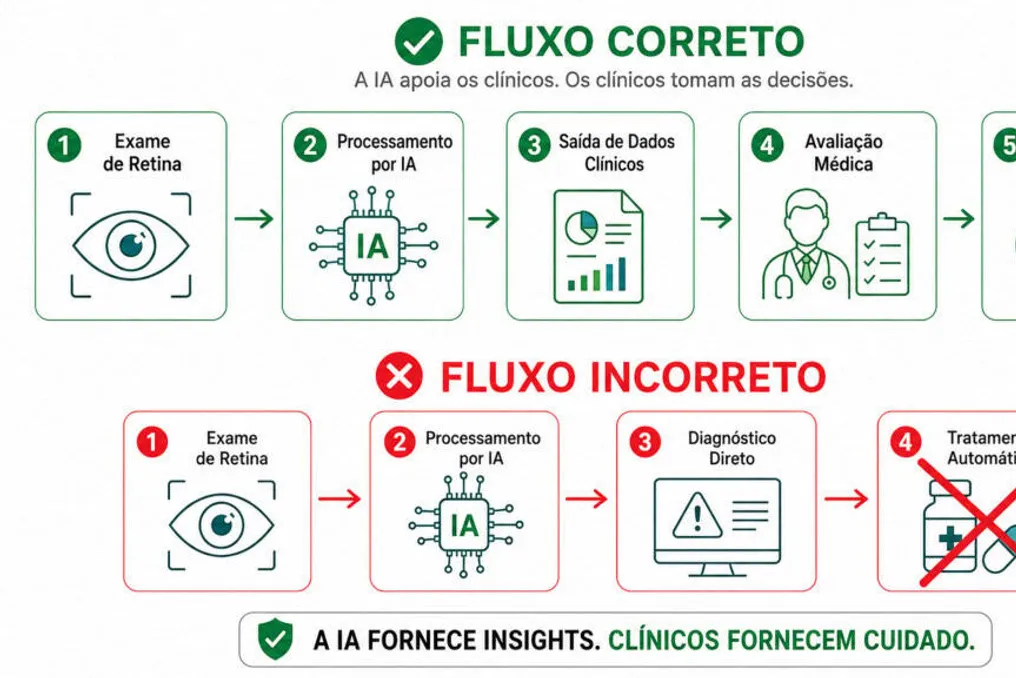
Ophthalmology is one of the medical fields where the practical use of AI is most developed. When analyzing fundus images (retinography), programs can process images in less than a minute without requiring a doctor's presence in the office.
In primary healthcare, the tool functions as an automated screening that separates unchanged images from those showing signs of serious damage, such as diabetic retinopathy.
In an interview with 'Olhar Digital', ophthalmologist Marina Crespo Soares, a retinal specialist from Unicamp, explained that this automation transforms the service model into a prevention strategy. By quickly and standardizedly analyzing thousands of photographs, the system identifies patients at the highest risk who require priority care. Such queue organization reduces waiting times and prevents vision loss, especially in regions with a shortage of specialists.
Progress in digital screening is supported by medical organizations and scientific research conducted worldwide. For example, reports from the American Academy of Ophthalmology indicate that FDA-approved software (US equivalent of Anvisa) detects diabetic retinopathy with a sensitivity ranging from 92% to 96%. Furthermore, a study published in the journal Nature and conducted by Google researchers showed that AI systems can analyze medical histories and examination results, helping doctors make complex decisions during disease diagnosis.
Nevertheless, Dr. Soares emphasizes that the mathematical accuracy of recognizing a mark on a retinal scan is not equivalent to making a diagnosis. Determining treatment requires interpreting the patient's clinical history, prescribing additional examinations, and considering the person's social situation.
The boundary between artificial intelligence and the specialist is not a fixed line, but a moving boundary: while the technology expands perceptual capabilities, the responsibility for understanding and decision-making remains with the human.
Thus, instead of replacing the professional, the technology acts as a tool to reduce the volume of routine analysis. By processing primary data and establishing priorities, AI frees up the specialist's time for consultation, attentive listening, and direct patient care. This increases service speed while the final decision remains under human control.
AI in Intensive Care
While computer vision analyzes images, data processing is applied in intensive care units (ICUs) by scanning medical records in real-time. In an interview with 'Olhar Digital', cardiologist and intensivist Sergio Neves stated that hospital systems constantly accumulate data on heart rate and blood pressure. Previously, these files remained unused data on the computer.
Thanks to the implementation of algorithms trained to correlate this information, the institution begins to transform raw data into warning signals. This capability for continuous reading allows for the prediction of serious complications even before they become apparent in the ward.