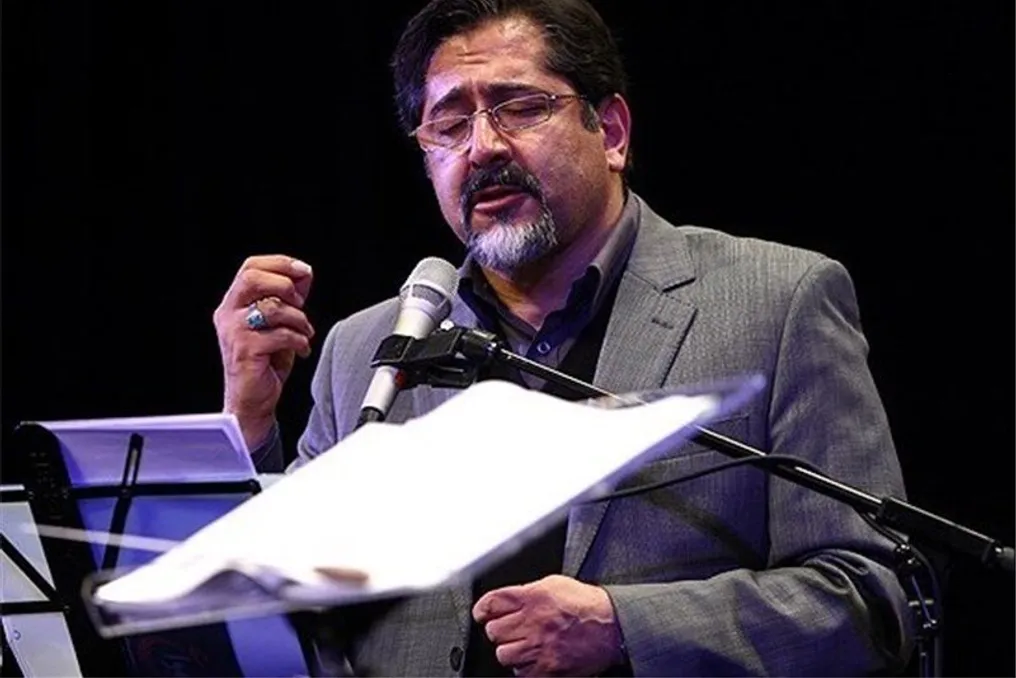
Iranian vocalist and composer Hesamaddin Seraj presented his new musical work, 'Spring's Broken Soul,' at a memorial ceremony marking the 40th day since the burial of the deceased leader of Iran.
The piece was presented on Thursday at the Hoshk Art Garden Pavilion in Tehran as part of a special program organized to commemorate the 40th anniversary of the interment of Ayatollah Sayyed Ali Hosseini Khamenei.
The event was held with the support of the Tehran Music Hall in collaboration with the Abbasabad Cultural and Tourist Zone. The composition 'Spring's Broken Soul' includes texts by the poet and lyricist Abdoljabbar Kakay, while Seraj served as both composer and performer. Davoud Varzide provided the arrangement and musical direction.
The musical piece combines traditional Iranian instruments with elements of a Western orchestra. A string ensemble, including violins, violas, and cellos, harmoniously blends with Iranian instruments such as the ney, tar, oud, and santur, as well as percussion and choir.
This musical creation was shown as part of a broader cultural and artistic program focused on the relationship between art and social responsibility. The program included works from various artistic fields, such as poetry, music, song, recitation, and graphic arts.
'Spring's Broken Soul' creates a contemplative and mournful atmosphere, using a combination of traditional Iranian musical motifs and orchestral arrangements to convey themes of loss and memory.
Ayatollah Sayyed Ali Hosseini Khamenei, leader of the Islamic Revolution, died on February 28, 2026, as a result of strikes by the US and Israel on Tehran. His death occurred at the beginning of the military aggression against Iran, during which several high-ranking military commanders, officials, and members of his family also perished.
Following his death, Iran entered a period of national mourning, and officials announced a series of farewell and funeral ceremonies across the country. The ceremonies took place over several days in Tehran, the holy cities of Qom and Mashhad, and separate memorial processions also occurred in Iraq, including the holy cities of Najaf and Karbala.
The funerals gathered millions of mourners who came to pay tribute to the late leader. The first major farewell events took place in Tehran, where mourners gathered at Imam Khomeini Mosalla on July 4th and 5th. A procession followed in the capital, and another ceremony was held in Qom on July 7th. At the request of religious and cultural figures in Iraq, farewell ceremonies were also held in Najaf and Karbala on July 8th before the body of the deceased leader was returned to Iran to complete the funeral rites.
The final funeral ceremony took place on July 9th in Mashhad, Ayatollah Khamenei's hometown. His body was escorted through the city amidst huge crowds of mourners before being buried in the holy shrine of Imam Reza (AS), one of the most revered religious sites in Iran and a vital pilgrimage destination for the country.
The burial concluded a week of nationwide mourning and farewell events. Many Iranian mourners, as well as foreign guests and delegations, attended the ceremonies. The scale of the gatherings reflected the significance of the event for supporters of the Islamic Republic and provided an opportunity for cultural and artistic communities to express their grief through poetry, music, and visual art.