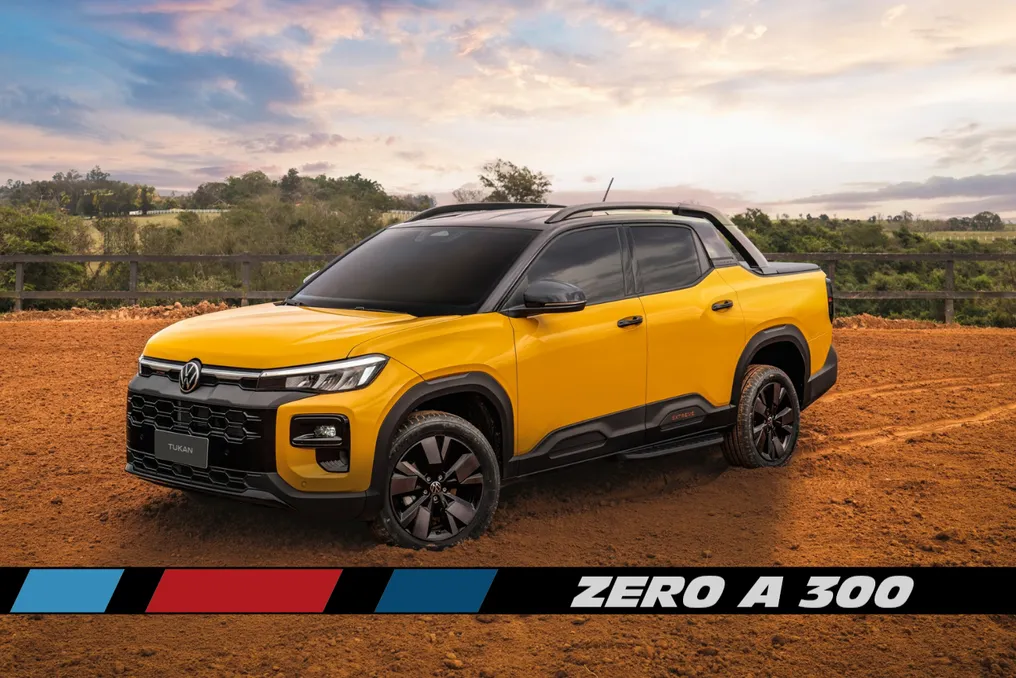
Volkswagen officially presented the Tukan model in Barretos, after years of speculation about creating a monobloc pickup truck to compete with the Fiat Toro. The vehicle, which hits the streets, was revealed on the 21st.
Built on the MQB A0 platform, the Tukan shares the front structure with the T-Cross, including the floor, steel panels, A and B pillars, windshield, suspension, brakes, and wheel hubs. However, by leveraging the platform's modularity, it incorporates a rear suspension with a rigid axle and semi-elliptical springs, bringing it closer to the Fiat Strada than the Toro, which uses an independent multi-link rear axle.
In Barretos, two configurations were displayed: the Extreme, intended for a double-cab lifestyle, and the Robust, configured for work with a single cab. Although it shares structural components with the T-Cross, the Tukan's design is more similar to the Tera, notably in the narrower headlights and bumpers and grille. The Extreme version features a chrome bar between the headlights, while the Robust version has this piece finished in glossy black. Volkswagen emphasizes that the Tukan is the first brand model to display its name directly on the body, specifically on the tailgate.
Internal details were not exposed, and Volkswagen only confirmed the adoption of a hybrid powertrain. However, it is likely that the more expensive versions will use the 1.5 TSI Evo2 flex hybrid from Mexico, which generates 150 hp and 25.5 kgfm of torque, coupled with a seven-speed DSG gearbox. The Robust version should be equipped with the 1.6 MSI engine, similar to that in the Saveiro, producing 116 hp and 16.1 kgfm of torque, with a five-speed manual transmission. There is also the possibility that future intermediate versions will adopt the 250 TSI setup used in the Tera, with a 1.4 turbo flex engine, 150 hp, and a six-speed automatic transmission. The debut of this model should reassure consumers until the Tukan arrives in 2027.
Automotive Trends and Technology
In another context, Aston Martin opted not to offer a manual transmission for now, a trend observed in analog supercars during Monterey Car Week. The Valen, the brand's most powerful front-engined car, equipped with a 5.2-liter biturbo V12 delivering 850 hp and coupled with an eight-speed ZF automatic gearbox, does not have a clutch pedal. The manufacturer's CEO, Adrian Hallmark, explained that the impediment is not in the capability of the manual gearbox or the development cost, but rather in the electronics. According to him, the main challenge is adapting the electronic safety systems and driver aids to function correctly with a manual gearbox, citing adaptive cruise control and post-collision systems as the most complex to integrate.
Bugatti Veyron Update
With 21 years since its launch and 11 years out of production, the Bugatti Veyron received a subtle update through the La Maison Pur Sang program, intended for preserving the brand's vehicles. An example named 'La Maison Pur Sang Veyron 20 Years' was presented in Monterey with subtle modifications using components from the latest Bugatti models. The paint combines the 'Rouge Rembrandt' red from the Tourbillon catalog and the 'Petrol Blue' blue from the Chiron. The wheels, sized 20 and 21 inches (front and rear), also follow the dimensions of the Chiron, resolving a previous Veyron issue related to tire mounting. Furthermore, the grille and air intakes received a redesign.
The interior changes are equally discreet, including Mocassin pattern stitching on the steering wheel and gear selector, and a Côte de Geneve wavy finish on the aluminum trim of the center console. These changes are so subtle that they may go unnoticed, highlighting the durability of the Bugatti Veyron.
GM's Strategy in Brazil
The global market for electric and hybrid vehicles is largely dominated by China, driven by strong government incentives. This situation forces major Western automakers to react, such as General Motors, which has decided to bring Buick to Brazil to compete with Asian competition. This offensive will also include the arrival of Cadillac this year, as communicated to Brazilian dealerships.
In a strategy that follows the principle of joining competitors, GM will use models developed in China, where Buick has a strong presence through a partnership with the SAIC group. This agreement, renewed for 20 years, foresees the export of models to markets such as Africa, the Middle East, and Latin America. The SAIC-GM joint venture will be responsible for the 'entry-level premium' vehicle portfolio, positioned below Cadillac, which will have an exclusively American portfolio.
Although the official debut of Buick in Brazil is scheduled for mid-2028, exports to other countries will begin in the coming months, with Mexico being the first Latin American destination. This move is part of a larger restructuring of GM in China, which plans to launch at least 30 hybrid and electric models by 2030. Among the potential models for Brazil are the medium SUV Electra E7, with a 1.5 turbo plug-in hybrid (PHEV) system and electric drive, capable of driving over 1,600 combined km; the fully electric SUV Electra E5; the executive sedan Electra L7 with range extender (EREV); and the luxury minivan Electra ENCASA.