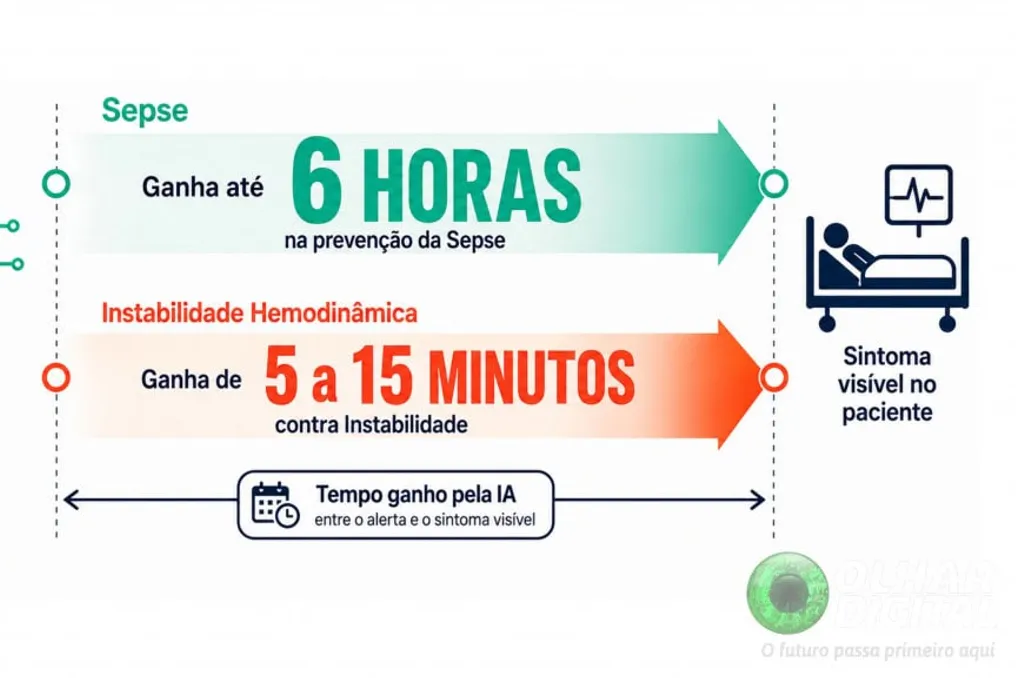
Artificial intelligence (AI) is already being used in intensive care units (ICUs), where it analyzes information from electronic health records in real time. By correlating data from tests and vital signs, the algorithm can predict, for example, septic conditions hours before the patient shows any initial signs in the ward. This technology also alerts medical staff to crises and patient instability with a lead time of five to fifteen minutes.
The ability to transform static computer data into a continuous alert system could fundamentally change hospital operations. Since receiving advance notice of complication development allows the team of doctors to intervene faster, AI potentially can reduce mortality rates and severe outcomes in ICUs.
Currently, hospitals generate enormous volumes of data that often go unnoticed in computer systems. In an interview with Olhar Digital, Dr. Sergio Naves, a cardiologist and intensivist, explains that hospital management systems constantly accumulate medical histories, heart rates, blood pressure, and lab results.
However, without an intelligent tool, the institution cannot convert this mass of files into practical conclusions about the patient's actual condition. This is precisely where algorithms demonstrate their usefulness.
Dr. Naves emphasizes that AI can read data tables in real time and predict serious conditions even before symptoms become visible. The specialist, who is also a medical coordinator at Unicamp Hospital, notes: 'There are algorithms that detect sepsis six hours in advance and hemodynamic instability five to fifteen minutes before standard clinical signs appear.'
This progress in digital monitoring is confirmed by international scientific research. A study published in the journal Nature and conducted by Google researchers showed that AI systems can analyze medical records and health histories, helping doctors make complex decisions regarding patient observation.
Furthermore, an article published in BMJ Innovations indicates that hospitals are replacing manual and periodic measurements with continuous automated monitoring performed by software.
Despite the advantages, the application of this technology involves operational risks. The intensivist warns that hospital AI faces issues such as low accuracy models, incorrect calibration for different populations, and a high rate of false alarms (which also occurs during solar storms).
Research in BMJ Innovations confirms that if a system frequently issues erroneous alerts, medical teams risk experiencing alarm fatigue and ignoring real emergencies.
In addition to technical shortcomings, there are practical limitations that the program cannot overcome. The algorithm calculates the probability of a complication occurring, but it does not synthesize a diagnosis or determine the exact cause of the problem. Assessing the patient's health risks and choosing further actions still requires human experience and judgment on site.
The boundary becomes even clearer when facing human and ethical dilemmas. Naves points out that software does not have the capacity to make end-of-life decisions, nor can it bear ethical and legal responsibility for treatment. The ideal model lies in a partnership between artificial intelligence, which analyzes data, and clinical judgment, as the latter includes ethics and the human aspect of the doctor-patient relationship.
In conclusion, scientific data and daily hospital practice show that AI acts as an advanced data assistant. The tool identifies invisible dangers in the computer many hours before they manifest. However, interpreting the condition, making nuanced decisions, and human involvement still depend on the physician's insight and sensitivity.