The advancement of the gaming industry has generated demand for professionals who go beyond mere game development. Areas such as audiovisual production, broadcasting, content creation, event organization, and brand relationship management have become part of a market that is progressively more competitive and professionalized.
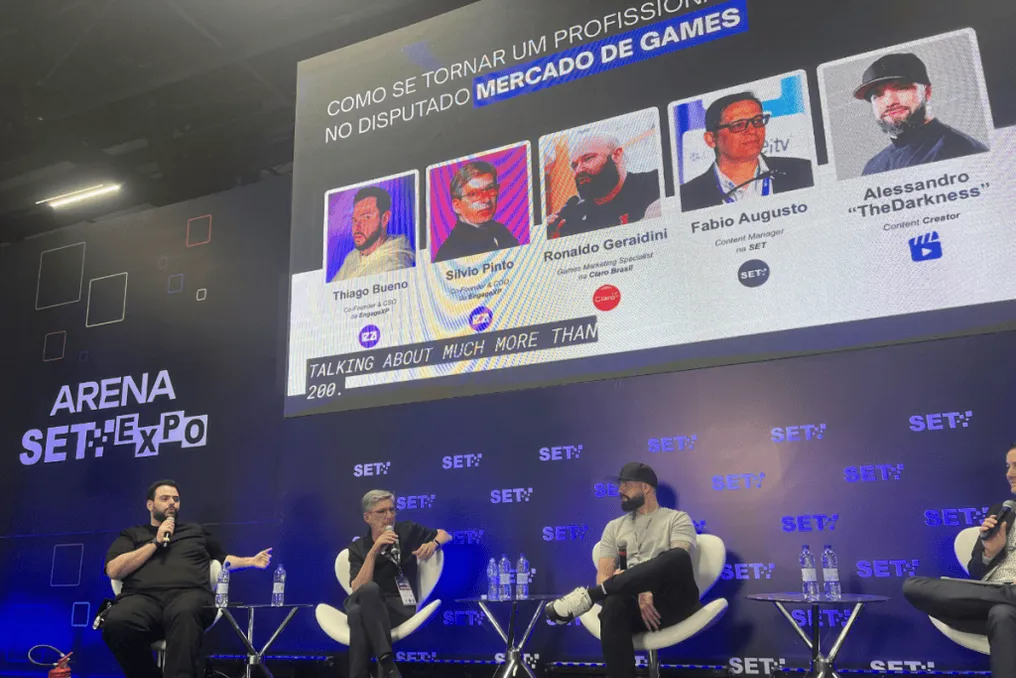
This topic was debated in the panel titled 'How to become a professional in the competitive gaming market,' held in the content area of SET Expo. The conversation brought together various experiences from the sector with the participation of The Darkness, a content creator, Thiago Bueno, and Silvio Pinto, founder of Engage XP.
One aspect highlighted by those involved was the speed at which the sector is changing. Participants observed that the strategic planning period has shrunk, making it more viable to focus on goals for the next six months instead of trying to predict the scenario two years ahead.
The current situation contrasts sharply with the early days of esports and gamer content production in Brazil. At that time, the segment operated improvisationally, with events depending on shared connections and competitions vulnerable to failures caused even by unexpected game updates.
The Darkness, who has been a streamer and creator since 2012, reported entering the sector without a defined plan, being forced to learn several phases of production alone in order to gradually improve the quality of broadcasts.
Thiago Bueno also shared an unusual trajectory. He realized the financial potential of this universe after selling a virtual item for R$ 50 thousand, at which point he initially doubted if it would be a scam. Later, he followed the rise of anime and gaming events and the arrival of projects with greater commercial complexity, noticing the emergence of more robust investments and high valuations around 2019.
The growing professionalization has introduced new technical obstacles. Silvio Pinto joined the sector acting as a link between traditional broadcast professionals and the specific demands of game broadcasts. According to him, simply transferring television knowledge to esports is not enough.
During an event mentioned in the panel, more than 60 cameras were used, a number higher than the approximately 20 used in a football broadcast. Other factors complicate production, such as the need for high frames per second rates for the gaming audience and the requirement for graphics that can keep up with games featuring hundreds of characters and simultaneous information.
For Silvio, the union of these two worlds represents a significant opportunity for the coming years. However, he points out that the broadcast market does not yet fully recognize the volume of gamer consumption to become a partner, still being in an embryonic phase; whoever enters first with modesty will have a great advantage.
Even with technological evolution, cutting-edge equipment does not guarantee viewership. Participants emphasized that there are creators who build large communities with simple infrastructure, while others, despite having advanced equipment, do not achieve equivalent results. Thus, the ability to create a community and know how to interact with it emerges as a central pillar for anyone wishing to produce content.
Thiago summarized this dynamic during the panel, stating that it is essential to be more engaging than merely interested. He stressed that before producing any material, it is essential to understand with whom, for whom, and why one is communicating.
Brands must consider this connection equally. One problem pointed out was the occurrence of campaigns where creators receive excessively scripted briefings, disregarding the specific language of the channel or the bond established with their audience.
Alessandro, The Darkness, drew attention to the power that a creator's voice acquires as their community grows. After working hiring creators for technology companies, he moved to the other side of the market and understood some of the brands' expectations. In one of his first experiences, he noticed the direct influence of the audience in directing people to the e-commerce of a computer store.
Over time, this relationship transforms: the audience grows along with the creator, and new generations begin to consume that content, which increases the responsibility regarding what is said. According to the discussion, creators can assume an almost consultative role within their communities, even if that is not their original function.
For those planning to enter the sector today, The Darkness advises against immediately abandoning the main source of income to invest in a career as a creator. Starting by producing content as a hobby allows testing formats while the audience base is built. There is no promise of accelerated growth; one video can go viral and change a career, while other creators may take years to gain ground.
Thiago added that various professional training paths can find opportunities in the industry, provided there is a willingness to learn and continuously evolve, noting that knowledge from traditional markets and companies can also be valued in the sector.
Artificial intelligence was presented as another change in this process. During the panel, it was defined as a tool that enhances the knowledge of someone who already masters an activity, and not as a substitute for professional knowledge.
It was concluded that the combination of experience from traditional sectors and understanding gamer culture can open new doors, but this depends on a recurring factor in the debate: the willingness to learn in a market that is in constant mutation.