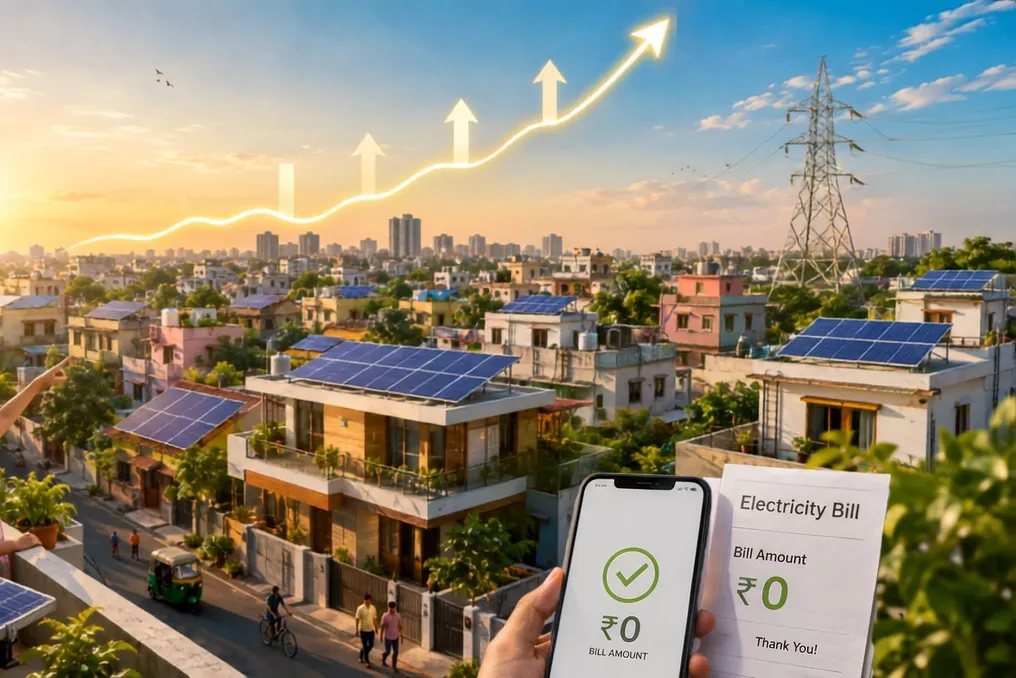
India's rooftop solar energy program has reached a milestone that was unattainable in the previous decade. The Ministry of New and Renewable Energy reported on August 4, 2026, that the PM Surya Ghar: Muft Bijli Yojana scheme has provided solar panel installations to over 50.06 lakh households, a result of work spanning just over two years.
Ten years before the launch of this program, only 7.94 lakh installations had been made. This scheme is the flagship program of the Government of India in the field of rooftop solar energy, implemented with a total budget of 75,021 crore rupees, and described by the ministry as the largest such initiative globally.
The goal of the program is to cover 1 crore households, with central subsidies being transferred directly to the beneficiaries' bank accounts. Union Minister for New and Renewable Energy, Pralad Joshi, stated on August 4, 2026, that solar power now supplies 50 lakh homes in India.
A key aspect is the speed of implementation: the daily number of installations has increased by 3.2 times over nine months—from 5,038 installations per day in October 2025 to nearly 16,328 installations per day in July 2026. July was the strongest month for the scheme, when 5.06 lakh households were connected. At the current pace, 1 lakh households are connected every six days.
The financial side is also developing in parallel. Through the Direct Benefit Transfer mechanism, 28,024 crore rupees have been disbursed to beneficiaries, and the total installed capacity of rooftop solar panels has reached 14.8 GW. Financing played a crucial role: loans at a preferential rate of 5.75% (linked to the repo rate plus 50 basis points) were approved for 21.87 lakh applicants.
Of this number, 17.5 lakh installations have already been completed using credit financing, made possible by the integration of Jan Samarth, which allows for paperless document processing. The entire process is fully online—from application submission to subsidy receipt. Integration with PFMS ensures that the subsidy is paid within 15 days, and application programming interfaces link the national portal with over 80 DISCOMs, with net metering agreements signed digitally.
Consumers can now check supplier ratings before choosing a company, addressing long-standing complaints about installation quality. The database of such suppliers has grown to 34,219 registered firms, of which 29,469 are active. Furthermore, over 2.32 lakh people have undergone training under capacity building programs. Approximately 23,000 independent third-party quality checks have been conducted.
Accessibility has also expanded. Under the Utility-Led Aggregation model, 1.6 lakh installations have been completed for households belonging to PMAY, BPL, and SC/ST programs across four states, and the model has been approved for implementation in 12 states. Rooftop systems up to 10 kW now receive presumptive approval and exemption from feasibility study requirements, and 32 states and union territories have waived application requirements and net metering charges.
The net metering system allows excess electricity generated during the day to feed back into the grid, as the meter records both household consumption and exported energy. The bill is issued only for the difference. If exports exceed imports during the billing period, the DISCOM pays the remaining amount. Currently, about 19 lakh households receive zero electricity bills.
For some owners, the panels have become a small source of income. In the financial year 2024-25, over 12 lakh households collectively earned 421 crore rupees from surplus energy, amounting to approximately 3,500 rupees per year for each household exporting energy to the grid.
The next phase will test whether this pace can be maintained. Achieving the target of 1 crore households means roughly doubling the current figure, and the ministry is expanding the program beyond households. Solar panels have been installed on about 1.06 lakh government buildings, and the City Acceleration Program has been launched in 46 cities. A payment assurance system has also been introduced to attract RESCO participants to state solar energy projects by reducing the risk of payment delays.
For suppliers, financiers, and installers associated with this scheme, the demand signal for the coming year is clear.