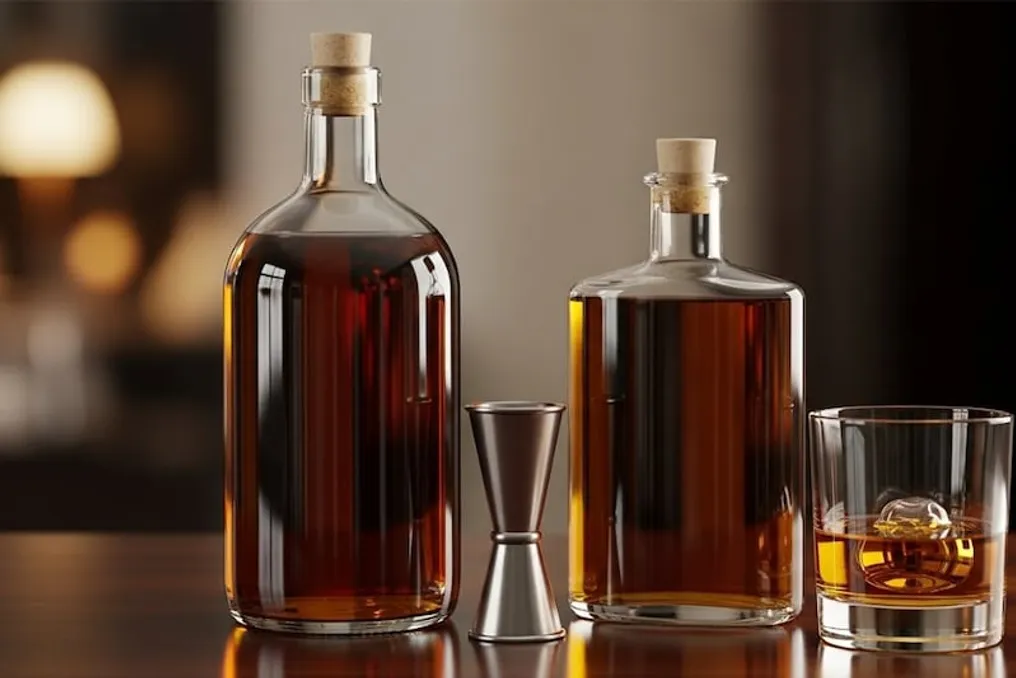
Alcohol is a liquid, and liquids are usually measured in milliliters or liters, which is the international standard for measuring any liquid. According to this standard, 1000 milliliters constitutes one full unit, and half is half a unit.
However, calculations differ in the case of alcohol, especially when considering India. In India, the system of designations 'full', 'half', and 'quarter' bottle has a different structure. According to the rules, a full unit should be 1000 ml, and a half should be 500 ml, but in India, a full bottle of alcohol is not equal to 1000 ml; instead, a full bottle is 750 ml. Similarly, a bottle of 375 ml is called a half bottle. In the local Hindi dialect, these are also called 'khamba', 'addha', and 'paunva'.
Nevertheless, the question remains why measurement standards change specifically regarding alcohol, and why bottles do not have volumes of 1000 ml, 500 ml, and 250 ml. The answer lies in the international system of alcohol serving worldwide, which is based on ounces. One ounce contains about 29 ml, which is close to 30 ml.
The culture of alcohol consumption in India has also been heavily influenced by the British. The British used a small packet of about an ounce, which is approximately 30 ml. There was also a large packet of 60 and 90 ml. It was based on these packets that alcohol bottles began to be produced.
Thus, a full bottle of alcohol in Great Britain and India is defined not as 1000 ml, but only as 750 ml. This is because a quarter bottle was 180 ml, corresponding to three large packets of 30 and 60 ml, and a half bottle was six large packets, and a full bottle was a combination of twelve large and one small packet.