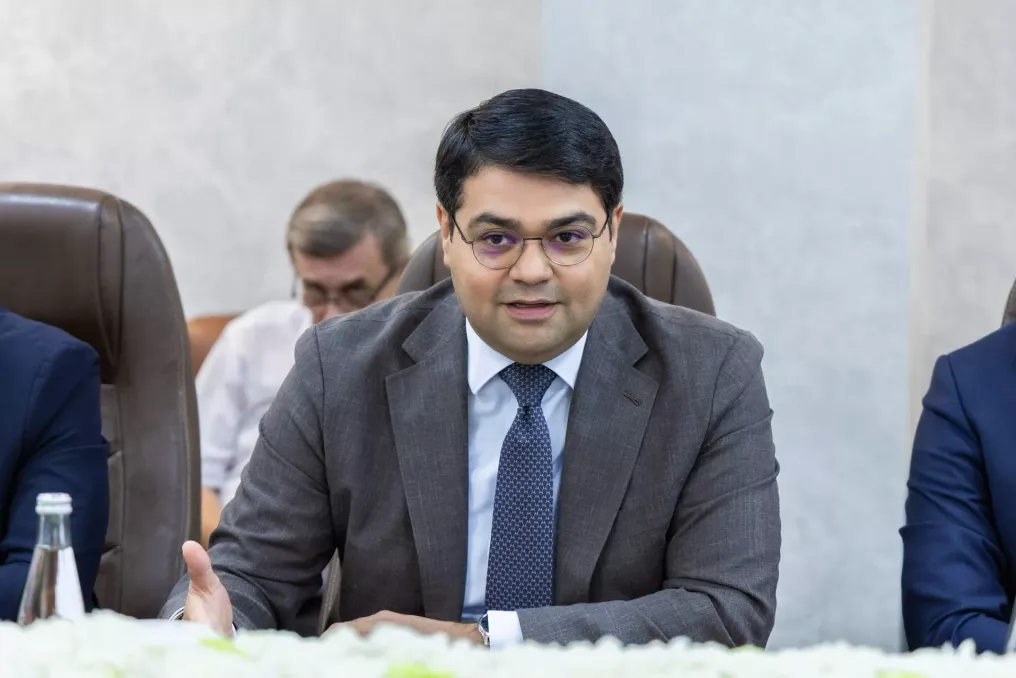
Representatives from Uzbekistan and Kazakhstan held negotiations during which the main principles of cooperation were agreed upon, including the development of a 'roadmap' and the definition of further steps.
A meeting took place at the Uzatom Agency with Mansur Oshurbayev, Deputy Minister of Ecology and Natural Resources of Kazakhstan. The Director of Uzatom, Azim Ahmedkhadzhayev, emphasized that safety is an integral direction of Uzbekistan's national atomic program. He noted that the country is consistently building a system of nuclear, radiation, and environmental safety in accordance with national legislation and international standards. Furthermore, he stated that open dialogue with neighboring states, particularly Kazakhstan, strengthens mutual trust and allows for the consideration of regional specifics at all stages of project implementation.
Mansur Oshurbayev, Deputy Minister of Ecology and Natural Resources of Kazakhstan, expressed interest in the stable and safe development of atomic energy in the region. He added that exchanging experience on environmental protection, transparency of approaches, and joint work meet the interests of both countries and the population of Central Asia. According to him, today's negotiations confirm a high level of strategic partnership between the states.
Participants were presented with up-to-date information on the progress of the project, search and preparatory work, as well as the approaches used to ensure safety and environmental monitoring. Following the meeting, agreements were reached on key aspects of future cooperation, including the creation of a 'roadmap' and the determination of next steps.
Special attention was paid to building the potential of regional personnel and experts. Uzbekistan presented a concept for a specialized center aimed at training specialists from Central Asian countries, conducting training sessions based on modern laboratories, providing expert consultations on developing national nuclear infrastructure in accordance with IAEA recommendations, as well as unifying a single academic mobile platform and a 'knowledge base' based on the experience of constructing and operating NPPs in the republic.
The main areas of this center's work include strengthening the culture of nuclear and radiation safety, improving the regulatory and legal framework, and increasing public acceptance of peaceful atom through digital platforms such as the 'Nuclear Knowledge Platform' and 'Nuclear Energy Modelling Hub'. The parties confirmed their readiness to continue regular expert consultations and strengthen cooperation in the direction of safe and responsible development of peaceful atomic energy in the region.
In May 2024, the first export deal in the history of Uzbekistan's atomic energy was signed in Tashkent—the construction of a small-scale nuclear power plant in the Jizzakh region. Rosatom is the general contractor for the station, and local companies are involved in the construction.
Last September, Rosatom and the government of Uzbekistan signed an additional agreement on the basic terms of implementing the project for the construction of an NPP integrated into the republic.