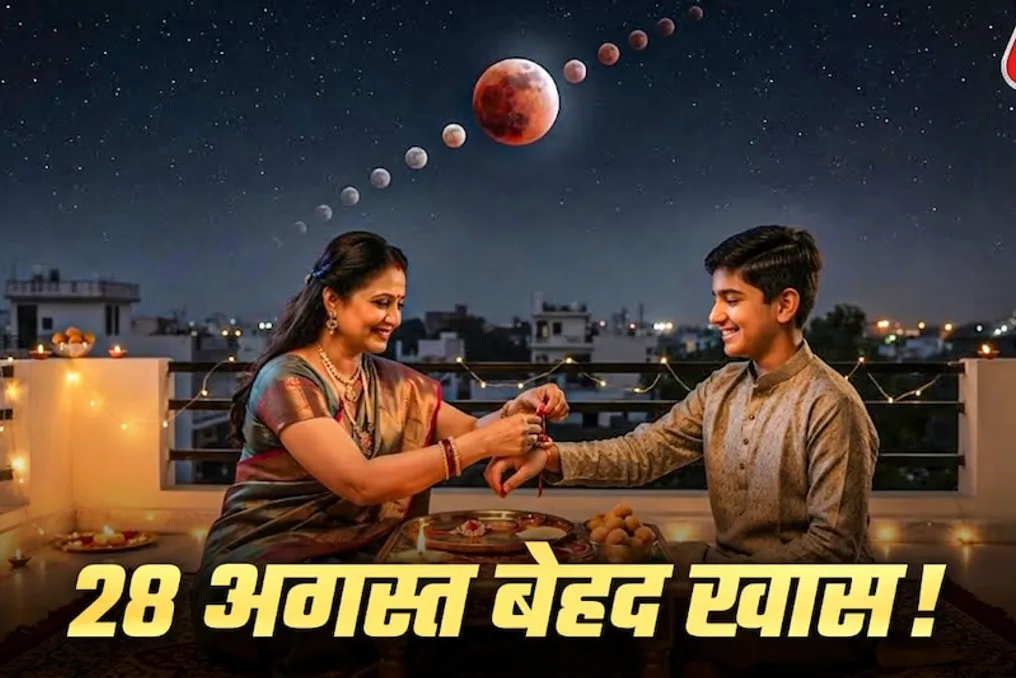
The last week of August will be special both from an astrological and astronomical perspective. On August 28, 2026, on the day of Raksha Bandhan, the last lunar eclipse of the year will occur. Particular attention is drawn to the coincidence of this event with the signs of Shatabhisha and Yoga Atigand, which is considered significant according to astrological beliefs. Such a unique combination of events—Raksha Bandhan, a lunar eclipse, and the configuration of planets and stars—happens approximately every 70 years.
Sharavanya Purnima will be celebrated on August 28, which will also feature the lunar eclipse. According to astrological calculations, the Moon will be in the constellation Shatabhisha, and Yoga Atigand will form on that day. Furthermore, the Moon will be associated with the zodiac sign Capricorn. The combination of all these factors makes this day important from an astrological point of view. However, it should be noted that this rare conjunction is based on astrological assumptions and beliefs, not on pure astronomical data.
Characteristics of the Lunar Eclipse
The eclipse occurring on August 28 will be a partial or segmental lunar eclipse. Its characteristic is that during the peak of the eclipse, about 96 percent of the Moon will fall into the Earth's deep shadow. Because of this, a large part of the Moon may take on a reddish-orange hue, which in some places is compared to 'lunar blood.'
Timing of the Lunar Eclipse
The main phases of the eclipse according to Indian time are as follows: contact with the penumbra at 6:55 AM; beginning of the partial eclipse at 8:04 AM; full coverage at 9:43 AM; end of the partial eclipse at 11:21 AM; and exit from the penumbra at 12:30 PM. The period of partial or actual eclipse will last about three hours and 17 minutes.
Visibility of the Eclipse in India
An important point is that this lunar eclipse will not be visible in India. The eclipse can be observed mainly in parts of America, Europe, Africa, and West Asia. Since the eclipse will not be visible in India, the Sutak Kal period will not apply here. This means that religious rituals on Raksha Bandhan, such as worship, tying rakshis, and other religious activities, will not be restricted due to the eclipse. However, opinions may vary depending on different traditions.
Impact on Zodiac Signs
According to astrological beliefs, the influence of the eclipse is not the same for all zodiac signs. Since the Moon is considered a factor of mind, emotions, and mental state, during an eclipse, there is talk of possible emotional fluctuations, indecision, and the reappearance of old problems. This eclipse is considered particularly important for people associated with the signs Capricorn and Pisces. Various consequences for other signs are also reported depending on the position of the eclipse.
Aries may see new opportunities in career and financial matters, as well as signs of progress in stalled affairs. Taurus is predicted to have positive results in investment matters along with profit. Gemini opens up new paths for progress in work and business. Cancer is expected to strengthen its financial position and receive good news related to family.
What to do on Raksha Bandhan
Since the eclipse will not be visible in India, general religious prohibitions related to the eclipse do not apply here. The festival of Raksha Bandhan can be celebrated as usual. People who adhere to religious views can perform charity on this day by giving food, clothing, or helping as much as they can.