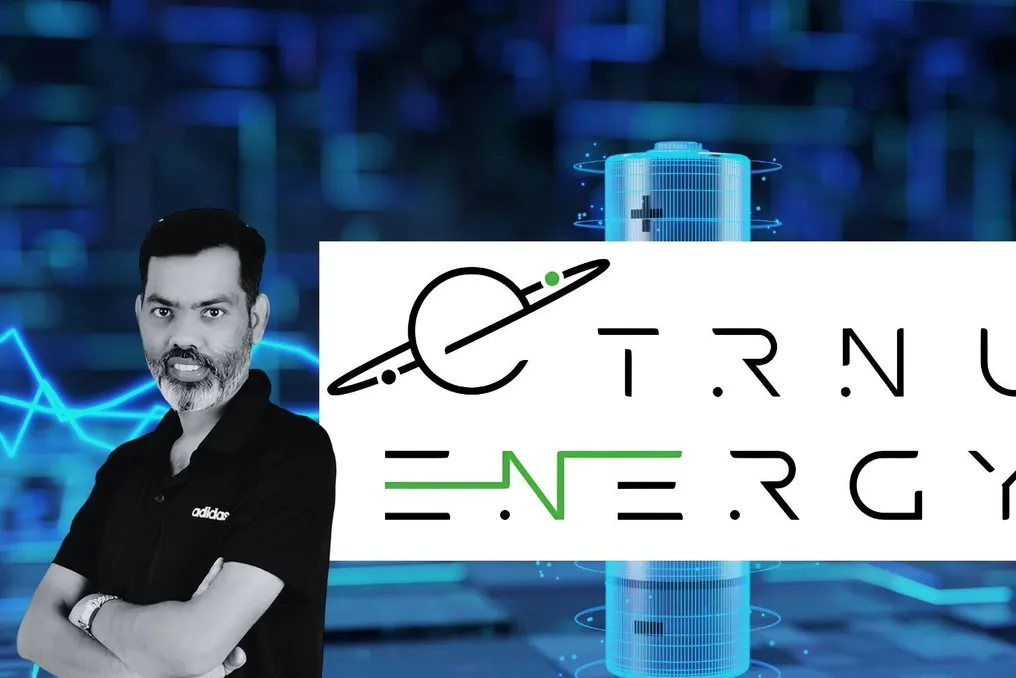
While most innovations in the battery sector focus on altering cathodes, electrolytes, and anodes, the physical design of the cell—how the layers are rolled, stacked, and packaged—has remained relatively unchanged for decades.
However, this physical design has a huge impact on cell characteristics, including heat dissipation, safe charging speed, power-to-package ratio, and manufacturing cost-effectiveness. A significant portion of these parameters is determined by the architecture, not just the chemistry.
e-TRNL Energy, founded in 2021 by Apurva Shaligram and Uttam Kumar Sen, stated that it has completely redesigned the cell architecture and manufacturing process from scratch, foregoing minor improvements to existing models.
The company's central thesis is that its architecture is chemistry-agnostic. e-TRNL Energy claims that its development is compatible with both current lithium-ion chemistries and anticipated next-generation sodium-ion chemistries. The advantages the company promises through this redesign include reduced heat generation, faster charging, increased cycle life, higher energy density, and improved manufacturing economics.
The company has secured two patents for the cell design and filed additional applications. It employs a comprehensive approach covering cell design, manufacturing technologies, and equipment development, with all production facilities being developed in-house from concept to full automation. Creating a new cell design is impossible on equipment designed for older models, requiring companies in this field to build their own manufacturing apparatus.
In February 2026, e-TRNL Energy raised ₹27.4 crore, amounting to approximately $3 million USD, in a seed round. The round was led by IAN Group through its IAN Alpha Fund. Participants also included Navam Capital and Anicut Capital, as well as existing investors Speciale Invest, Micelio Mobility, and IIMA Ventures. Angel investors were co-founders Tarun Mehta and Swapnil Jain of Ather Energy.
The founder called this round a turning point rather than a beginning. Shaligram noted that the last three years were dedicated to creating the design and manufacturing machinery and processes for its implementation, and the funding received will allow the company to move into demonstration, testing, and scaling phases.
The Managing Partner of IAN Alpha Fund supported this view, noting that the rethinking of cell architecture and manufacturing from scratch, rather than gradual improvements to outdated designs, is impressive, and emphasized that India's energy transition depends on owning the cell design, not just adopting ready-made batteries.
Previously, in 2022, the company raised about ₹7.5 crore from Speciale Invest, Micelio Mobility, and CIIE. These new funds are intended to complete product development, verify performance and safety, and demonstrate the capability to manufacture cells in India at an industrial scale.
The company operates a R&D facility spanning 20,000 square feet in Bengaluru and plans to establish a pilot manufacturing plant with a capacity of 250 MWh by 2027, subsequently expanding to 2 GWh. However, no independent validation of any data has been conducted: there is no public information regarding customers, orders, or revenue, nor have third-party test results been released; according to the company itself, it is transitioning into the demonstration phase after three years of development.