Pranos Fusion is developing the industrial equipment necessary for India to generate electricity through nuclear fusion. Nuclear fusion is a process that powers the Sun, where light atoms combine to release energy without producing carbon dioxide or long-lived radioactive waste, unlike the fission of heavy atoms.
Although the wait for nuclear fusion energy has lasted seventy years, the delay is not due to physical problems, as laboratories have repeatedly demonstrated fusion reactions. For example, China's tokamak held plasma for 1066 seconds, and WEST in France exceeded this figure, reaching 1377 seconds. However, the necessary industrial complex is missing: magnets, control systems, design tools, and supply chains that could turn an experiment into an operational power plant.
Pranos Fusion focuses precisely on this missing industrial part, not on the reaction itself. Founded in Bengaluru in 2024 by Shaurya Kaushal and Roshan George, the company positions itself as a developer of an integrated technology stack for fusion, asserting that the world needs commercial infrastructure to connect fusion to power grids.
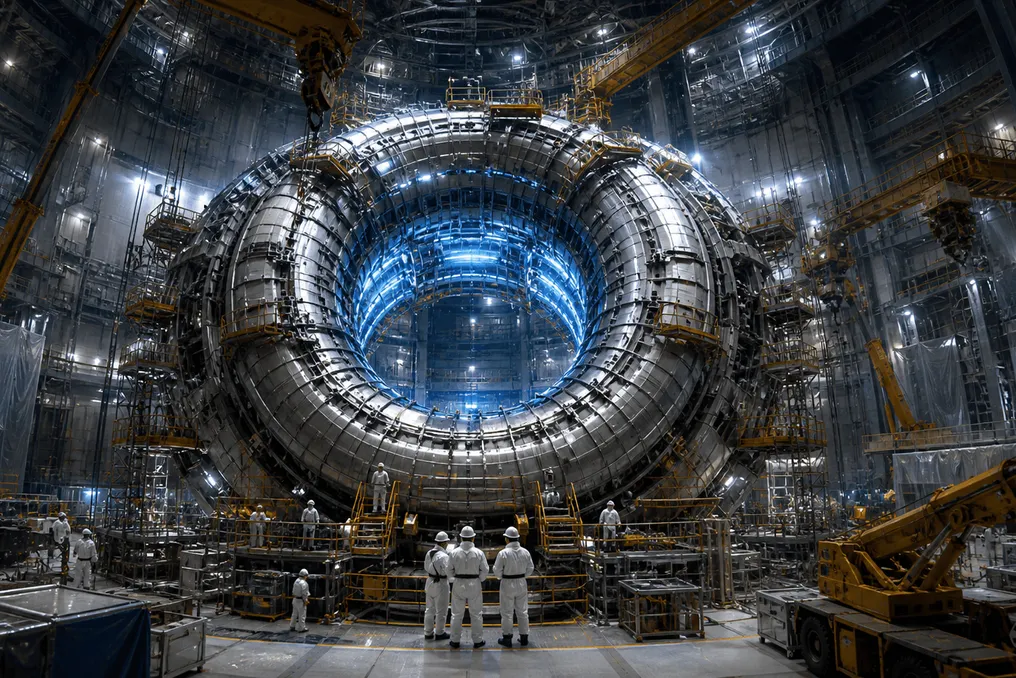
This technology stack consists of three components. JENGA is a platform for plasma design and control—a digital twin that links plasma physics with the engineering aspects of the device, allowing configurations to be tested in simulation before working with hardware. MAGGA is responsible for high-temperature superconducting magnets that confine the plasma; more powerful magnets allow for the creation of more compact machines, which was key to achieving compact fusion in the last decade. PRAGYA is the machine itself, a compact spherical tokamak. The tokamak confines plasma in a donut-shaped magnetic field, and the low aspect ratio version built by Pranos has a more squat appearance compared to the classic design, which complicates engineering but reduces production costs.
In August 2026, the company announced the completion of the development of the first privately built tokamak in India. This year, the company aims to achieve the first plasma milestone, which is a separate and more complex stage than simply building the apparatus.
The founders possess experience from different sides of the technology stack. Kaushal holds a Ph.D. in computational physics from JNCASR and an engineering degree from BITS Pilani, and has worked at the UK Atomic Energy Authority and CSIR-CEERI; he oversees physics and hardware. George has a background in computer science and has spent many years creating digital platforms for the energy sector; he is responsible for software and control algorithms.
The company started with preliminary funding of about 3.5 crore rupees from Industrial47 and a grant of 2 lakh rupees from Startup India Seed Fund. In March 2026, it raised $6.8 million, equivalent to about 63 crore rupees, co-led by Pi Ventures and Ankur Capital, with participation from Industrial47 and angel investors, including Groww co-founder Lalit Kashre, founders of Razorpay and Bhukhanwala Industries. The total amount of funding raised reached approximately $7.22 million, which is directed towards supporting a team of about eight people, test sites, and three technological directions. The company collaborates with third-party manufacturers in Bengaluru, Pune, and Chennai for equipment fabrication.
Pranos is incubated at the Institute for Plasma Research, which manages India's operational tokamaks, as well as at JNCASR. Plasma control systems are being developed with subsequent integration into existing IPR facilities in mind.
It is worth noting the scale of the project: Commonwealth Fusion Systems and Helion Energy have collectively raised billions of dollars but have not yet achieved net energy gain. Pranos has raised seven million dollars and aims to build an industrial base, rather than participate in the race.