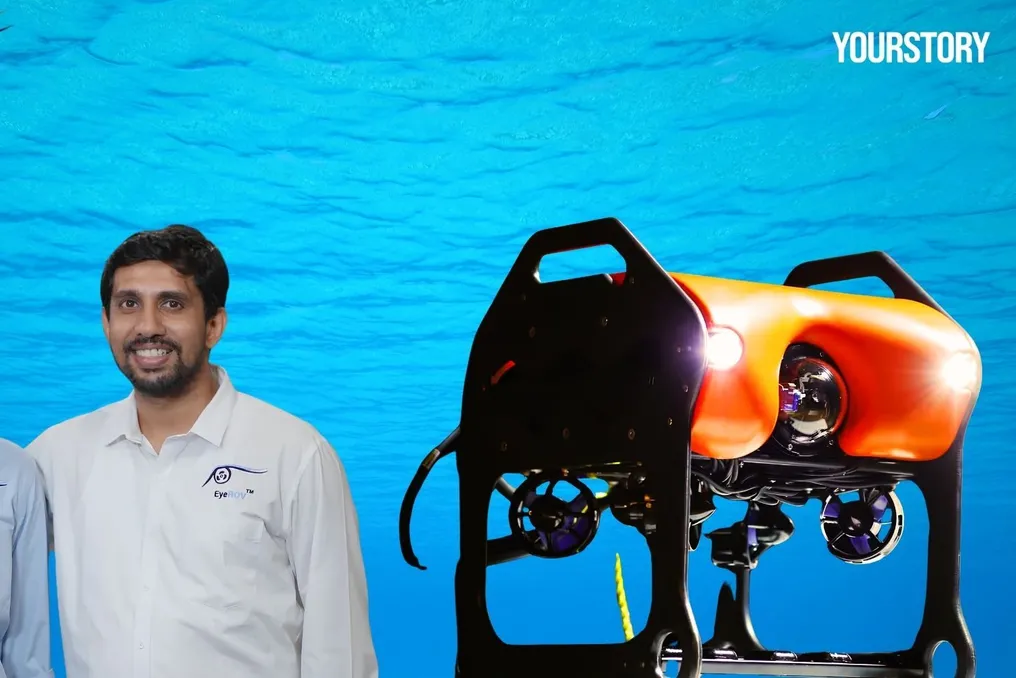
Inspecting objects such as dam walls, ship hulls, or underwater tunnels traditionally requires human presence. This process is slow, involves dangers, requires a team of divers and a support vessel adhering to safety protocols, and becomes impossible at certain depths. Nevertheless, these assets are still inspected, which incurs costs and risks.
However, the robot has no such limitations. It can dive deeper, stay in place longer, is equipped with sensors unavailable to divers, and records all the information it sees. Initially, the obstacle was not so much an engineering problem as a trust issue—convincing the industry to replace divers with a robot from a new Indian company.
The EyeROV technology emerged through an unexpected path. It was initially used to assist fishermen in determining fishing zones before the company shifted its focus to infrastructure inspection.
A significant breakthrough occurred thanks to an order from a government client. DRDO became one of the first buyers, confirming the operational capability of the company's TUNA underwater robotic system for laboratories such as NSTL and NPOL. According to Matai, this completely changed the course of the discussion, which aligns with the typical model of deep technology development in India: first the government customer makes the purchase, and then the private sector follows.
Currently, the product line includes remotely operated vehicles that are tethered and controlled from the surface, as well as unmanned surface vessels for hydrographic surveying. Payload systems are also used for non-destructive testing: ultrasonic testing, sonar imaging, and AI-based defect detection, which identifies corrosion, cracks, and structural wear as the robot moves.
The company's specifications relate to operating range. EyeROV robots function at depths of up to 450 meters, and their tunnel inspection capability reaches 10 kilometers, placing the company among a small number of global players with comparable ranges. The company has successfully implemented projects in Antarctica and developed a solution for monitoring leaks in tunnels, which it calls the first in India.
EyeROV's strength lies in its commercial track record. The company claims to have completed over 150 projects for more than 80 clients. Industrial clients include Tata Power, NHPC, Adani, ONGC, BPCL, and Maersk, while government clients include the Indian Navy, DRDO, and the Indian Coast Guard. In September 2025, the company received an order from the Indian Navy worth 47 crore rupees for underwater robotic systems, significantly exceeding the size of any previous funding round it had attracted.
The company offers two sales models: direct product sales, where the client purchases the equipment entirely; and a 'robotics as a service' model, where the company conducts inspections as a project, eliminating capital expenditure for buyers who require periodic work. The second option opens the market to smaller clients, such as port authorities or dam operators who inspect facilities twice a year and see no point in purchasing their own robot.
In February 2026, EyeROV raised 13 crore rupees in a pre-Series A round, co-led by AWE Funds and Unicorn India Ventures, bringing the total funding to over 2 million US dollars. GAIL previously invested in the company. These funds will be directed towards research, developing new product lines, and entering international markets where larger underwater control business is concentrated.