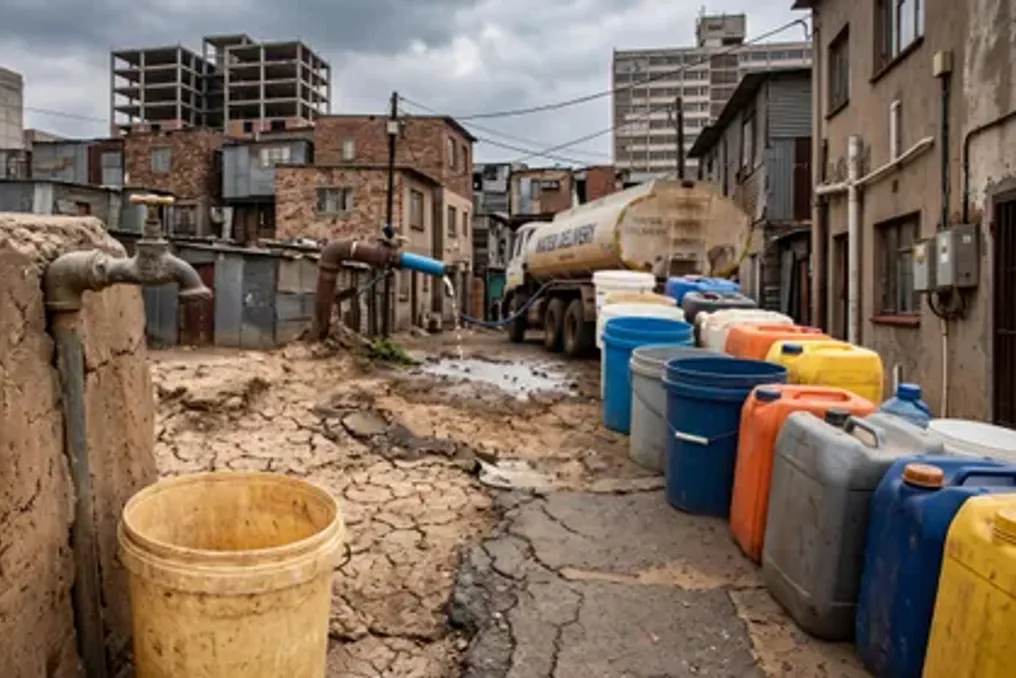
The city of Cape Town has strongly urged residents to conserve water. Although the city's taps are not in immediate danger of running dry, the administration warns that residents cannot become complacent as water demand is increasing, and forecasts indicate a drier end to the rainy season.
As of August 17, six major reservoirs in the Western Cape Water Supply System were at 77.7%, which is approximately 12.9% lower than during the same period last year. Total water consumption in Cape Town reached 847 million liters per day, which is below the city's winter limit of 860 million liters per day.
The city administration states that there is no immediate threat to the water supply; however, the combination of year-on-year reservoir level decline, rainfall uncertainty, and increased demand exceeding targets means that restrictions are not ruled out.
According to the city's drought response framework, one of the key planning indicators is the forecast of reservoir storage levels falling below 80% by November 1. Nevertheless, reaching this level does not automatically trigger restrictions; the city considers factors such as consumption, rainfall forecasts, and the overall state of the water supply system before taking action. Consequently, the immediate risk to Cape Town's water supply was assessed as low.
However, behind this reassuring figure lies a warning: during the 2025/26 financial year, water demand increased by 1.5% above the target. This increase is largely attributed to the early end of the rainy season, subsequent insufficient rainfall, and a prolonged, drier summer. Furthermore, household water consumption remained higher than expected during the winter, although the city notes that water usage appears to be decreasing mainly during the rainy period.
Seasonal forecasts add to the concern, suggesting that rainfall shortages may persist throughout the remainder of the rainy season. The city stated that it is closely monitoring conditions and assessing the need for low-level restrictions.
Zahid Badroodien, a member of the Water and Sanitation Mayoral Committee and advisor, reported that the municipality is working to avoid repeating the vulnerable situation observed during previous droughts. Badroodien emphasized: 'We are not waiting for the next drought to begin preparing. We are investing now in new water sources and improved management of our existing resources.'
Nevertheless, the GOOD party believes that the current situation raises serious questions about the adequacy of Cape Town's pace of action to protect residents from future shortages. The party warned that water restrictions could become an increasingly regular occurrence in the coming years and stated that the poorest and most vulnerable communities would likely feel the greatest impact if water becomes scarcer, more expensive, or less reliable.
GOOD specifically highlighted delays affecting major projects intended to increase the city's water supply. The party expressed concern over the uncertainty surrounding the Paarden Island desalination project, cable theft affecting the Atlantis scheme, and the revised delivery date for the Berg-Voelweley River Augmentation Scheme to 2030.
The city noted that increased demand, aging and limited infrastructure, planned maintenance, and complex timelines for large new projects are part of the risks facing the system.
At the heart of long-term plans is the New Water Programme, which aims to add a peak capacity of 300 million liters of water per day by 2036 through groundwater, additional surface water, water reuse, desalination, and nature-based interventions. This is equivalent to approximately 100 million cubic meters of additional water annually.
Some of these measures are already yielding results. Since 2019, the Greater Cape Water Fund has been clearing invasive alien vegetation in strategic areas of the Western Cape Water Supply System. According to the Water Forecast, this work can provide an additional 30 million liters of water per day, equating to about 11 billion liters per year.
Groundwater is also becoming an increasingly important part of the city's strategy. The Table Mountain Group aquifer is functioning, and production is gradually increasing after addressing pumping issues. The Atlantis Water Management Scheme has been expanded, although production there has suffered due to large-scale electrical cable theft. Work is also continuing on the Cape Flats Aquifer Management Scheme, within which the construction of 74 production wells has been completed.
The commissioning of the Strandfontein West treatment plant with a capacity of six million liters per day is planned, while the Hanower Park/Phillipi plant with a capacity of 10 million liters per day continues to be built. The design for the much larger Mitchells Plain plant with a capacity of 38 million liters per day is nearing completion.
However, some of the most significant future water sources are still distant. The Berg-Voelweley River Augmentation Scheme is now expected to start supplying about 40 million liters per day in 2030 following delays in funding and procurement. The planned Faure scheme, which could provide up to 70 million liters per day in its first phase, is currently expected to deliver its first water in 2031.
Meanwhile, the planned Paarden Island desalination project with a capacity of 70 million liters per day has been pushed even further into the future. Uncertainty surrounding the Transnet National Port Authority Development Plan has affected assumptions about the project's feasibility, prompting the city to explore alternative locations and options. Desalinated water is now only expected by 2036.