China has intensified its efforts to promote 6G technologies and the related industrial ecosystem since the beginning of this year. In May, the Ministry of Industry and Information Technology (MIIT) permitted the IMT-2030 (6G) Promotion Group to use test frequencies in the 6 GHz band.
In June, a joint initiative was launched at the provincial and ministerial levels to coordinate pilot programs for 6G innovation and development. Next month, Jiangsu province in eastern China formed a 6G industry alliance, while in central China, Hubei province presented an action plan to stimulate innovation-driven 6G growth.
As 6G transitions from laboratory research to field testing and industrial application, its development trajectory is becoming clearer, and progress is more stable. 6G represents the next generation of global mobile communications following 5G.
Significance of the Test Frequency Approval
The approval to use test frequencies means that engineers can test 6G technologies in real-world environments, such as cities and industrial sites, solving practical problems including signal penetration and device interference. This process is compared to learning to drive: after passing the theoretical exam and practicing in a closed area, permission is granted to drive on real roads to test skills. Thus, this approval marks an important step toward the practical implementation of 6G.
China is conducting 6G technology trials in three stages: key technology trials, technical solution trials, and system network architecture trials. The main objectives include identifying key technological directions for 6G, developing 6G prototypes for typical application scenarios and performance requirements, and creating pre-commercial 6G equipment.
The first stage has been completed, and the second has begun. 6G is expected to begin commercial application around 2030, becoming part of users' daily lives. More than three years ago, China released its 2023 radio frequency spectrum allocation rules, which serve as a guide for global 6G spectrum planning. China's early research in the 6 GHz band and the timely provision of 6G test frequencies demonstrate systematic spectrum management and targeted resource allocation.
The combination of thoughtful planning and strong execution has been a crucial factor in the transformation and rapid development of China's telecommunications industry over the past decades. This approach will remain a key advantage as China continues to move towards new heights in technological development.
In 2025, China added 588,000 5G base stations, bringing the total number to nearly 4.84 million. Over 330 cities now have 5G-Advanced network coverage. However, this does not mean that 5G infrastructure will become obsolete with the advent of the 6G era. Currently, China is working on creating 'six networks,' including a next-generation network. This implies not only building new networks based on new technologies but also upgrading existing ones.
Academician Zhang Ping from the Chinese Academy of Engineering and his team, for example, confirmed the possibility of achieving 6G-level transmission capabilities over existing 4G and 5G channels using semantic communication technology. They are exploring a new path to achieve 6G performance targets through low-frequency bands and narrow bandwidth. This approach aligns with the principles outlined in China's Five-Year Plan framework: infrastructure development should be moderately farsighted, not excessive, with a high level of coordination in planning, optimized schemes and structures, and stronger integration.
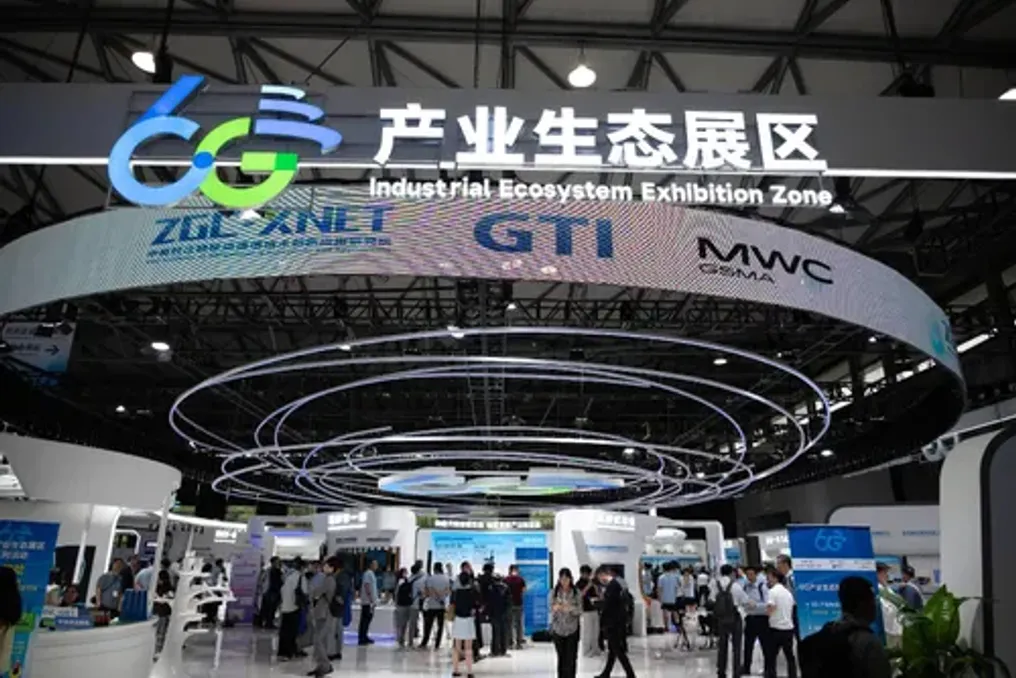
A 6G industry ecosystem exhibition in Shanghai in 2026, scheduled for June 24, will feature a 6G zone.
The evolution of mobile communications constantly lowers technological barriers and helps bridge the digital divide, allowing many people who previously struggled to use digital tools to enjoy greater convenience and embrace digital life. While some changes brought by 6G can be anticipated, many others are difficult to predict. However, one thing is clear: as technological development is guided by the principles of universal accessibility and rational use of technology, thoughtful planning and effective implementation will make the path of innovation increasingly robust and open up broader horizons for development.