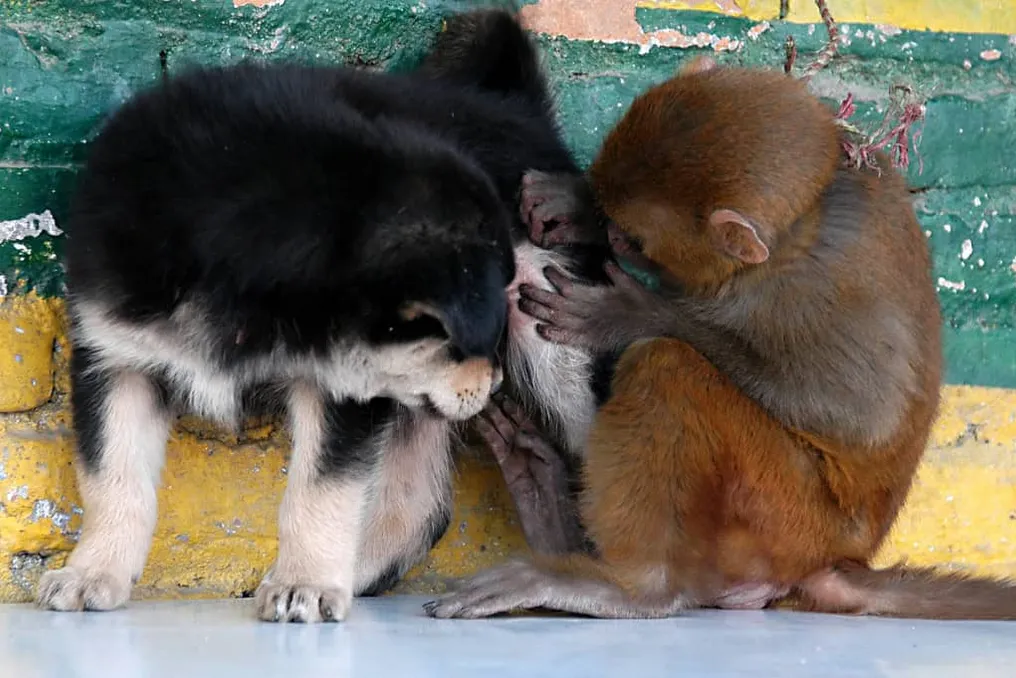
The idea of having a pet is often considered a behavior exclusive to humans, given that maintaining, caring for, and forming companionship bonds with another species requires a combination of tolerance, social interaction, and care that does not always occur between distinct species.
However, a recent study published in the journal Primates suggests that certain behaviors present in these relationships can be observed in other animals. Scientists conducted the first comprehensive analysis of social interactions between monkeys, primates, and animals of other species, identifying examples of affection, play, and acts of care.
To compile this survey, the team integrated data from scientific articles, visual records (photos and videos), and responses provided by primatology specialists. In total, 427 observations were collected: 303 from scientific literature, 58 from images and videos, and 66 from a questionnaire directed at researchers.
These records covered 88 primate species and 127 partner species, of which 72 were other primates and 55 belonged to non-primate species. The observations took place in both natural environments and controlled settings.
Types and Initiative of Interactions
Of the 17 types of behavior cataloged, the most frequent were play, recorded 139 times, followed by hygiene care, with 136 occurrences. The interactions also included physical contact, transport, proximity, hugs, food sharing, and other manifestations of closeness. It was possible to determine who initiated the interaction in 219 cases, with the primate itself taking the initiative in 66% of these situations.
There are notable examples, such as capuchin monkeys assisting other primates, monkeys interacting with dogs, Japanese macaques walking on deer, and young monkeys playing with domestic pigs. A specific case recorded in Brazil involved a capuchin monkey that adopted and nursed a saguin pup.
Behavioral Differences by Age and Sex
The research also revealed variations depending on the age and sex of the animals. It was observed that adult females had a higher probability of participating in affectionate interactions compared to adult males. Younger individuals showed a greater inclination to play, while adult females appeared more frequently in care and hygiene activities.
According to the authors, such relationships may help investigate the behavioral characteristics that, over evolution, led to contacts similar to those established by humans with animals. However, the study clarifies that this does not imply that the analyzed primates have pets in the same human sense. The research itself excluded human-animal relationships, emphasizing that many observed interactions may have ecological origins, such as foraging, defense against predators, or mere proximity between species.
Additionally, the researchers acknowledge certain methodological limitations. The database combines sources with varying levels of credibility and may tend to highlight more unusual or visually impactful events. For this reason, the study should be seen as a starting point for new hypotheses, and not as an exact metric of the frequency of this behavior among primates.
The central conclusion, therefore, is broader: the tendency to develop positive social bonds with animals of other species may not be a characteristic exclusive to humanity. Studying these behaviors in other primates can contribute to a deeper understanding of how the evolutionary foundations of coexistence between humans and animals arose.