Consulting in its familiar form, which existed for half a century, is concluding its cycle. The machine based on creating presentations, loud advertising, and billing by the kilogram is collapsing thanks to the very technologies that its practitioners themselves excessively exaggerated. The author, with nearly forty years of experience in this field, believes this is a deserved fate for this industry.
In 2010, the author headed a company that created one of the first commercial WiMax networks in South Africa. This technology was ahead of its time and significantly surpassed mobile networks of that period. Instead of presenting this history honestly, consultants exaggerated the technology's capabilities, selling peak speed and maximum range as if they were achieved simultaneously. The author knew how this would end: the gap between promotional brochures and real experience would result in disappointment for end customers, not the technology itself being at fault.
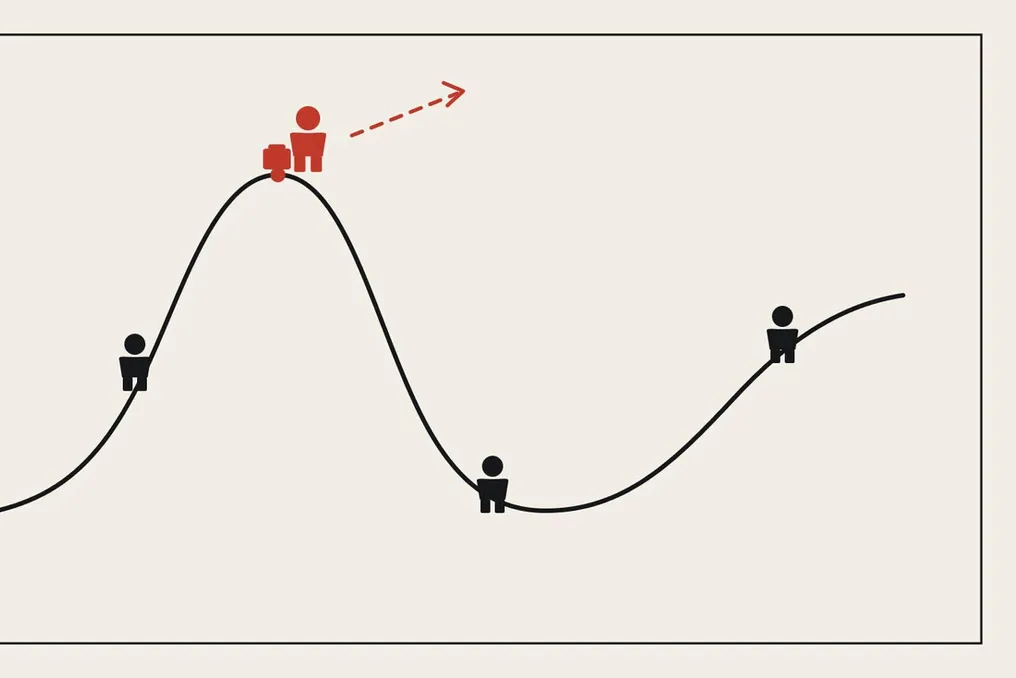
This scenario repeated throughout most of the author's career. He points to the Gartner cycle, familiar to every executive: 'peak of inflated expectations,' 'trough of disillusionment,' and the long road to the 'plateau of productivity.' Underlying this cycle is an honest observation, often attributed to futurist Ray Amara: we tend to overestimate technologies in the short term and underestimate them in the long term. Amara proved right.
However, who stands at the top of this peak with a megaphone? Almost always, it is large consulting firms. And this peak does not happen by chance; someone artificially inflates it, making trillion-dollar forecasts and setting distant deadlines, after which they sell work preparing for panic. When reality does not match the stated figures, and the technology falls into a pit, consultants move on to the next wave.
The Fortune Teller on a Retainer
When venture capitalist Michael Mallani analyzed Gartner's twenty-year cycle of new technologies, he found that most technologies did not follow this curve at all; dozens appeared and disappeared. One such example was WiMax, the technology the author developed, while the slide industry promised the impossible. Gartner even has a category for 'obsolete before plateau' for those that die on the rise.
Frankly, this curve predicts nothing. It is a flexible narrative enough to be true regardless of the outcome: a boom confirms the peak, a crash confirms the trough, a quiet fade is 'obsolete before plateau,' and a later recovery proves the existence of a plateau. The consultant who cannot be wrong becomes the fortune teller on a retainer.
In 2022, McKinsey valued the metaverse at up to $5 trillion by 2030, calling it 'too big to ignore.' Citi raised this estimate to $8–13 trillion. Gartner predicted that by 2026, a quarter of people would spend at least an hour a day in the metaverse. It is now 2026, and this is not happening. Meta, a company so confident in this future that it renamed itself after it, has since absorbed losses exceeding $60 billion in its Reality Labs division and subtly redirected focus and capital to artificial intelligence.
The author personally witnessed this conviction. Several years ago, he was given a tour of a consulting firm's innovation center in Europe, where an entire floor was dedicated to the metaverse: headsets, virtual showrooms, sincere young evangelists. When the author argued that he saw no business value beyond a few narrow niches, he was almost convinced otherwise. This floor still exists, but now every desk there is occupied with 'AI-powered' work. The sign on the door has been changed, but nothing new has been assimilated.
Not all of these things were useless. Big data is real. AI, unlike the NFT circus, clearly has practical significance—the author daily observes it performing useful work in industrial settings, and it helped him write this article. What is important is that the firms were as confident in failures as they were in real shifts. Their confidence in the metaverse was indistinguishable from their confidence in cloud computing. Like any player, they are betting.
This confidence carries no information because, as a rule, the firm selling 'deep industry expertise' does not possess it for your business. The model of large firms is a pyramid of bright graduates with a rigid 'up or out' schedule, and deep subject knowledge is what such a model cannot retain.
Therefore, consultants do what reliably works. They survey your own employees—engineers and operators who have long pointed out the problem—and repackage what they hear into a confident narrative and a beautiful presentation.
Mariana MacCatto states directly in her industry research that large firms often 'lack expertise in the areas they consult on.' Clayton Christensen noted many years ago that consulting resisted scrutiny precisely because its work happens 'in the black box of the conference room,' where the client does not see what they are paying for.
The model borrows its name from cloud computing: 'lift and shift.' Knowledge from the client's staff is extracted and transferred onto a slide. The added value lies in the polishing and the logo, expensive enough to make a pre-existing decision safe to sign off on. The client buys cover—responsibility rented by the hour.
Now the Machine Writes the Slides
There are exceptions, and the most telling is the person the author just quoted. Christensen began his career as a consultant at Boston Consulting Group and became a rare person who correctly understood that even consulting would one day be disrupted from below. The author was fortunate to spend time with him. 'The Innovator's Dilemma' remains required reading, that business book that, according to Steve Jobs, truly shaped his thinking. Christensen's authority was based on theory that was constantly confirmed, not on the certainty with which it was presented. Marketability is what a machine can imitate, but not what it can replace.
Synthesizing a pile of documents and interviews and turning them into a confident, well-structured story is the only task that generative AI performs best. Firms know this because they created the tools themselves. McKinsey's internal assistant, Lilli, can generate a presentation upon request and adhere to corporate style. BCG has a tool called Deckster that creates and polishes slides on command. Some estimates suggest these tools already perform up to 80% of a junior analyst's work, taking seconds instead of weeks.
The pyramid thins from the bottom because packaging is the part the machine mastered first. This is not the end of all advice. When effort becomes cheap, judgment becomes scarce and valuable, and consultants who are truly worth their fee—those who possess real, seasoned, deep industry experience, who created the product themselves rather than just presenting it—will become rarer and more valuable.
Responsibility also cannot be delegated to the model; a person must still be accountable for the decision made. Success is enjoyed by the skillful generalist whose sole advantage was a prettier font, but for him, mathematics no longer works. Such advisors will experience a brief surge in popularity while they use these tools, until their clients notice the same tools on their desks and realize that the knowledge in the presentation originally belonged to them.
The Price the Industry Chose to Pay
None of this happened to us. It happened along with us. For decades, the industry invited firms, treated them, and paid for services, often to rediscover what its own employees already knew, and sometimes at a cost far exceeding monetary value. South Africa knows the extreme form of this phenomenon: prestigious firms were identified by investigative commissions as those that contributed to the depletion of the institutions that hired them. The price, as MacCatto best describes it, is this: every time an organization rents its thoughts, it forgets a little more about how to think independently.
The author offers a test to any executive facing the inevitable revolution. Ask the person promoting it to define the core idea without using buzzwords or trillion-dollar figures. Ask what they were certain of three years ago and how it has changed. Then ask them to 'skin the game': tie the fee to the result and watch as confidence leaves the room.
Buzzwords will change again in about two years; they always change. The difference this time is that the machine can handle the packaging, which leaves the uncomfortable truth: the client actually needed only to listen to their own people. Consulting in its familiar form is over, killed by the last wave it tried to sell. Having observed the sale of disappointment for 40 years, the author can only say: it could not have happened sooner.