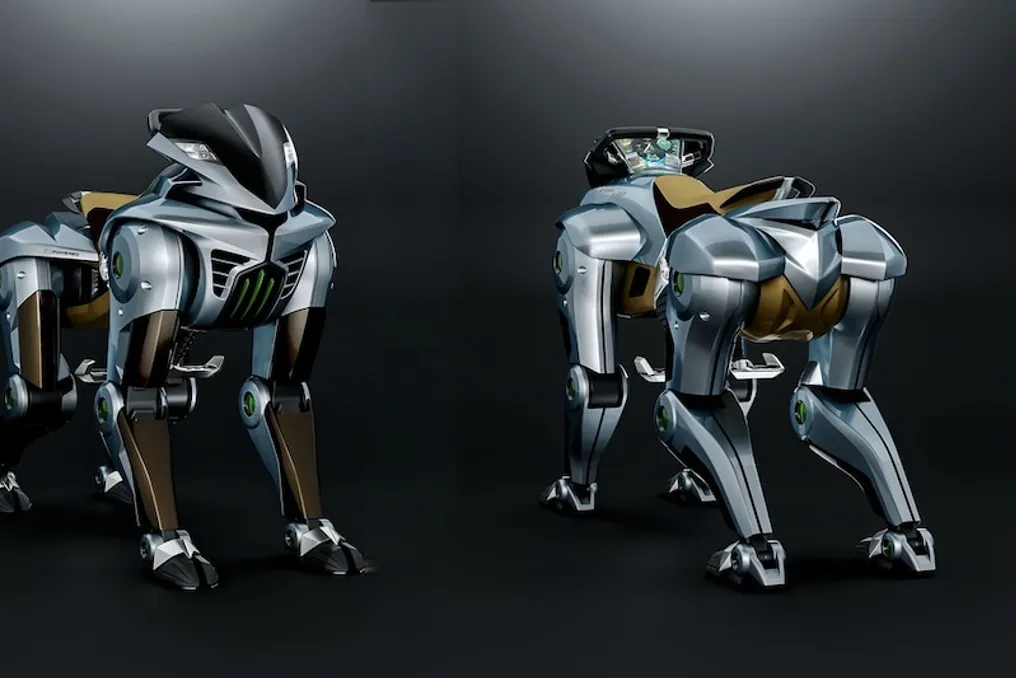
Currently, there are many different machines around us, but the idea arises that these machines could take the form of animals. This could significantly simplify people's use of these mechanical beings as they see fit. Although robotic dogs already exist, one company has begun developing a robotic horse.
Kawasaki has started developing its robotic horse named Corleo. It will be an all-terrain vehicle on four limbs that will operate on hydrogen energy. Notably, this company, which is creating such a four-legged robot, is one of the world's largest manufacturers of two-wheeled vehicles.
Kawasaki plans to use Corleo as mobile transport at an exhibition in Riyadh (Saudi Arabia) in 2030. Furthermore, the company is working towards commercializing this project by 2035. The Corleo concept was first presented by the company at an exhibition in Osaka in 2025.
At the same time, the company has formed a special team for safe business development, whose task is to develop Corleo for commercial use. This team's focus is also on using Corleo at the Riyadh exhibition in 2030.
Corleo is a four-legged robot whose four legs perform various functions. The rear limbs are equipped with a hinged mechanism that allows them to move differently, and they absorb shocks, helping the driver maintain proper posture.
This vehicle functions similarly to a real horse. Hydrogen will be stored at the back of the robot. It will run on a 150 cc hydrogen engine that will generate energy for all four legs. Kawasaki reported that the hydrogen tanks in it can be replaced.
This changes the traditional method of refueling: when one hydrogen tank runs out, it can be replaced with another. Corleo's control system will monitor the position and movement of the vehicle. This will ensure improved reaction of the robot on complex routes. Kawasaki is preparing this apparatus for places or roads where operating existing motorcycles or cars is difficult, eliminating the need to build special paths.