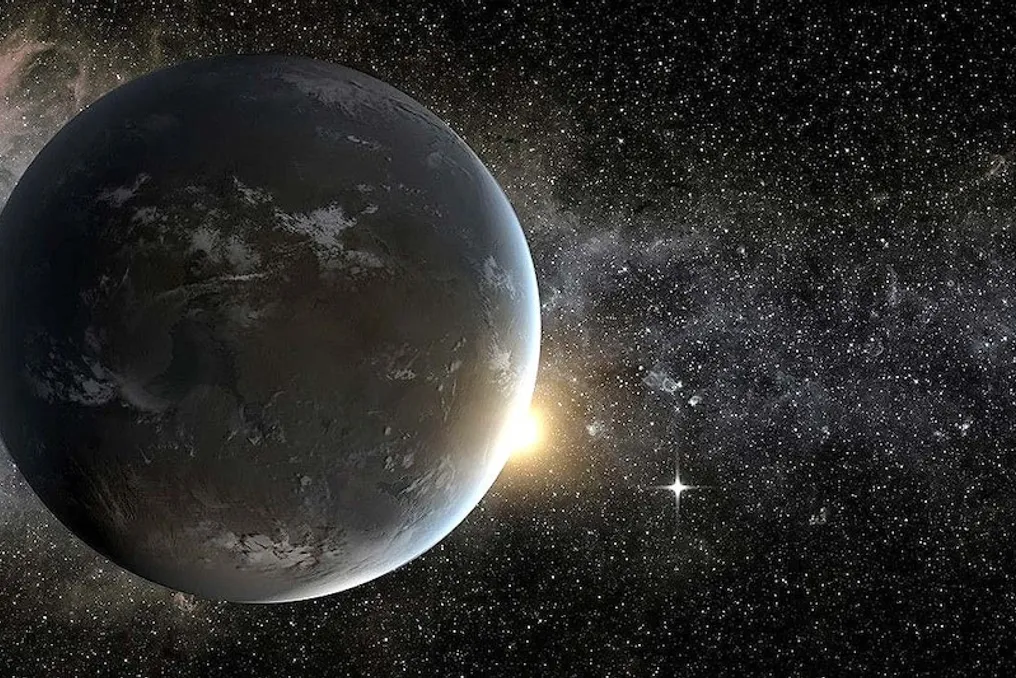
Space scientists have discovered a new planet located approximately 25 light-years from our solar system. This planet has been named GJ 3378b. According to the scientists' data, GJ 3378b is more than twice as massive as Earth, and its surface may be rocky.
A significant aspect is that the planet orbits within the habitable zone of its star, where water could exist in liquid form if the temperature is suitable. This is why scientists consider this planet important for the search for life in the universe. Information about this finding was published in the Astrophysical Journal.
GJ 3378b orbits a small and cool red dwarf star, GJ 3378. The planet receives about 90 percent of the light that reaches Earth from the Sun. However, this does not guarantee the presence of water or life on the planet, and NASA scientists need to gather additional information.
The mass of GJ 3378b slightly exceeds that of Earth, being twice as large. Scientists call such planets super-Earths. This does not mean the planet is identical to Earth; it simply means its size and weight are greater than Earth's. The proximity of this planet also makes it special: GJ 3378b is only 25 light-years away from us. One light-year is the distance light travels in one year. From a cosmic perspective, a distance of 25 light-years is considered quite close. This planet is located in the direction of the constellation Camelopardalis in the northern sky.
Scientists used the Hobby-Eberly and WIYN telescopes to discover this planet. For this, they applied the radial velocity method. Instead of directly observing the planet, researchers tracked very slight wobbles of its star. When the planet orbits its star, its gravity slightly pulls the star, causing a small tremor. Scientists collect data about the planet by measuring exactly this change.
GJ 3378b is located in the habitable zone of its star, which can simply be called the life-friendly zone. Here, the temperature might be such that water remains liquid. Water is considered a vital element. Therefore, scientists search for such planets where there is a possibility of water existing. Nevertheless, it is currently unknown whether there is actually water on GJ 3378b.
Currently, no evidence of life has been found. Scientists also do not know if this planet has an atmosphere, and if it does, what gases it contains remains unclear. In the future, more powerful space telescopes will be able to study the atmosphere of this planet. If conditions suitable for water and life are found there, GJ 3378b could become an important target for the search for life in the future. At present, it can only be said that GJ 3378b is a potentially habitable planet, but the presence of life there has not yet been confirmed.