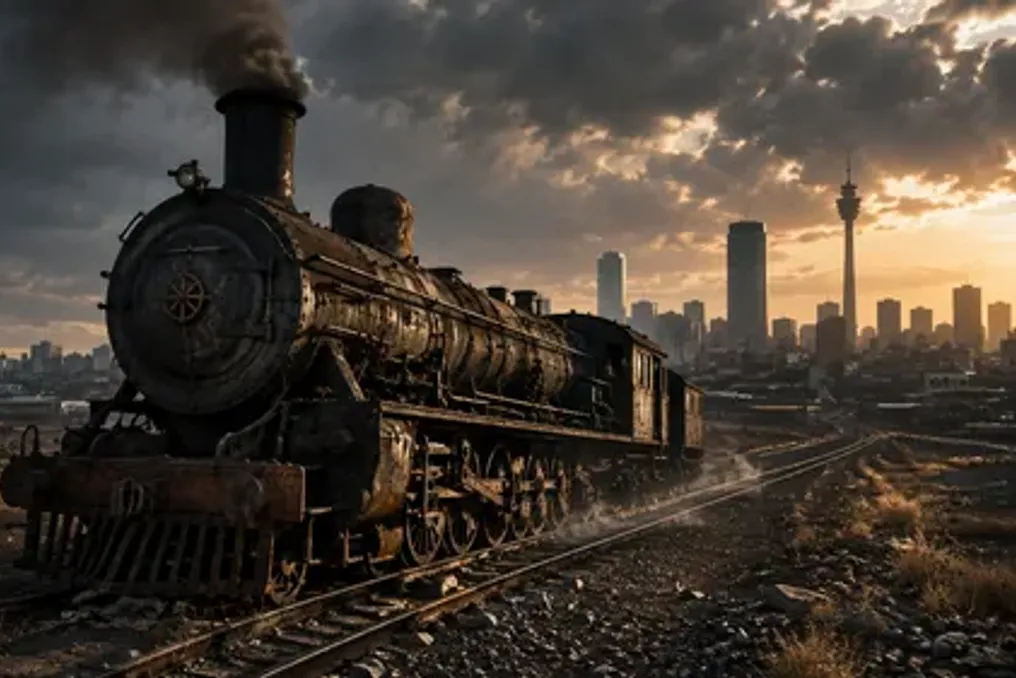
Johannesburg, as the economic center of South Africa, is experiencing a period of decline due to a number of serious problems. The city is facing growing pressure caused by deteriorating infrastructure, financial constraints, poor service delivery, and political instability.
The Centre for Development and Enterprise (CDE) conducted a series of studies on the difficulties faced by the country's economic hub. CDE notes that approximately 70% of South African companies' headquarters are located in Johannesburg, and the city collects 21.8% of the national income tax. Furthermore, 1.91 million people are employed there, accounting for about 11% of the country's jobs. CDE emphasized that the ongoing decline of Johannesburg hinders the recovery of growth, opportunity expansion, and investment attraction in South Africa.
The city contributes almost 16% to South Africa's GDP and about 40% to the economy of the Gauteng province. The business sector includes mining, manufacturing, and especially the service industry. However, the infrastructure supporting this economic activity is under increasing strain, even though Johannesburg remains South Africa's financial center, which, according to Harvard University Professor Ricardo Hausmann, is 'the deepest financial market in the developing world.'
Water, electricity, and road problems
Johannesburg Water has identified an infrastructure renewal deficit of R26.6 billion, with over 226.9 million liters of water lost daily through leaks. CDE reports that the city replaces only 60–70 kilometers of pipes annually. At the current rate, completely replacing the city's outdated pipe network, which spans over 12,500 kilometers, would take nearly two centuries.
The energy infrastructure is also under stress; the deficit in this area is estimated at R44 billion. Between July and December 2025, the city recorded 54,132 power outages, including 105 high-voltage failures. Cable theft and vandalism accounted for 20% of these outages.
Road and transport infrastructure faces similar difficulties. CDE points to a road maintenance deficit of R90 billion and R37 billion for bridges. Residents reported 23,572 potholes during the second half of 2025, and about 55% of traffic lights failed in the last quarter of the year.
CDE asserts that disruptions in water and electricity supply reduce the quality of life for all residents and significantly increase the cost of doing business, which reduces company revenue and forces some to close or relocate, leading to job losses and a shrinking tax base.
Treasury Intervention
Financial pressure has also drawn the attention of the National Treasury, which temporarily suspended payments of part of Johannesburg's equivalent allocation in July. This occurred after it was found that the city was not complying with the Municipal Finance Management Act. The National Treasury stated that funding would resume once the city demonstrates a funded budget and a credible financial recovery plan, reaches payment agreements with major creditors, including Eskom and Rand Water, and implements measures to eliminate unauthorized, irregular, fruitless, and wasteful expenditure.
In response, Johannesburg Mayor Dada Morelo stated that the city's budget for 2026/27 is funded and that the city's financial management has 'not reached a crisis state,' although he acknowledged the need for further efforts in cash flow and revenue management. Morelo noted: 'Johannesburg is the economic heart of this country. The problems we face are real, but not insurmountable... The novelty lies in the discipline, transparency, and accountability with which we are now tackling them.'
More harm than good
Morelo reported that historical expenditures totaling R1.8 billion have already been legalized within management processes, and another R6.4 billion was under review by municipal enterprise boards. He also pointed out that large electricity procurement by City Power is the biggest factor in new unauthorized expenditures, amounting to R2.1 billion by the end of the third quarter.
According to the Auditor-General's report on municipalities for 2024/25, City Power incurred R11.8 billion in irregular expenditure since 2021/22. The report indicated that 'since 2021-22, 77% of the R73.9 billion in irregular expenditure incurred by metros and their structures is linked to non-compliance with procurement and contract management legislation.'
The National Treasury subsequently released the frozen funds on July 31st but clearly stated that this did not mean the municipalities had complied with the requirements—it was a release necessitated because longer retention of the money could have harmed the provision of basic services.
Jobs and politics
CDE believes that financial difficulties coincide with the deterioration of the city's economic indicators. In the second quarter of 2026, the official unemployment rate in Johannesburg reached 35.9%, the highest among South Africa's metropolitan municipalities. Political instability is also a concern. CDE notes that nine mayors have changed in Johannesburg since 2016, and the city has operated under eight coalition administrations, which complicates long-term planning and implementation.
CDE believes that Johannesburg can be fixed, but this will require stable political leadership and effective partnerships with the private sector, civil society, and the national government. The Centre for Development and Enterprise concludes that 'national economic, social, and political recovery requires a thriving Johannesburg that will drive growth, investment, and employment in the country and on the continent.'