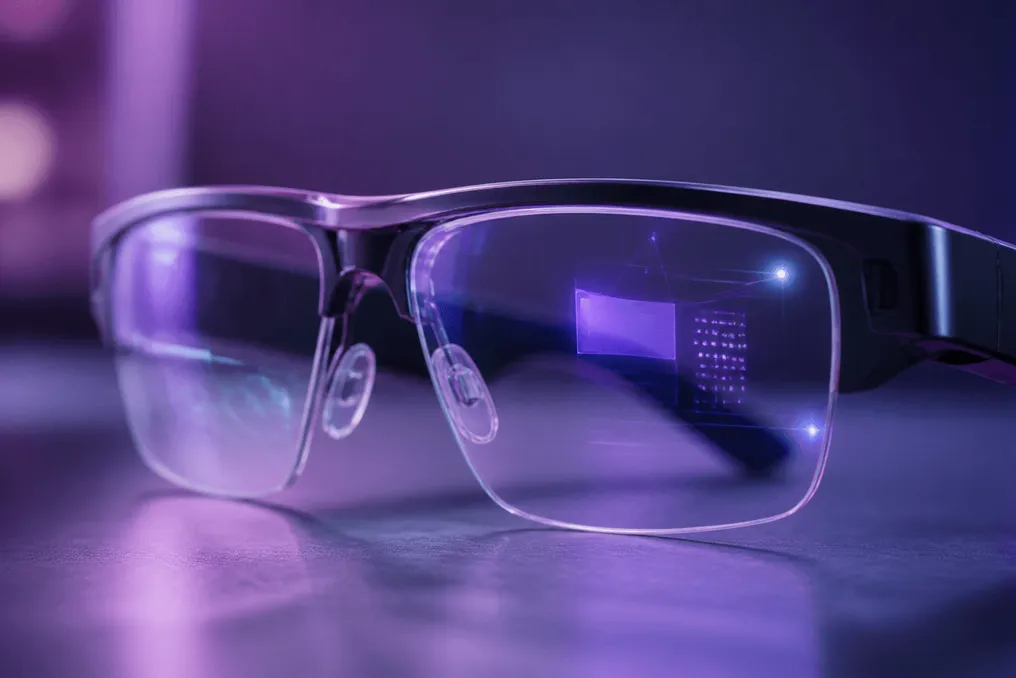
China's optical waveguide industry for augmented reality achieved a structural breakthrough in the first half of 2026. Several major manufacturers are now capable of producing devices in millions of units. For instance, Greatar-Tech aims to produce one million SRG devices, AAC Technologies plans to reach one million SRG capacity, and Nika Optical launched an automated VHG production line with a capacity of one million units.
The term 'mass production year' signifies the point when supply constraints cease to be an issue, and price becomes the competitive factor.
However, a more significant aspect is the consolidation of the technology roadmap around three distinct paths. The primary diffraction method is SRG. Another route is the volumetric holographic method (VHG). The third path, the polarization volumetric holographic method (PVG), although having the smallest production volume this year, offers the greatest differentiation in optics. The Parallel Vision pilot line began operation at the end of 2025 with an annual output of fifty thousand units.
According to a Counterpoint Research report, global shipments of AR glasses grew by 136% in the first quarter of 2026 compared to the previous year, with the share of optical waveguide AR glasses increasing from 18% to 42%. Companies such as Meta, Alibaba, Rokid, and Even Realities have committed to AI+AR formats, which require displays with high transparency and a thickness of less than one millimeter. Waveguide technology is currently the only one that meets the wearability requirements for consumer AI glasses.
The bottleneck is shifting. The waveguides themselves can now be manufactured. The remaining challenge is solving the problem of the optical specification stack. Greatar-Tech CEO Meng Xiangfeng listed over ten criteria that must be met simultaneously: elimination of chromatic aberration, light leakage control, 98% transmission, low grating sensation, wide field of view, high luminous efficiency, image uniformity, contrast, and clarity. Parallel Vision CEO Zhang Yunin added three commercial criteria: total module cost, power and output stability, and reliability under drop, impact, and moisture exposure. Both leaders believe that the engineering task will be solved at the process level, not the chemical level.
The broader conclusion is that AR hardware is moving out of the optics waiting phase. Earlier demonstration versions of AR were limited by the lack of a manufacturable waveguide. The 2026 generation is defined by alignment with AI and software: how useful can a round-the-clock AI assistant in first-person mode be for a consumer to wear glasses for an hour? The 'wearability' test has become the new filter. Once passed, the supply chain is ready to ensure large-scale deliveries. China has become the only country where three independent waveguide production lines reached the one-million-unit threshold in the same year, representing a structural advantage for the Chinese AR industry in the next product cycle.