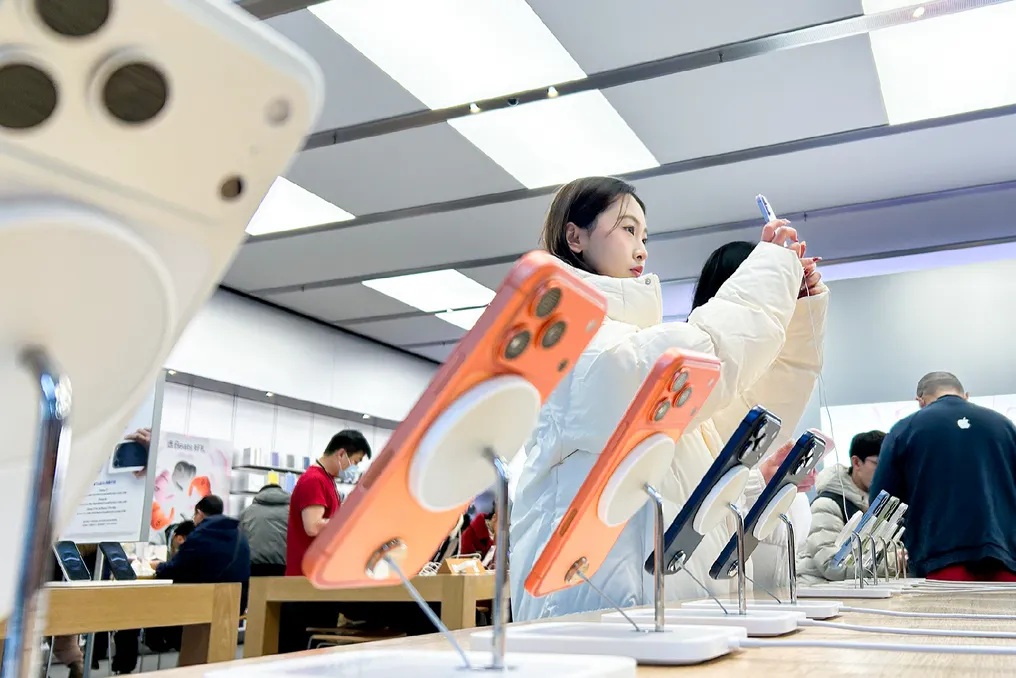
The consumer goods exchange program in China was expanded starting in 2025 and now covers vehicles, home appliances, mobile phones, tablets, and other digital devices. Foreign brands have gained the opportunity to participate in this program on par with domestic manufacturers.
Apple is one example. When subsidies for mobile phones came into effect in January 2025, corresponding iPhone models were included in the program. According to data from China Media Group, the iPhone 16 model with 128GB storage cost 4,699 yuan (approximately 700 US dollars) at the official Apple store on JD.com after receiving a subsidy of 500 yuan. This subsidy applied to items valued at no more than 6,000 yuan, constituted 15% of the final selling price, but could not exceed 500 yuan.
Foreign automakers also participated. In January 2026, consumers were observed at a Tesla store in Wuhan after the implementation of a new round of vehicle exchange subsidies. The program offered subsidies of up to 20,000 yuan when replacing an old car and 15,000 yuan when replacing through trade-in, provided the requirements were met.
Official data demonstrates a significant contribution from foreign brands. On June 22, Lin Zhi, Deputy Minister of Commerce and Deputy Representative of China for International Trade, stated that foreign automotive brands accounted for over 35% of new car sales under the exchange program. Furthermore, foreign brands accounted for over 13% of new purchases of home appliances, digital, and smart products. He also emphasized that China supports the participation of companies with foreign capital in the consumer exchange policy on equal terms.
The principle of equal treatment is reflected in the policy rules. Regarding the implementation of subsidies for new mobile phones, tablets, and smartwatches in 2025, there was a direct requirement for equal and fair participation from both domestic and foreign brands, as well as various types of enterprises.
The Ministry of Commerce confirmed this principle in its July 28 document on 'overcapacity,' stating that China's consumer exchange policy ensures equal treatment for domestically and foreign-funded enterprises. It was also noted that some subsidy programs in the United States and the European Union link support to local production or local content, which creates barriers for companies from other economies.
China's stated approach is to use consumer subsidies to improve people's access to updated products and stimulate consumption, rather than to support companies based on their ownership. Foreign brands can participate within the same policy framework.