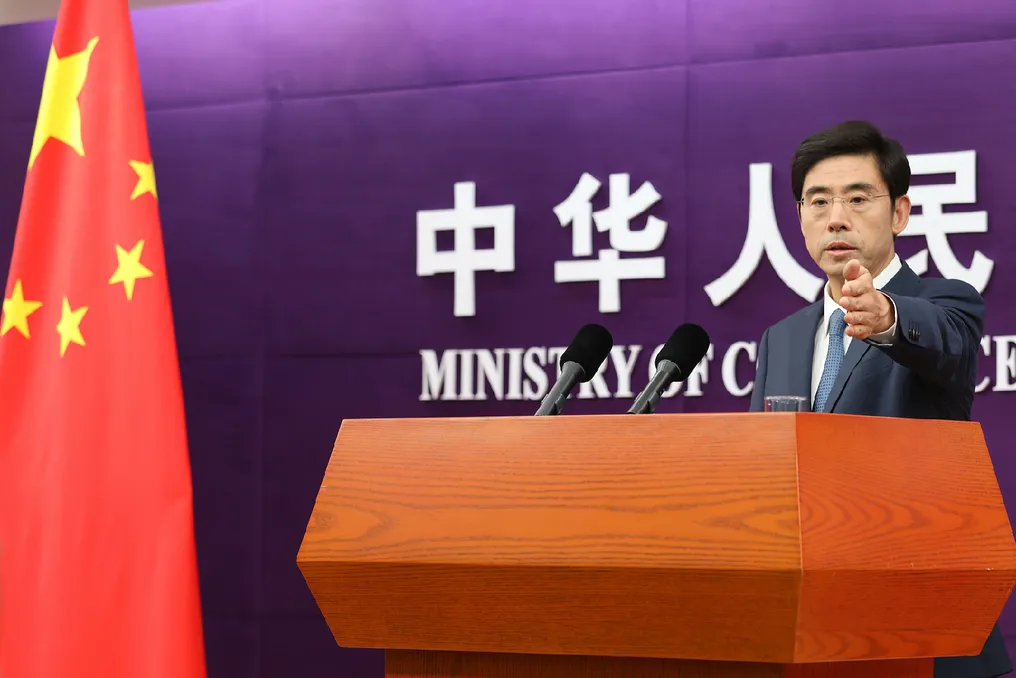
China opposes the European Union's unilateral measures against Chinese companies
Read more
CGTN
cgtn.com

China opposes the European Union's unilateral measures against Chinese companies

A representative of China's Ministry of Commerce stated on Thursday that China has always opposed the misuse of unilateral tools by the European Union (EU), such as the Foreign Subsidies Regulation (FSR), directed against Chinese firms.

Speaking in response to China's recent directive, which stipulates that no organization or private individual should comply with or assist in implementing EU cross-border investigative measures against the Chinese e-commerce giant JD.com, the representative He Yadong made these statements.

China's Ministry of Justice ruled on Wednesday that the recent EU cross-border investigation into JD.com under the FSR constitutes illegal extraterritorial jurisdiction.

Previously, the European Commission announced the start of an investigation into the alleged acquisition of JD.com of German retailer Ceconomy in May. According to He, in this case, the EU arbitrarily demanded extensive information from relevant banking institutions in China, including details irrelevant to the investigation.

He noted that this conclusion was reached after careful study and in accordance with China's rules on countering illegal extraterritorial jurisdiction of foreign states, issued in April this year.

China first determined in May that the EU's anti-subsidy investigation into the Chinese security inspection company Nuctech is also an illegal extraterritorial jurisdiction, and demanded that no organizations or individuals comply with or assist in implementing EU measures.

The representative added: 'We hope that the EU will move towards the same goal as China, quickly correct its erroneous practices in FSR investigations, and strengthen communication through government dialogue.'

He also stated that China will closely monitor developments from the EU and take necessary measures to firmly protect national security and the legitimate rights and interests of Chinese companies.

Similar stories

China threatens retaliation against the EU over trade investigation into JD.com
Read more
noticiasaominuto.com

China threatens retaliation against the EU over trade investigation into JD.com

China's Ministry of Justice issued a statement on Wednesday, asserting that the European Union (EU), by using the foreign subsidy regulation in its investigation of JD.com, requested extensive and deemed 'unnecessary' information from Chinese entities, crossing borders and located within Chinese territory.

A spokesperson for the government agency, cited by official media outlets, declared that such actions constitute inappropriate demands against the affected companies and represent 'a serious violation of international law.' The Ministry of Justice signaled, together with the Ministry of Commerce and other departments, that these practices are legally classified as acts of 'improper extraterritorial jurisdiction,' as stipulated by Chinese regulations against the unjustified application of foreign laws and measures.

In response, Beijing demanded that any organization or individual refrain from executing or assisting in these measures, and requested the European side to 'immediately correct its erroneous practices' and cease the abuse of the 'foreign subsidy' investigation tool. The ministry warned that 'if the European side insists on proceeding, China will respond firmly in accordance with the law.'

This dispute originated at the end of May when the European Commission launched an investigation to verify whether public support provided by China to Jingdong, the controller of JD.com, conferred competitive advantages upon the Chinese group in the acquisition of Ceconomy, a German retailer of electronics and home appliances.

The initial analysis conducted in Brussels mentioned potential forms of support, such as tax incentives, preferential financing, and subsidies attributable to China, suggesting that these subsidies might have facilitated JD.com in offering more advantageous terms during the purchase.

This dispute adds to months of tensions between Beijing and Brussels, driven by the European trade deficit, allegations of excessive Chinese industrial capacity, mutual investigations, and restrictions in sectors considered strategic. The EU leadership deemed the economic relationship unsustainable due to the annual trade deficit, estimated at approximately 360 billion euros, and the impact of Chinese exports in areas such as electric vehicles, batteries, solar panels, and chemicals.

Beijing refutes the accusations of excessive industrial capacity, denying that this is the result of state subsidies or insufficient domestic demand, and accuses Brussels of politicizing trade differences and implementing measures it considers protectionist. The situation escalated further after the European Commission imposed a fine of 550 million euros on the Chinese platform AliExpress this month for alleged failures in combating the sale of illegal goods, a decision criticized by Beijing.

Ursula von der Leyen, President of the European Commission, warned that Brussels is prepared to introduce new trade measures starting in the autumn if there is no progress in negotiations with China. Nevertheless, in April, He Yadong, spokesperson for the Chinese Ministry of Commerce, stated that an agreement was reached in the first meeting of the China-EU trade and investment consultation mechanism, aiming to define bilateral relations as a 'stable and balanced' trade partnership.

China demands respect for digital sovereignty in response to US actions in the AI race
Read more
olhardigital.com.br

China demands respect for digital sovereignty in response to US actions in the AI race

China has voiced its reaction to the United States' plan, which aims to compel other nations to align with one side of the artificial intelligence (AI) competition. The Chinese government emphasized on Wednesday (19th) that each country's digital autonomy must be respected.

This stance comes after the publication of a US government document signaling the exclusion of international partnerships for countries that also maintain ties with Beijing. In response, China's Ministry of Foreign Affairs declared its opposition to the fragmentation of the technology sector into competing blocs.

Lin Jian, spokesperson for China's Ministry of Foreign Affairs, criticized the attempt to exert pressure on other governments in the field of technology. He stated that 'each country has the right to choose its partners based on its national conditions and development needs,' as reported by Reuters.

This declaration is a response to an internal draft from the US Department of State that was obtained by the press. This document sent a warning to approximately 35 nations that had shown interest in collaborating with Washington in the area of artificial intelligence.

The US government's objective is to prevent its allies from simultaneously participating in agreements promoted by China. Countries that sign projects with Beijing risk being vetoed from strategic alliances led by the United States.

Meanwhile, the US is promoting the Pax Silica initiative to safeguard the supply chain of critical minerals and microchips. Concurrently, China established the World Organization for AI Cooperation with the aim of expanding access to its own models.

This dispute between the two major powers intensifies the debate on global security and technological advancement. For Chinese diplomacy, imposing restrictions and blocking international collaboration are considered detrimental to worldwide scientific progress.

Popular