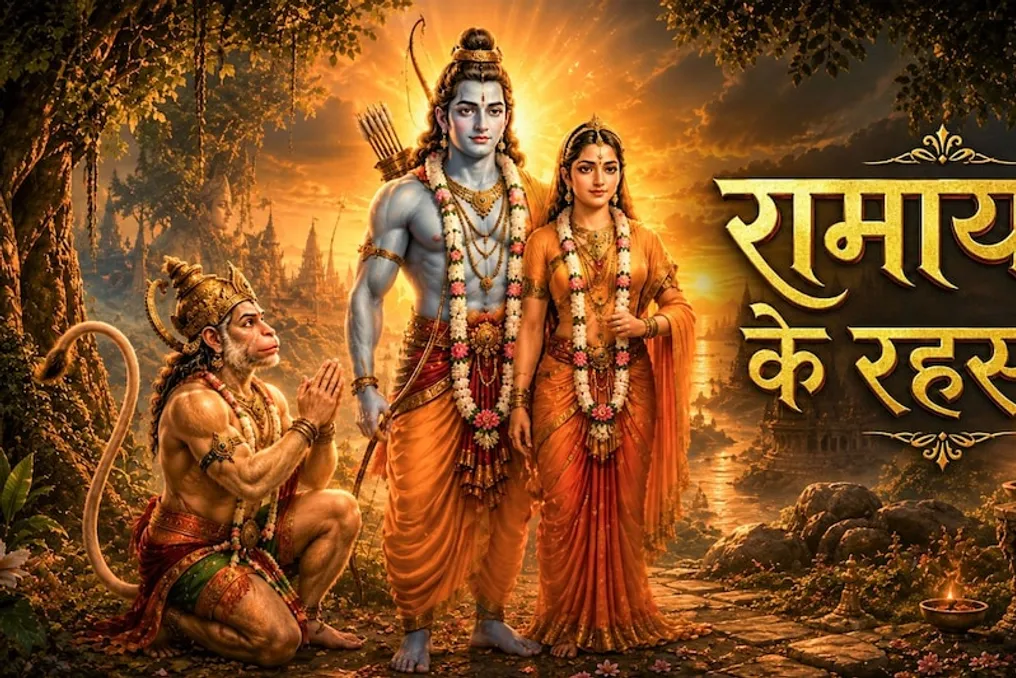
The story of the Ramayana is well known to everyone, as it tells of the life of Lord Shri Rama—from his birth and exile to his victory over Ravana and subsequent dissolution in the Sarayu River. However, besides the main plot, there are many fascinating beliefs that few people know about.
There is a popular belief that before Valmiki wrote the Ramakhyana, Hanuman recorded the story of Rama. There are also rumors about the daughter of King Dasharatha and that Urmila's refusal of marriage explains why Lakshmana did not sleep for 14 years.
Ramayana: 24 Thousand Verses and the Gayatri Mantra
One of the well-known religious concepts is related to the Gayatri Mantra. According to tradition, Valmiki's Ramayana contains about 24 thousand verses. It is believed that one letter is taken from every thousandth verse of the Ramayana to form the 24 letters of the Gayatri Mantra. This belief is viewed in religious tradition as a special spiritual union between the Ramayana and the Gayatri Mantra.
The Gayatri Mantra sounds like this: 'Om Bhur Bhuvah Svah Tat Savitur Varenyam Bhargo Devasya Dhimahi Dhiyo Yo Nah Prachodayat.'
Did King Dasharatha have a daughter besides Rama, Lakshmana, and Bharata?
Most people know that King Dasharatha had four sons: Rama, Lakshmana, Bharata, and Shatrughna. Nevertheless, traditions associated with the Ramayana also mention the daughter of King Dasharatha named Shanta. It is said that Shanta was raised by King Rompad and his wife from Angdesha. Later, she married Rishyashringa. According to belief, it was with the help of Rishyashringa that King Dasharatha performed the Putrakameshti Yajna, after which he was granted sons such as Rama, Lakshmana, Bharata, and Shatrughna. Although Shanta's story is not detailed in the main plot of the Ramayana, she is mentioned in various traditions and folk tales about the Ramayana.
Did Ravana himself attend Sita's wedding contest?
Everyone knows the story of the marriage of Shri Rama and Mata Sita. At Mata Sita's wedding contest, the condition was set: one had to lift Shiva's divine bow and string it. Many kings and mighty warriors failed this test, and finally, Shri Rama lifted the bow and strung it. However, folk tales also claim that Lankapati Ravana attended the contest and tried to lift Shiva's bow. The details of this episode vary in different traditions of the Ramayana and cannot be considered part of a specific plot of Valmiki's Ramayana. There is also a belief that even such a powerful warrior as Ravana could not lift Shiva's bow.
Why didn't Lakshmana sleep for 14 years?
When Shri Rama was assigned 14 years of exile, Lakshmana went with him into the forest to serve and protect his brother and sister Sita. According to folk beliefs, Lakshmana refused to sleep throughout the entire 14 years of exile so that he could always be ready to protect Shri Rama and Mata Sita. It is told that at the beginning of the exile, the Goddess of Sleep appeared before Lakshmana. Lakshmana asked her to release him from sleep for 14 years. According to this story, Lakshmana's wife, Urmila, took the sleep instead of Lakshmana and slept for a long time. Therefore, Urmila's sacrifice is considered very important in folk tradition. Nevertheless, this episode is not described in detail in Valmiki's Ramayana, but became more known in later traditions.
The Connection Between Bali's Death and Krishna's Incarnation
The Ramayana recounts the killing of Bali by Shri Rama. Shri Rama shot Bali from a humble hiding place. In connection with this event, an interesting belief emerged in later folk tales. It is said that Bali's wife, Tara, bitterly grieved over her husband's death in this manner and cursed Shri Rama that in his next life, he would also cause her death. According to this belief, in the next life, Shri Rama incarnated as Shri Krishna, and Bali was born as a hunter named Jara. Shri Krishna's death on Earth is linked to Jara's arrow. This episode appears in various Puranic and folk traditions, although it is not considered the main plot of Valmiki's Ramayana.
Hanuman's Son, Makardhwaja
Hanuman is revered as the greatest devotee of Shri Rama and a lifelong celibate. A question arises: how could he have a son? According to a popular mythological story, when Hanuman descended into the sea to cool the heat of his tail after burning Lanka, a drop of sweat fell into the sea. It is said that a large fish swallowed this drop, and Makardhwaja was born from it. Later, Makardhwaja guarded the gates of Patala Loka. When Hanuman arrived in Patala Loka searching for Shri Rama and Lakshmana, he met Makardhwaja. Makardhwaja introduced himself as Hanuman's son. After this, a battle ensued between them, and ultimately, Hanuman defeated him. This story is mainly known in later mythological and folk traditions.