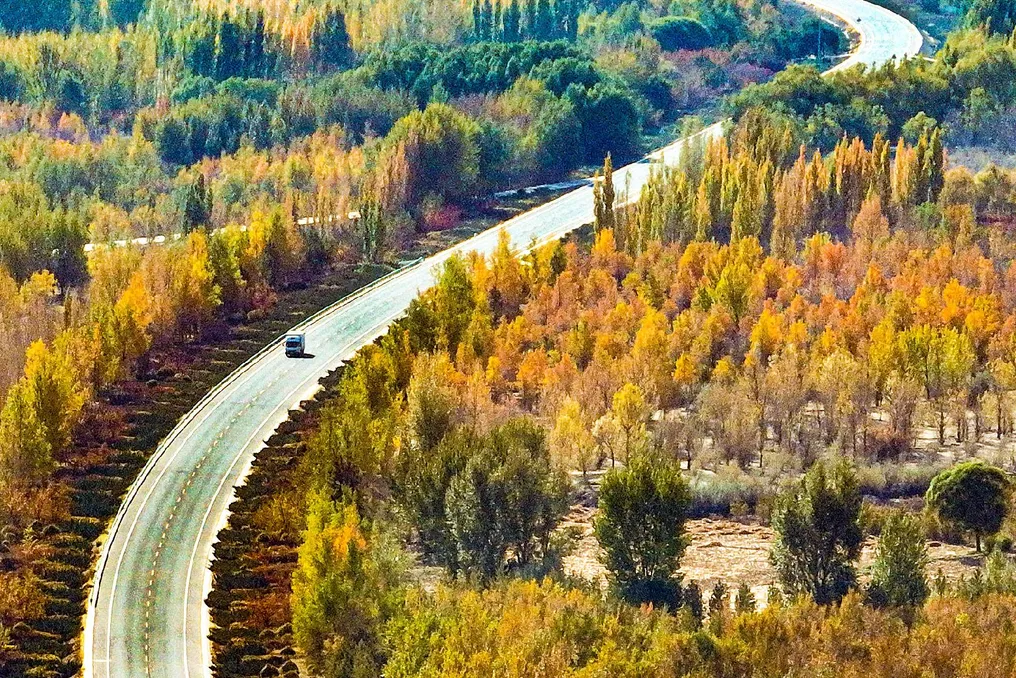
China is using the 'China Pavilion' at the 17th session of the United Nations Convention to Combat Desertification (UNCCD) Conference of the Parties (COP17) to present its ecological strategy. This experience, built on decades of domestic restoration work and willingness to share knowledge, was described by UNCCD Chair Yasmin Fouad as 'one of the most vivid examples of large-scale degraded land restoration.'
On the southeastern border of the Tangger Desert in China, rows of straw woven into the sand are holding back dunes that might otherwise advance southward. This technique, initiated in the 1950s, helped the Ningxia Hui autonomous region, located in northwestern China and surrounded by deserts on three sides, become the first provincial region in the country to successfully reverse desertification.
As one of the countries most affected by desertification, China possesses vast arid territories in its northwest, north, and northeast. Consequently, the Three North Shelterbelt Program (TSFP) was launched in 1978 to slow the spread of deserts and restore degraded lands. Today, China has managed to bring 53% of its degraded lands under management, which accounts for approximately a quarter of all new green zones created globally in recent years.
In the Ningxia region, barren dunes are now used to host solar panels and desert tourism centers. In neighboring Gansu province, where sand-dwelling plants such as cystes and desert onions grow, a commercial ecosystem has formed, including over 100 agricultural enterprises.
Yasmin Fouad noted that 'China's experience shows that when restoration is integrated into broader development planning, environmental actions become an investment in people and prosperity.'
China's experience within the TSFP program has influenced the African Union's 'Great Green Wall' initiative, launched in 2007. The goal of this initiative is to restore 100 million hectares of degraded land in the Sahel-Sahara region and create 10 million green jobs by 2030. In Mauritania, where the China-Africa Green Technology Park was established in 2024, a two-hectare oasis was created from the desert.
The efficient irrigation system is powered by dark blue solar panels, while strips of fodder grasses, palms, and bougainvillea protect fruit tree and vegetable saplings from wind and sand. The first harvest, collected in February 2025, included peppers, cabbage, watermelons, and tomatoes. In addition to building the park, China trained 45 local technical specialists in greening technologies and created 120 jobs for the local population.
In Kazakhstan, pilot quinoa crops developed in China are restoring saline land while reducing water consumption by more than 30%. Meanwhile, Chinese specialists are supporting Mongolia's 'Billion Trees' movement and exporting solar-powered sand stabilization technologies to Saudi Arabia, combining ecological restoration with the regional energy transition.
Hosam Shawki, President of the Egyptian Desert Research Center, emphasized that given Egypt's annual loss of critical land due to drought and advancing dunes, 'cooperation with China on green belt creation and reforestation projects is vital not only for environmental protection but also for preserving investments in new urban and agricultural areas.'