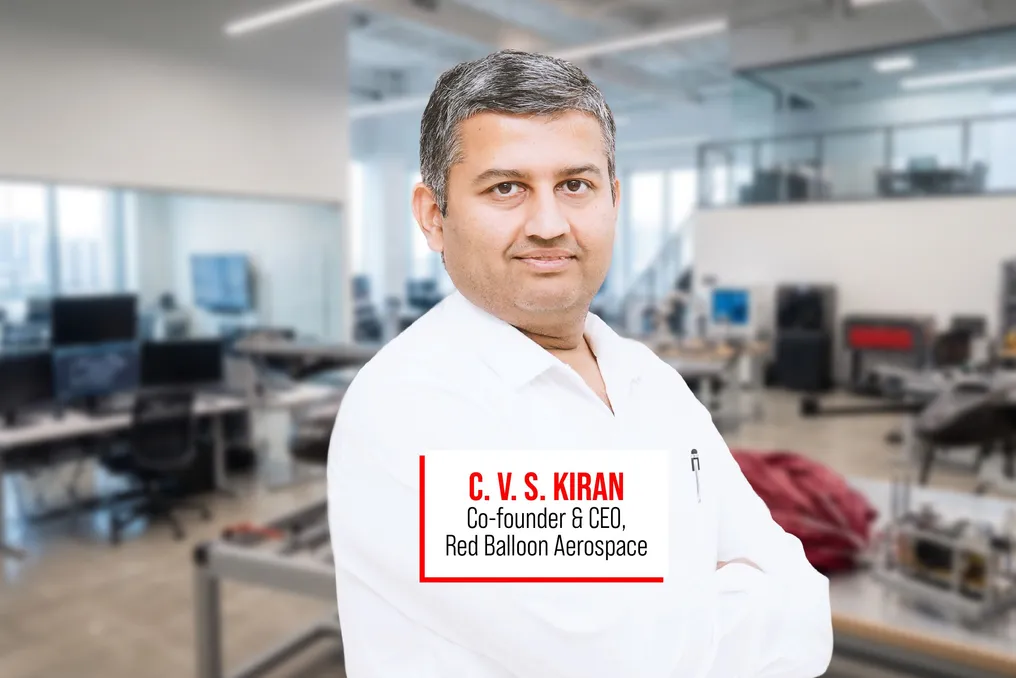
Before a payload can be sent into space, it must be tested in near-space conditions. However, access to such facilities in India is limited, notes CVS Kiran, who has spent years developing spacecraft capable of reaching orbit.
Several existing facilities are overloaded, leading to long waiting lists and increased development timelines. Kiran, a former scientist at Vikram Sarabhai Space Centre and former Vice President of Skyroot Aerospace, saw an opportunity in the area between aviation and satellites.
He states: 'The space between where airplanes end and where satellites begin is an entire area that is largely unused—close enough to be accessible and high enough to be persistent.'
This prompted him to co-found Red Balloon Aerospace in 2025. This space technology startup, based in Mangalagiri, Andhra Pradesh, focuses on creating platforms for what he considers the near-space infrastructure layer, utilizing stratospheric airships, aerostats, and superpressure balloons.
CVS Kiran, the CEO, told YourStory: 'Red Balloon Aerospace exists to ensure that India owns, operates, and leads in the near-space domain through indigenous platforms, deep technological development, and a long-term vision of near-space as national infrastructure.'
The startup's core platform is HELIX, an autonomous stratospheric airship designed for continuous operations in near-space with long endurance. On May 27, Red Balloon Aerospace launched its VISTA superpressure balloon to test core subsystems that will also be used in HELIX.
The launch, conducted at Indira Gandhi Stadium in Vijayawada, placed India among five nations—alongside the United States, France, Japan, and China—that possess indigenous hydrogen-fueled stratospheric balloons. The company is also preparing for the flight of ALTIS, its tethered aerostat, which will serve as another testing ground for systems to be integrated into HELIX.
The company independently develops the envelope film (an ultra-thin flexible polymer used to create the gas-retaining skin of high-altitude stratospheric balloons) and the reinforcement structure. Kiran emphasizes: 'We own the design of our envelope film and reinforcement structure from start to finish in-house, which allowed us to move from the start of operations in November to the first flight in less than a year.'
The startup is developing VISTA, ALTIS, and HELIX as a modular family of platforms. These platforms are intended for applications such as communications and V2X, disaster response, remote sensing, and domain awareness. The company creates materials, avionics, navigation systems, payload interfaces, communication systems, and mission software as building blocks that can be deployed on its platforms.
Red Balloon Aerospace operates its own facility in Vijayawada, Andhra Pradesh, and plans to build a larger site as an expansion. The company serves both business clients (B2B) and government customers (B2G). For commercial clients, the company uses a rideshare model, allowing multiple payloads to be transported in a single mission.
Kiran notes: 'Commercially, partners approach us today for various applications through our rideshare model, where one mission carries multiple payloads simultaneously.' Government tasks may include sovereign communications, Earth observation, and emergency response. The startup has also attracted international B2B clients who are soon planning to launch payloads involving the company.
In Kiran's view, India's private space industry has entered a phase of broader participation, but he believes that near-space still needs recognition as a distinct category.
The near-space environment begins in the stratosphere, at an altitude of 20 to 50 km above Earth, whereas the Earth's geostationary orbit (GEO) is located at an altitude of 35,786 km. Between aviation and orbital space, near-space platforms can operate at altitudes where conventional aircraft and satellites have different limitations.
Kiran believes that the task before them is to achieve clear recognition of near-space as its own category, separate from satellites and aviation, so that policy and investment discussions directly address this field. He believes that India possesses the necessary engineering talent, capital, and governmental support for global competition once this category receives wider recognition.
The Red Balloon team has over seventy years of cumulative experience in Light Technology Air (LTA) and stratospheric platforms. Kiran also says that the company attracts subject matter experts in key technical areas as mission frequency increases. Currently, the company is self-funded and plans a funding round, although details are yet to be determined.
It competes with international companies such as World View from Tucson and Sceye from Moriarity, but Kiran argues that Red Balloon's advantage lies in its team and control over the developed technology. 'We control the entire value chain, from the envelope film and structural reinforcement elements to the data processing systems collected by our platforms,' he says. 'This ownership, combined with our speed of operation and already built infrastructure, puts us years ahead of everyone else in India.'
Currently, the company is focused on generating field experience for its VISTA, ALTIS, and HELIX platforms while developing the infrastructure and technologies that it believes can establish near-space as a new category for India's private space industry.