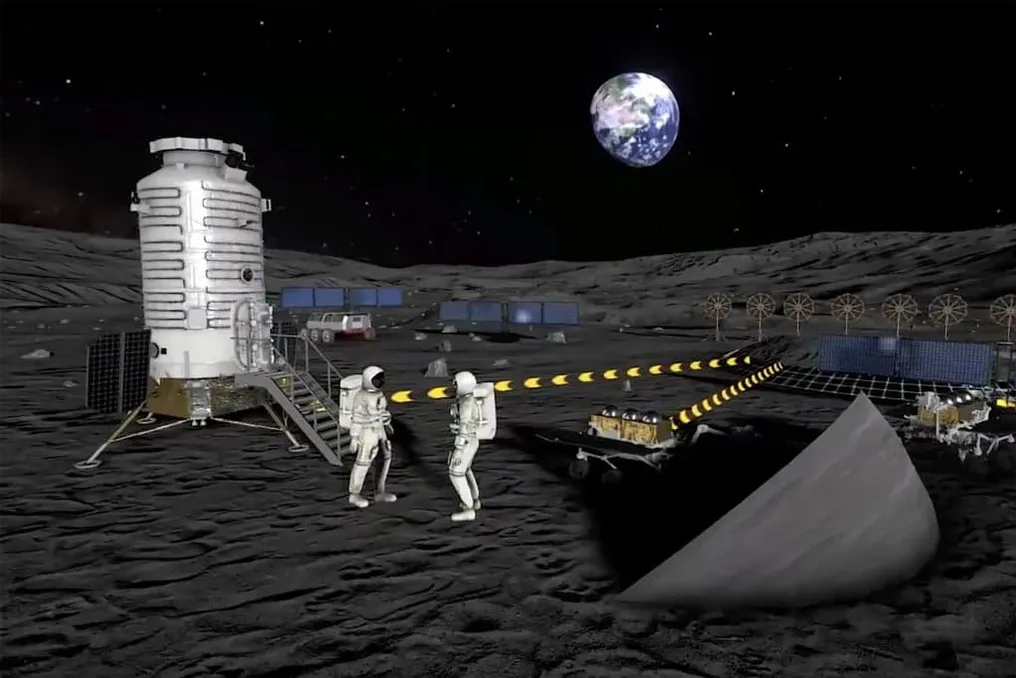
China is preparing to launch Chang'e-7 this weekend—one of the most large-scale robotic missions planned for the Moon. This probe will include an orbiter, a lander, a rover, a vehicle capable of hopping across the lunar surface, as well as a number of international scientific experiments, including cargo supported by the United States.
The launch is scheduled for August 24 Beijing time. It will take place using the Long March 5 Y14 rocket from the Launch Center in Wenchang, China. The equipment for Chang'e-7 was delivered to the site in April.
The lander is set to head towards the region near the rim of the Shackleton crater, located at the Moon's south pole. After the start, the orbiter will orbit the Moon for several months before releasing the lander for a landing attempt planned for the end of the year.
In addition to scientific goals, the mission should contribute to preparing the path for China's project to send astronauts to the lunar surface by 2030.
Expert Assessment of the Mission
James Head, a lunar scientist from Brown University's Department of Geological Sciences, characterized Chang'e-7 as a new stage in the exploration of the natural satellite. According to Head, 'Chang'e-7 is the most ambitious, comprehensive, and complex robotic lunar mission any nation or organization has ever attempted.'
Zhang Jingbo, spokesperson for the China Manned Space Agency (CMSA), previously stated that the mission fully utilizes the experience and technological potential accumulated by the country over decades to achieve the goal—China's first crewed lunar landing by 2030.
Scientists from various countries hypothesize the presence of water ice on the Moon, but the quantity and characteristics of this resource have not yet been definitively determined. Ye Peijian, a member of the Chinese Academy of Sciences, told state television CCTV that China plans to search for water using various methods—from surface analysis to subsurface exploration of craters.
Chang'e-7 will use an integrated approach to exploration, combining orbital flight, landing, surface traversal, and hopping to study the environment and resources of the Moon's south pole.
Following Chang'e-7 will be Chang'e-8, planned for around 2028. The goals of this mission will be to test technologies for constructing structures and habitats using lunar regolith. Both robotic missions should help prepare for the International Lunar Research Station (ILRS)—a multi-stage Chinese project for lunar exploration.
International Cooperation within the Mission
Although Chang'e-7 is a Chinese mission, it carries various instruments developed by institutions of other countries and international organizations. The lander will host PmL-Ch7, a complex developed by the Russian Academy of Sciences for detecting lunar dust, as well as a Langmuir probe to measure nearby plasma temperature and density. An Italian laser retroreflector provided by the Frascati National Laboratories will also be placed there.
Another piece of equipment will be a small wide-angle optical telescope installed on the lander. This instrument was created by the International Lunar Observatory Association (ILOA Hawaii) and the University of Hong Kong's Space Research Laboratory.
The orbiter will also be equipped with the LunaHcam camera, jointly developed by the space agencies of Bahrain and Egypt. This instrument will provide high-definition hyperspectral images of the lunar surface. Another instrument on the orbiter will be the Moon Aiming Thai-Chinese Hodoscope (MATCH), developed by the National Institute of Astronomical Research of Thailand. It will study high-energy particles associated with space weather and solar radiation.
The orbiter will also carry the Moon-based Dual-channel Earth Radiation Spectrometer, provided by the Swiss Physico-Meteorological Observatory. One of the notable instruments is the ILO-C camera, developed by ILOA Hawaii and the University of Hong Kong's Space Research Laboratory. It will be installed directly on the Chang'e-7 lander, which is expected to reach the illuminated area near the rim of the Shackleton crater.
According to Quentin Parker, a professor on sabbatical at the University of Hong Kong, the laboratory is proud of the partnership and hopes to maximize the scientific return from the wide-angle optical camera. The project aims to use color images in the visible spectrum to increase public interest in lunar exploration, astronomy, and space science, while also helping to create a social foundation for future lunar scientific missions.
Elisa Perednya, president and director of ILOA, stated that the camera will be able to capture the first color astronomical images taken from the Moon. The instrument is designed to record wide-angle color images of the Milky Way, including its galactic plane, from a stable observation point on the lunar surface.
The camera also has a personal history for the project creators. Its development was initiated by Steve Dirst, founder of ILOA, who passed away earlier this year. He worked with representatives of the Chinese aerospace sector since the 1980s. The Beijing Institute of Space Mechanics and Electricity (BISME) built the camera according to the specifications of the ILO-C team. Parker noted: 'We are proud of our participation in the mission and helping to realize Steve's wonderful vision.'
The combination of various apparatuses, scientific experiments, and technologies makes Chang'e-7 a mission designed not only to study the Moon's south pole but also to prepare for the next stages of China's exploration program and, eventually, human presence on the Moon.