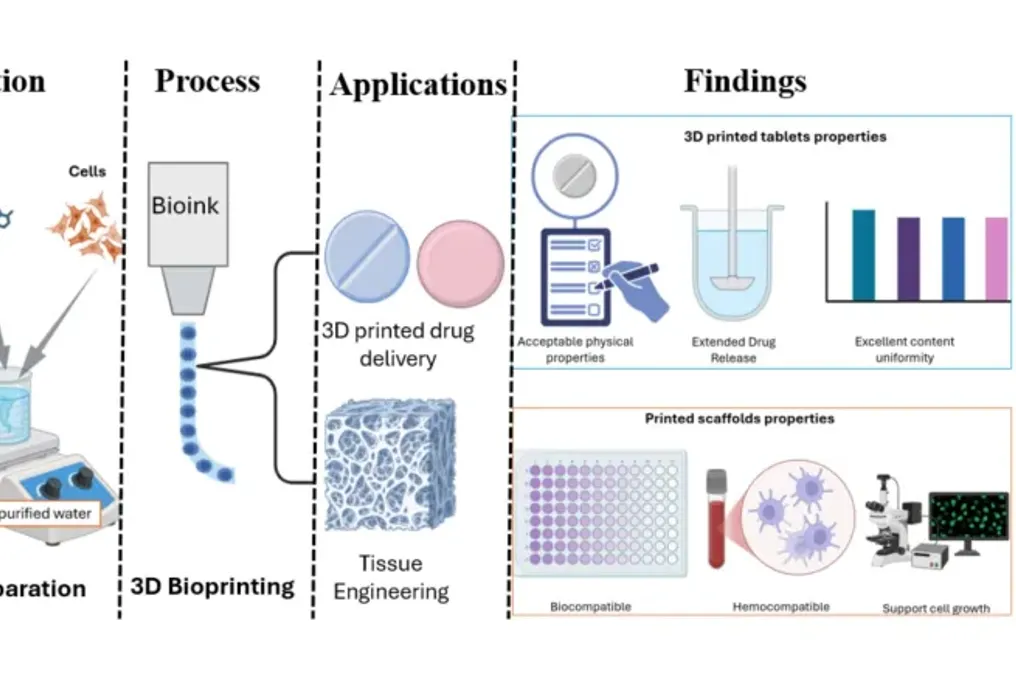
Scientists from the Birla Institute of Technology and Science (BITS) Pilani have created a new three-dimensional bioprinting method. This method utilizes common pharmaceutical polymers to manufacture both living tissue scaffolds and customized drug formulations. This achievement opens up an economically accessible pathway for the advancement of regenerative medicine and personalized drug delivery.
The team addressed the issues of high costs and safety concerns that have long hindered the integration of 3D printing technology into conventional hospitals and pharmacies. To overcome the limitations of traditional methods, the researchers developed an innovative bioink composed of corn starch, maltodextrin, and sodium alginate.
These components were selected because they are already approved by health regulatory bodies, do not contain animal products, and are widely available at a low cost. The process used to form the structures is known as semi-solid extrusion 3D bioprinting. This technique functions similarly to using a caulking gun, depositing ink layer by layer according to a digital design to create complex three-dimensional objects.
The new bioink is based on a property called shear thinning. In this state, the material becomes less viscous and flows easily under pressure through the printer nozzle, but rapidly regains its solid structure after deposition. The researchers found that their specific formula recovered almost 87% of its thickness almost instantly, allowing it to maintain its shape without collapsing.
After printing, the structures undergo a chemical treatment called ionic crosslinking. Exposure to calcium chloride causes the formation of a known pattern called eggshell-type composites, which bind the molecules into a stable, water-rich gel known as a hydrogel. This hydrogel was used to print two different items: porous scaffolds for skin regeneration and chewable tablets for drug delivery.
The skin scaffolds were designed as a highly porous microscopic sponge, with pores approximately 39 micrometers in size. These tiny pores are critical as they ensure the supply of oxygen and nutrients to living cells while providing them with a structure for attachment and growth.
In biological tests, the team demonstrated that these scaffolds are highly favorable to cells. Two types of skin-related cells were tested: mouse fibroblasts and human keratinocytes. Over 70% of the cells survived and actively proliferated on the printed structures for more than 48 hours, confirming the material's non-toxicity and compatibility with human biology. Furthermore, blood compatibility tests showed that the scaffolds caused minimal damage to erythrocytes, which is a crucial safety requirement for any materials intended for medical implants or wound dressings.
Beyond skin healing, the researchers demonstrated the versatility of the technology by printing 'smart' drugs. They loaded the bioink with Glimepiride, a drug often used to treat type 2 diabetes, and printed it in the form of chewable tablets. These 3D-printed tablets showed excellent content uniformity, meaning each tablet contained the precisely specified dose of 2 milligrams. This is often a challenge in the traditional manufacturing of low-dose medications. Moreover, the tablets exhibited a sustained release profile, gradually releasing the drug over four hours. This level of customization allows doctors to print tablets in specific shapes, flavors, or doses tailored to individual patients, such as children or the elderly who have difficulty swallowing traditional capsules.
The shift from expensive or animal-derived specialized bioinks to affordable, regulatory-compliant pharmaceutical polymers makes the transition of 3D printing from the laboratory to the clinic possible. This could lead to a future where hospitals can print custom skin grafts on demand for burn victims, or local pharmacies can produce personalized tablets combining multiple drugs into one easily digestible pill. By reducing the risk of immune rejection and lowering production costs, this technology brings us closer to a healthcare system truly adapted to the needs of every individual.