On Christmas Eve in 1966, British veteran Paddy Roy Bates, who had experience in the Spanish Civil War and World War II, traveled 11 km into the North Sea to Roughs, a former anti-aircraft platform on the English coast. As a retired military man, he decided to use this structure to create a pirate radio station.
At the time, the BBC monopolized airtime, broadcasting music only in the middle of the night. In Britain in 1966, opportunities to listen to popular artists such as Tom Jones, Kinks, Supremes, Beach Boys, Elvis Presley, or The Who were extremely limited, causing disappointment among fans.
Bates joined a movement that began on the other side of the North Sea, on the Dutch coast, in 1964 with the appearance of the island of REM. Since Dutch laws did not permit commercial broadcasting, some dissatisfied people created a station in international waters. Round-the-clock music broadcasting from ships or platforms became a symbol of support for independent media.
The British serviceman spent months away from home, subsisting on canned meat, flour, sweet rice, and whiskey. Upon his return, he stated that the radio station was a gift for his wife, and she now had her own island. Although she was grateful, she noted the absence of palms, sun, and a flag.
Although a tropical atmosphere was difficult to recreate, creating a flag was easy. Thus, in 1967, Bates founded the Principality of Sealand. This military platform, abandoned after the war, might have been too small to be considered a country, but Bates did not care. His micro-nation attracted attention and caused irritation among the British government.
According to Ian Urbina, founder of the journalistic NGO Outlaw Ocean Project, which specializes in humanitarian and environmental crises in seas and oceans, attempts were made to regain control of the platform, sometimes with the help of mercenaries. However, all these attempts were met with fire and bombs. Official documents indicate that in the late 1960s, Sealand was viewed as a potential threat during the Cold War, and authorities discussed the possibility of bombing it.
For decades, Sealand experienced coups, counter-coups, and hostage crises. It became the arena for extravagant projects to turn it into a casino, a digital paradise, or a Wikileaks base (none of which materialized). Besides a flag, the principality has a passport, currency, and coat of arms, but it lacks the international recognition that distinguishes a sovereign state. Nevertheless, it became an experiment on the boundaries of diplomatic institutions and an example of how islands can inspire and serve as backdrops for utopian, megalomaniacal, or simply crazy projects.
Perhaps Michael Oliver is the one who accumulated the most such attempts. A Jew born in Lithuania, he survived Nazi concentration camps, emigrated to the USA, and amassed a fortune in real estate and precious metal sales. In 1968, he published a manifesto for the creation of a nation free from bureaucracy and regulation, which he believed stifled entrepreneurship.
This independently distributed leaflet found a receptive audience. Furthermore, the era seemed favorable for such dreams. Post-war decolonization led to the emergence of dozens of countries in the world, so Oliver believed he could negotiate with some newly independent government to acquire territory.
Between 1968 and 1971, he and his followers visited the Bahamas, Curaçao, Honduras, Suriname, French Guiana, Vanuatu, and New Caledonia in search of a suitable location. They studied the climate, political systems, and land laws. Since no project succeeded, he decided to look for territory that belonged to no one.
In 1971, Oliver financed an operation to create an artificial island on the Minerva reefs in the South Pacific. An Australian dredger began dumping sand onto the submerged atoll. The plan was to exploit a loophole in international law: if the island was artificial, uninhabited, and located in the open sea, it might claim sovereignty.
Minerva and Sealand, as well as the Isle of Rose, which appeared on the Italian coast with similar characteristics, inspired similar dreams in other eras, such as Caribbean New Utopia (1990s) and the Principality of Iceland (2010s). These projects were idealized as self-sufficient communities beyond the reach of traditional governments, combining political utopia and business fantasy.
Researcher Manor Mursey, a specialist in architectural theory and author of articles on the political, philosophical, and urbanistic features of islands, notes that central governments often created specific functions for islands, almost always negative ones that no one wanted nearby. Examples include prisons and island quarantine centers. In the case of the previously described utopias, the main motivation is political freedom.
American anarchist Peter Lamborn Wilson created the concept of Temporary Autonomous Zones (TAZ) in the 1990s, regions that fall outside formal structures of control. In his view, islands governed by pirates in the 17th century were examples of utopian micro-nations. These include Libertalia, a supposed colony off the coast of Madagascar whose existence has never been proven, and the Republic of Salé, which resisted in Morocco for 40 years.
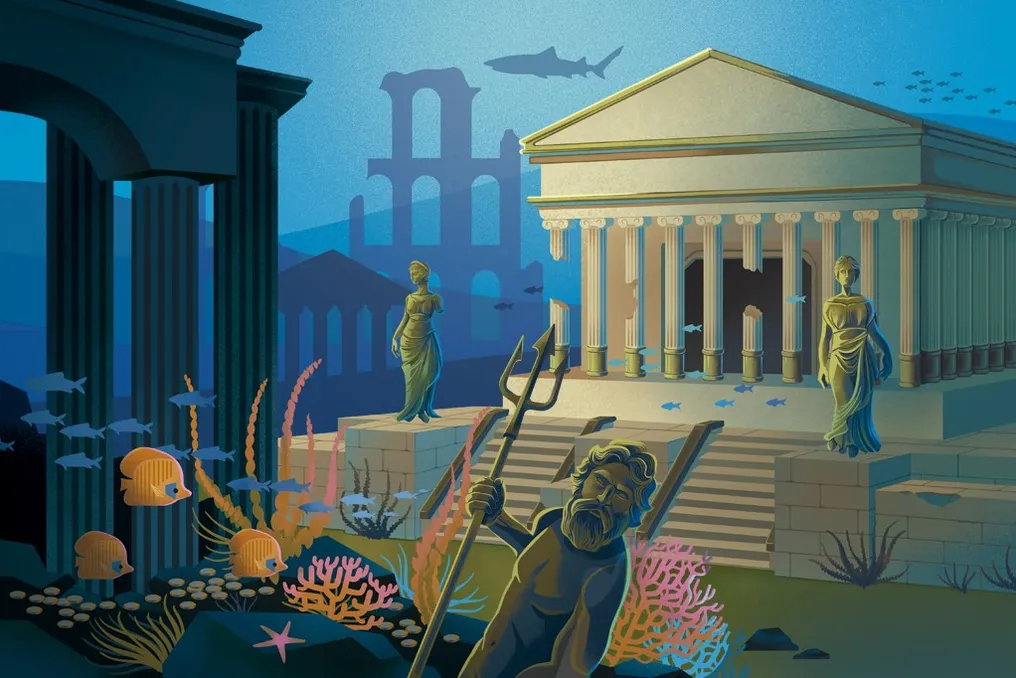
According to Mursey, perhaps the earliest story of a fictional island is Atlantis. Plato described it in his Dialogues as a naval power whose inhabitants, in their isolated environment, became more corrupt and greedy than continental dwellers until they were swallowed by a natural disaster that flooded the island.
Over the centuries, the myth took on new forms, refuting dystopia and portraying Atlantis as a magnificent society. This view still influences the creation of island micro-nations. 'Utopian visionaries seek to use isolation as a tool for political transformation,' explains Mursey. 'For them, political dilemmas, such as ethnic or ideological disagreements, can be resolved through physical separation on islands.'
Those who wished to escape the restrictions of their governments on the continent sought refuge on islands, using their natural ability to isolate people. Ideals varied greatly, but since the mid-20th century, they have taken on a libertarian slant (libertarianism, as the name suggests, advocates for maximum individual freedom and minimal government intervention).
In the 1970s, German merchant Alexander Achenbach approached Bates with plans to expand the micro-nation. He became Minister of Foreign Affairs and helped draft the Constitution, sending it to dozens of countries and the UN. It was ignored, but not entirely, as subsequent events showed.
Achenbach eventually broke ties with Bates and, with the support of lawyer Gernot Pütze, participated in an invasion of the platform that led to the capture of the founder's son, Michael. Bates gathered armed men, reclaimed Sealand, and imprisoned Pütze for treason. When the German diplomat arrived at the platform to negotiate the release of the lawyer, Bates interpreted this visit as an implied recognition of Sealand's sovereignty. Pütze was released after paying a fine, and years later reunited with Bates: he represented the microstate's founder in court against Achenbach and the invaders, which fueled suspicions that the entire episode was fabricated to promote Sealand.
Meanwhile, in Oceania, Oliver organized an administrative structure, gathered about 15,000 interested individuals, and in 1972 proclaimed the independence of the Republic of Minerva, possessing its own flag, currency, and government. He sent letters to over a hundred countries, but like Sealand, received no recognition. Nevertheless, he believed it was only a matter of time.
The reefs are located between Fiji and Tonga, two Pacific island nations that were part of the British Empire and gained independence in 1970. Before this, neither claimed the Minerva territory, but the appearance of Oliver's libertarians changed the situation. The King of Tonga, Taufa'ahau Tupou IV, stated that he would not allow a private group to settle on the reefs for commercial purposes. With the support of Fiji and other regional countries, Tonga dispatched a small force to the site and easily conquered it.
Failure did not stop Oliver's struggle. In 1973, he attempted to support the separatist movement on the Abaco Islands in the Bahamas. The project brought together businessmen, mercenaries, arms dealers, dissident British aristocrats, and former CIA agents. The strategy was to leverage the existing autonomist sentiment of the archipelago, but it was unsuccessful.
The following year, he became active again in the New Hebrides, an archipelago in Oceania jointly administered by France and Great Britain, which was preparing for independence as Vanuatu. Oliver allied with local leader Jimmy Stevens and supported the proclamation of another country: the Republic of Vemerana on Santo Island.
The new government of Vanuatu requested assistance from neighboring Papua New Guinea, which sent troops to suppress the Vemerana rebellion. For the second time, the libertarians were defeated by one of the smallest armies in the world.
In 1982, former project participants returned to the Minerva reefs in Oceania to reclaim the territory. They were expelled by Tongans forces within a few weeks.
As for Sealand, throughout all these decades, the population consisted of only six permanent residents. The old military structure acquired a wind farm. On the official website of the 'country', one can buy a noble title for 300 reales. Maintaining energy, communication, and infrastructure in the conditions of North Sea dampness and storms is expensive and difficult. But the mere fact of the micro-nation's existence remains the most astonishing. According to Urbina of Outlaw Ocean Project, the secret to survival lies in its modest ambitions. Ignored by the international community, it occupies a legal vacuum, posing no threat. If there was once concern, today nobody cares.
Bates died in 2012, leaving the throne to his son Michael, who lives in the Netherlands.
Sealand, Minerva, and other libertarian projects served as inspiration for seasteading—a term in English denoting the establishment of permanent marine dwellings in territories not governed by any state. The Institute for Seasteading was founded in 2008, co-founded by Pat Friedman, an anarcho-capitalist activist with a famous surname—his grandfather was Milton Friedman, one of the most important economists of the 20th century and considered the 'father of neoliberalism.'
The institute's proposal is to create oceanic communities functioning as 'city-states managed by an entrepreneurial mindset.' The project was funded by tech billionaire Peter Thiel, co-founder of PayPal and a well-known libertarian activist. 'Decades from now, those who look back at the beginning of the century will understand that the concept of 'seasteading' was an obvious step toward stimulating the development of more efficient and practical models in the public sector worldwide,' Thiel stated then, advocating for the idea of competitive governments functioning as a free market system.
The institute negotiated with the authorities of French Polynesia, but nothing progressed. However, Friedman and Thiel, along with Sam Altman, CEO of OpenAI (owner of ChatGPT), found ground for their experiments in Honduras. They supported the project of Eric Bremen, an investor born in Venezuela, who arrived in the country in 2018.