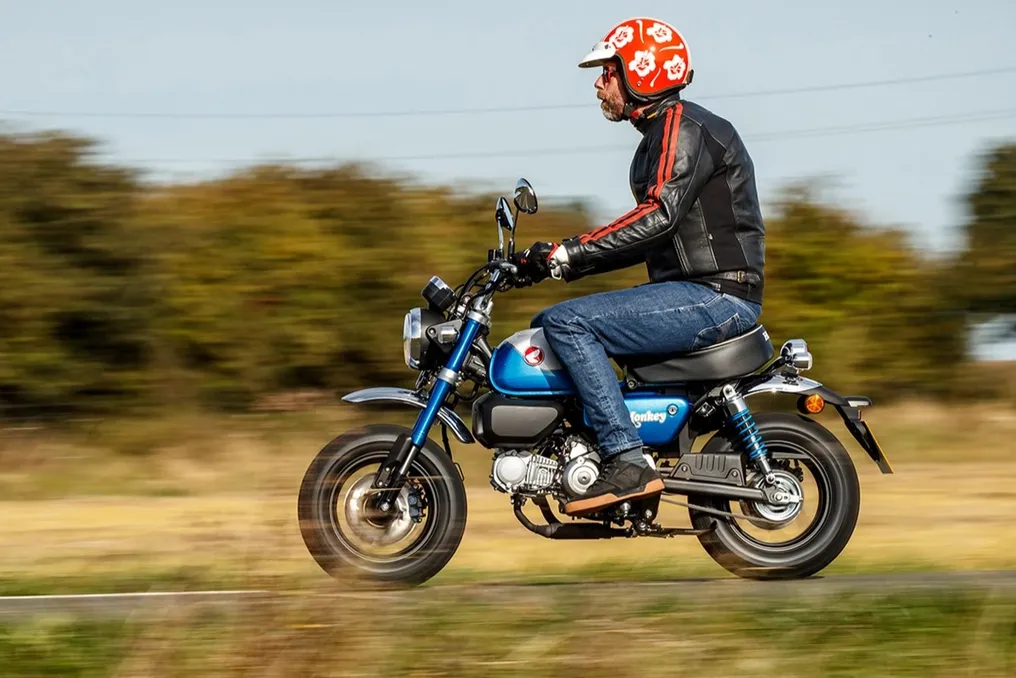
Like many people today, the author frequently scrolls through the Instagram feed, which requires paying attention to what is happening on social media. Observing the content, he notices a two-hour gap between memes, influencer videos, and vehicle advertisements, with the motorcycle category being particularly interesting lately due to the appearance of various mini-motos for sale.
It is important to note that the text does not refer to traditional 2-stroke trail motorcycles available in dealerships like Honda or Yamaha, which were the author's childhood dream. The mini-motos discussed are street motorcycles sized for adults, although their importation status is complex; while they are legalized and can circulate on public roads abroad, in Brazil they rarely obtain documentation, usually being advertised as 'condominium toys'—expensive items intended for use on private roads or circuits.
The author's interest led to the discovery of the origin of these mini-motos, which is linked to Honda. Although it is widely accepted that Honda conceived the original idea of mini-motos for adults, they were initially created for children. In 1961, Honda opened the Tama Tech theme park in Tokyo, which featured the Honda Z100 attraction, a 50cc micro-motorcycle based on the Super Cub, with five-inch wheels and a rigid frame, designed to be playful and safe for little ones.
However, parents did not just watch, and adults began to compete for space on the track. A journalist of the time described the riders as 'circus monkeys riding on small bicycles.' Recognizing this new market niche, Honda developed the Honda Monkey. The first version, the CZ100, appeared in 1963, a rustic model without suspension, sent in small quantities to Asian and European markets as a reception test.
Based on positive sales, the definitive version, the Z50M, was launched in 1967. It used the Super Cub's 50cc four-stroke SOHC engine, mounted on a new chassis. A notable feature of the Z50M, which would later be used in the Motocompo, was the seat that lowered and the handlebar that folded over the tank, allowing it to be stored in car trunks or airplane cargo holds.
Crossing the Atlantic in 1968 as the Z50A Mini-Trail, dealers expected failure, but the opposite occurred: the first stocks sold out quickly. The Mini-Trail helped demystify the image of motorcyclists, making riding a light and fun pastime, and the Monkey became a pop icon. John Lennon, for example, acquired a Z50A K1 in 1969 for his property in England.
In the 1970s, Honda improved the bike's usability by adding headlights and turn signals. In the 1972 K3 version, the rigid frame was replaced by conventional rear suspension with a swingarm and helical springs. In 1979, the Z50R represented a conceptual shift, removing lights and adopting a motocross look inspired by the CR Elsinore line, aiming to encourage early interest in off-roading. The Z50 family also produced special editions, such as the 1986 Z50RD Christmas Special.
After more than three decades and the production of about one million units, the classic line was discontinued in 1999 because it could not meet new environmental standards with its 49cc carbureted engines.
The Renaissance
The period of absence of Honda mini-motos seemed long, but in 2013, the Thai division introduced the Honda Grom (MSX 125 in Europe). Unlike nostalgia, the Grom focused on being a modern, lightweight, and aggressive mini streetfighter, equipped with a 125cc injected engine and 12-inch wheels, achieving immediate success in Japan, Europe, and the USA.
In 2016, Honda explored another aspect of the category with the Navi, developed in India with a focus on cost-effectiveness. It featured a 110cc engine with a CVT gearbox mounted on the rear wheel, freeing up space for a closed trunk. This hybrid concept, combining the ease of a scooter with the look of a mini-moto, was popular in Latin America, with assembly lines in Mexico, but it did not reach Brazil due to the consolidation of models like Pop 110i and larger scooters.
With the heated market and the validation of 125cc injected technology by the Grom, Honda revitalized the Monkey in 2018, replacing the old 50cc with a 124cc single-cylinder engine with 9.3 hp and a five-speed gearbox, capable of handling traffic on a 104 kg motorcycle. Engineering also advanced with inverted front forks, sophisticated rear suspension, full LED lighting, and disc brakes with ABS managed by IMU.
The Niche Expands
Honda's dominance in this segment was not exclusive. The global success of the Grom and the return of the Monkey alerted other manufacturers that mini-motos were a lucrative and desired segment. Kawasaki was the first major competitor, launching the Z125 Pro in 2016, which featured a sporty design, adapting the Sugomi language of its larger bikes, with sharp angles and Lime Green color.
Mechanically, the Z125 Pro competed with the Grom, having a 125cc air-cooled single-cylinder engine and 12-inch wheels. Kawasaki differentiated itself with a more forward-leaning riding posture and a decentralized rear shock absorber, ideal for circuits or urban use with a mini-superbike aesthetic.
The Chinese manufacturer CFMoto entered the dispute with the XO-1 variant (Papio SS), inspired by 1980s endurance racing. Instead of being generic, it boasted a striking neo-retro look, with a full front fairing, two circular 'X' and 'O' headlights, clip-on handlebars, and an integrated exhaust. Its 126cc engine with a six-speed gearbox provided an engaging riding experience.
Benelli, the Italian brand controlled by the Chinese group Qianjiang, also participated with the TNT 135. Aiming for performance and low-cost style in Europe and North America, it used a 135cc engine with an oil radiator and dual spark plugs, generating about 13 hp. The Benelli's design reflected Italian influence, featuring an exposed steel trellis frame, a four-reflector LED headlight, and a side exhaust with a double tip.
Back to Brazil
Although the enthusiasm for riding a mini-moto is understandable, legal viability in Brazil is not entirely impossible. Older models can be imported as classics, following a process similar to importing classic cars, but the final cost can double after taxes and documentation.
Importing a brand-new model is theoretically permitted, following a procedure similar to that of a new car, however, it is a complex and costly process. For a new motorcycle to legally circulate in Brazil via direct import, it is necessary to obtain the License for Use of Vehicle or Engine Configuration (LCVM) from Ibama, which requires laboratory tests to prove compliance with PROMOT noise and emission limits, in addition to issuing the Certificate.