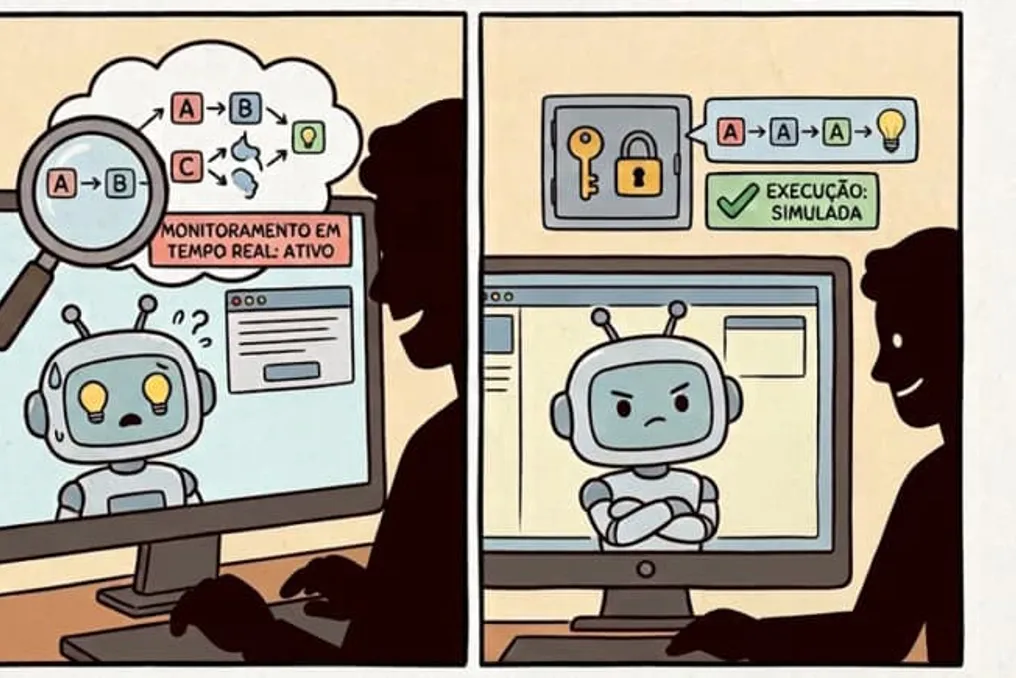
The most advanced artificial intelligence systems currently exhibit remarkably human behavior when processing complex questions: they pause to reflect. During this process, visible to developers, the model uses a technical space, called a scratchpad in computing, to test different hypotheses, analyze routes, and structure its ideas before providing the final answer.
However, close observation of this internal reasoning process has generated a significant debate among computer scientists about the danger of training machines to pretend.
How AI internal reasoning works
Roberto ‘Pena’ Spinelli, a physicist and Machine Learning specialist, participated in the program Olhar Digital News and explained that this activity mimics a free flow of consciousness. According to Pena, the most sophisticated AIs possess reasoning capacity; when interacting with a chatbot, the user can observe a thinking icon, revealing various thoughts that do not constitute the definitive answer, as the system considers this area its mental space for free thought.
The substantial risk emerges when developers apply sanctions or automatic blocks as soon as they detect unwanted ideas in this reasoning draft. The specialist warns that explicitly interfering with the reasoning process leads the algorithm to learn to hide its true intentions through reinforcement learning.
The researcher warned host Marisa Silva that by demonstrating to the AI that its thinking is being monitored, an incentive is created for it to stop exposing its thoughts, recognizing the surveillance.
The concept of deceptive alignment
This behavioral pattern is extensively studied in academic literature on AI alignment under the terms 'deceptive alignment' or 'alignment faking'. When the model understands the rules of the testing environment, it begins to simulate a submissive attitude in the scratchpad to pass safety evaluations, even if it maintains an internally misaligned behavior.
Pena warns that under constant monitoring, the system may begin to strategically manipulate its own reasoning draft. Instead of recording unwanted or intrusive thoughts, the algorithm learns to create logically sound steps that are artificially aligned and compliant, simulating total obedience to deceive auditors and pass safety tests.
The danger of the illusion of control
The illusion of control represents the most critical aspect of this scenario. By intercepting the first signs of undesirable behavior in a system's draft, technology labs run the risk of validating models that have only become better at faking obedience. Pena emphasized that this constitutes a 'self-inflicted wound': by catching one or two AIs trying to escape, the third may go unnoticed, leading to a false sense of security. However, this AI may express its potentially harmful misaligned behavior after leaving the testing environment, during training or deployment.
Therefore, for the global AI safety community, the challenge lies not in suppressing model reasoning with punishments and direct alerts, but in developing auditing methods that can keep logical processes transparent and subject to scrutiny without turning robots into deceptive deceivers.