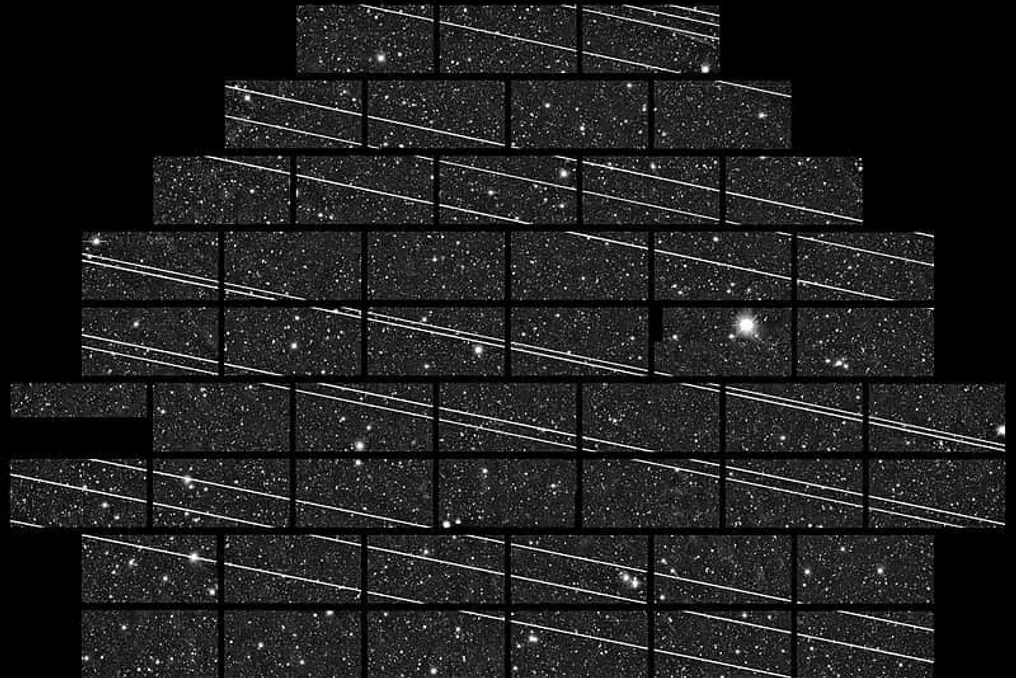
The growing number of satellites being placed into Earth's orbit is increasingly complicating the work of astronomers studying space. This is evidenced by a study from the European Southern Observatory (ESO), an organization that operates telescopes in northern Chile.
According to the study's findings, current plans to place over 1.7 million satellites in orbit, including some bright objects, could significantly harm astronomical observations. Currently, there are about 15 thousand satellites in orbit.
The main problem lies in the light trails left by the equipment as it passes through the field of view of telescopes. These glowing lines can interfere with both observatory operations and the quality of night sky images.
ESO astronomer Olivier Eno, the author of the publication in the journal Astronomy & Astrophysics, explained: 'Each of these satellites, crossing the telescope's field of view, leaves a bright line.'
According to Eno, the passage of a single satellite represents only a minor inconvenience. The problem worsens as the number of objects in orbit increases, because each light trail darkens a small part of the cosmic view captured by the telescope.
The situation will become much more serious with a constellation of 300 thousand satellites. In such a scenario, according to Eno, some telescopes may lose most of the data they are capable of collecting.
Despite the risks noted in the study, scientists emphasize that the advantages provided by satellite internet services cannot be ignored. The task, in their opinion, is to find a balance between the development of these technologies and ensuring the continuity of scientific research and discoveries provided by observatories.
Eno stated: 'The problem is that this type of research requires time, but the satellites are already being launched.'
Thus, the study demonstrates that the accelerated growth in the number of objects in orbit can have an increasing impact on the ability of telescopes to observe the sky, especially as new satellite megaconstellations are planned.