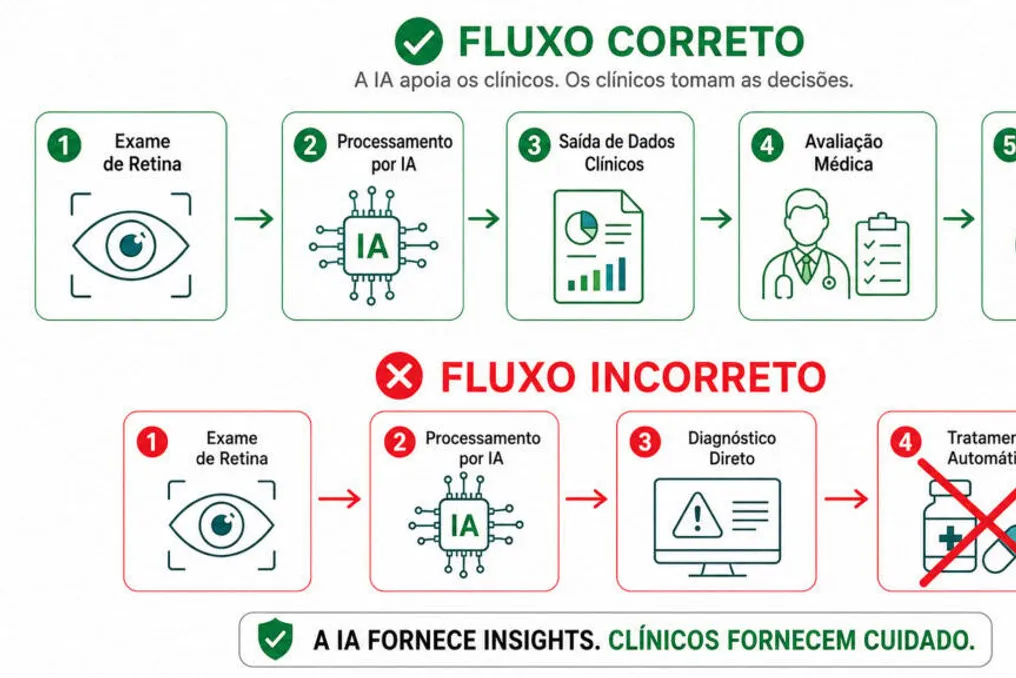
Ophthalmology is a medical field where the use of artificial intelligence (AI) is highly developed. For example, in retinal photography exams, which are photos of the back of the eye, algorithms can analyze the images in less than a minute, identifying signs of serious illnesses, such as diabetic retinopathy, without the immediate presence of a doctor during the test.
In the context of primary healthcare, this technology operates as an automated screening system. Instead of subjecting patients to a general queue, the system classifies exams, promoting greater agility. This change transforms the care model from reactive to preventive, accelerating the referral of severe cases to specialists and preventing vision loss.
Limitations of AI in Diagnosis
Despite the accuracy of AI in mapping the back of the eye, there is a crucial difference between detecting an anomaly in an image and establishing a definitive diagnosis. Reports from the American Academy of Ophthalmology indicate that even when AI software approved by regulatory bodies, such as the FDA (the US equivalent of Anvisa), signals diabetic retinopathy with a high success rate, the algorithm only calculates mathematical probabilities based on pixel contrast. This means that AI recognizes the visual alteration but does not know its biological meaning for the specific individual.
In conversation with Olhar Digital, Dr. Marina Crespo Soares, an ophthalmologist trained at Unicamp, clarifies that a complete diagnosis requires analyzing the patient's history, performing complementary tests, and observing the reaction to previous treatments. The retinal specialist emphasizes that a professional's evaluation transcends the mere identification of a lesion pattern, demanding a personalized clinical analysis that the machine cannot replicate.
For Dr. Soares, the technological tool must be correctly integrated into the care flow to avoid hasty conclusions. In practice, the technology should function as an information bridge. Another aspect that the software cannot capture is the impossibility of considering social and human variables in the treatment plan. The decision to monitor progression, apply intraocular medications, or recommend surgery depends on the person's routine, financial situation, and preferences.
In summary, the algorithm provides a statistical probability, but it is up to the doctor to assess whether a certain course of action is safe and feasible within the patient's reality. Instead of replacing the specialist, the technology optimizes the organization of work in clinics and health networks. By processing data and separating normal exams from those requiring attention, the tool reduces repetitive analytical load.
According to the Unicamp physician, this automation of initial tasks allows the professional to dedicate more time to direct care and listening to patients' complaints. This distribution of functions keeps ethical and legal responsibility strictly under human control, while the technology expands the scope of preventive screening. The limit between AI and the specialist is not a static barrier, but rather a dynamic line: while technology increases perception capacity, the responsibility to understand and decide remains human.
Scientific data and clinical experience demonstrate that artificial intelligence establishes its place in medicine as a powerful screening filter. The tool accelerates risk detection in primary care and organizes the care flow. However, the final diagnosis, selection of treatment, and comprehensive care fundamentally depend on medical judgment.