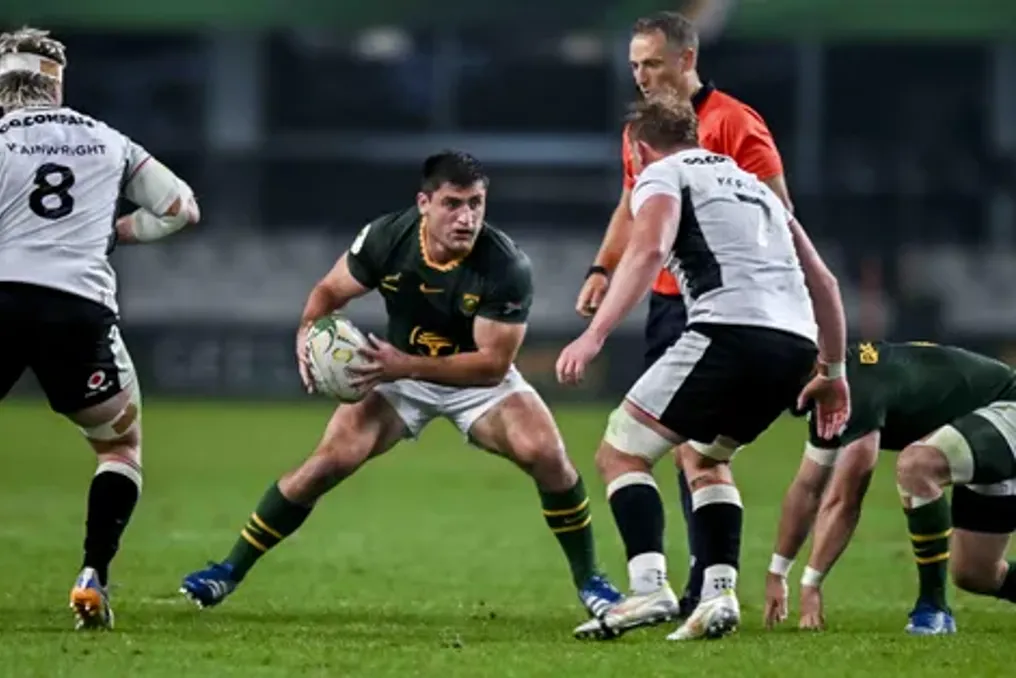
Rassie Erasmus: The series of matches between the Springboks and All Blacks is a marathon, but the Springboks aim to land the first blow
Read more
IOL
iol.co.za

Rassie Erasmus: The series of matches between the Springboks and All Blacks is a marathon, but the Springboks aim to land the first blow

Rassie Erasmus admitted to feeling nervous ahead of the upcoming clash between the Springboks and the All Blacks, but emphasized that both teams will play at their maximum capacity at Ellis Park stadium.

Before the start of the first test match in this greatest rugby rivalry, Erasmus stated that the Boks team does not intend to slow down, even knowing that the series in Johannesburg will not be decided by a single match. He noted that no member of the management, players, coaching staff, physiotherapist, or medical staff wishes to lose the first match, so they will certainly put forth all their efforts to win.

Nevertheless, the Boks coach understands that a defeat at the beginning of the series is not fatal. Previously, the Boks lost the first match of the British and Irish Lions series in 2021, but then won the next two. They also recovered from a loss to New Zealand in the group stage of the 2019 World Cup to win the Webb Ellis Cup. A similar situation occurred in the 2023 World Cup when they lost a group match against Ireland.

Erasmus predicts that the fate of the entire series will only be determined in the third match. He suggested that one could lose the first match and win the next two, or lose the first and win the second, and the third match might not be decisive, with the fourth match in Baltimore becoming the deciding factor. He added that there will always be time to return to the series, but winning the first match is always preferable, and both teams will fight for it with full power.

Furthermore, Erasmus realizes that this test match is only the beginning of a physically demanding campaign, and believes that player management could be a decisive factor. The Boks deliberately kept their players in better condition compared to their New Zealand counterparts during preparation. Over the last six weeks, New Zealand averaged 200 minutes per player, while the Boks used about 130 minutes per player. He stressed that players' form cannot be judged by matches played before this period, as they do not reflect current readiness for play, and that the main focus is on maintaining squad freshness.

Erasmus expects injuries to play a significant role as the series progresses. He is one hundred percent sure that by the third round, which could be the most important, there will be another six or seven injuries in each camp. This is why managing player playing time is of enormous importance.

Despite the series being a marathon, Erasmus knows the psychological value of an early advantage. He stated that if they manage to strike the first blow in the first match, it will be a huge achievement.

The Boks coach was also asked whether the All Blacks are the team South Africa most wants to beat in world rugby. His answer reflected both the history between the two countries and his personal experience of feeling underestimated when the Boks were recovering. Erasmus assured that he would answer honestly, as he always tries to respect other countries. He recalled times when the Boks were ranked sixth in the world, and the All Blacks, England, and Ireland only discussed major world teams, which caused unpleasant feelings.

However, he did not hide what the rivalry with the All Blacks means to him, nor the pressure it creates. Erasmus admitted that the preparation is not without nervousness: 'If I say that this preparation is not causing nervousness, I will be lying. Sitting here, I am nervous. I am not going to pretend that I am not nervous. The team is nervous. I think the fans are nervous too. But I am almost sure that on the other side it is the same. We can look calm, we can say that we are completely in control of the situation, but no, it is colossal.' In this rivalry, which needs no exaggeration, Erasmus agreed that the Springbok versus All Black match is at the very top of the rugby hierarchy. He concluded that if it is not the greatest rivalry, it is only slightly below that title, and it is a very emotional and proud thing to be part of it.

Team Lineups for Ellis Park:

The Springboks squad includes: 15 Damian Willemse, 14 Cheslin Kolbe, 13 Jesse Kriel, 12 Damian de Allende, 11 Kurt-Lee Arendse, 10 Sasha Feynberg-Mngomezulu, 9 Grant Williams, 8 Jasper Wiese, 7 Pieter-Steph du Toit (captain), 6 Paul de Villiers, 5 Juan Nortje, 4 Eben Etzebeth, 3 Wilko Lou, 2 Malcolm Marx, 1 Ox Nche. Reserves: 16 Jan-Hendrik Vessels, 17 Gerhard Steenkamp, 18 Zachary Porten, 19 Kobus Wiese, 20 Andre Estherhoizen, 21 Marco van Staden, 22 Kobus Reinhans, 23 Mani Libbok.

The All Blacks squad includes: 15 Damian McKenzie, 14 Will Jordan, 13 Quinn Tupaea, 12 Jordie Barrett, 11 Josh Murphy, 10 Ruben Law, 9 Cam Roigard, 8 Ardie Savea (captain), 7 Luke Jakobson, 6 Tupou Va'a, 5 Fabian Holland, 4 Josh Lord, 3 Tyrel Lomax, 2 Cody Taylor, 1 Ethan de Groot. Reserves: 16 Asafu Amua, 17 George Bower, 18 Fletcher Newell, 19 Anton Segner, 20 Peter Lakai, 21 Kyle Preston, 22 Anton Lienert-Brown, 23 Leroy Carter.

Similar stories

Springboks coach Rassie Erasmus states he has no objection to South Africans supporting the All Blacks
Read more
iol.co.za

Springboks coach Rassie Erasmus states he has no objection to South Africans supporting the All Blacks

Springboks coach Rassie Erasmus stated that his team is unaffected by the massive support enjoyed by the All Blacks ahead of the RGR test match opening on Saturday.

Rassie Erasmus emphasized that he has no complaints about the large number of South Africans who continue to support the All Blacks during the tour, which is dubbed the 'Greatest Rugby Rivalry.'

During apartheid, many disadvantaged South Africans supported the multiracial All Blacks teams during their visits to the country. Although some of them later switched allegiance to the revamped Springboks team under Erasmus's leadership, a significant portion maintained their loyalty to the New Zealand team.

This was evident during the first match of the tour between the All Blacks and the Stormers in Cape Town on August 7th. Erasmus told a press conference in Johannesburg on Monday: 'When I grew up, I watched the series of rebellious New Zealand Cavaliers in 1986, and before that, the 1981 tour to New Zealand, when bombs filled with flour were thrown at players in Eden Park.'

He also mentioned his idols: 'My heroes were also the All Blacks, such as Murray McTestad and Zinzan Brooke. Danny Gerber was also my hero, but I wanted to play like McTestad, as well as Rob Law.'

Erasmus noted that there is nothing unusual about South Africans supporting teams other than the Springboks. He compared it to football: 'If you look at our coaching staff, some guys support Liverpool, others support Manchester United. We must allow this, provided that the team support does not become indecent and personal conflicts do not arise between people.'

The coach admitted that he understands the political reasons behind some South Africans supporting the All Blacks, while others simply admire the New Zealand style of play. In his opinion, this 'adds spice' to the competition. He added that the situation in Cape Town with mass support was characteristic since childhood, from his first match against them and his last match as a coach.

At the same time, Erasmus noted the growth of his audience: 'The other side of the coin is that several years ago we did not have such large support in South Africa. We grew from five or six million to 16 million active fans. So we have grown too.'

Erasmus believes that the upcoming first match between traditional rivals will be beneficial for rugby as a whole. He concluded: 'Such games make people want to watch rugby more. Because nobody knows who will win on Saturday. Nobody can say. So we have no problem with people supporting the All Blacks. If we cannot win them with how we play, how we behave as a team, and put our country first... Maybe these fans just like how the All Blacks play. Or maybe they look back in history and see what New Zealand meant to them or to their fathers. Who are we to tell them they cannot support the All Blacks?'

Springboks vs. All Blacks rivalry remains the greatest in rugby after 105 years
Read more
iol.co.za

Springboks vs. All Blacks rivalry remains the greatest in rugby after 105 years

After 105 years, the rivalry between the Springboks and the All Blacks continues to be considered the most significant in world rugby. When the 'Greatest Rugby Rivalry' tour between New Zealand and South Africa was first announced, some critics dismissed the title as arrogant. However, it is difficult to surpass the unending drama that has existed between these two teams for over a century.

Although there are long-standing and exciting confrontations, such as England versus France or New Zealand versus Australia, the uniqueness of the All Blacks and Springboks matches lies in the fact that since their first meeting in 1921, both teams have regularly competed for the title of world champion—first unofficially, and then officially.

History of the Rivalry

When the Springboks first visited New Zealand in 1921, the series of three matches ended with one win and one draw. Since then, both teams have consistently been among the world's best, often occupying the No. 1 or No. 2 positions in world rankings. As early as 1928, series in South Africa were positioned as a contest to determine the best team in the world. This was true in subsequent series in 1937, 1949, 1956, 1960, 1965, 1970, 1976, and 1981. Even the Cavaliers sporting tour from New Zealand to South Africa in 1986 pitted the two strongest teams in the world against each other.

After South Africa emerged from international isolation in 1992, the countries played 37 matches since 1921. The Springboks won 20, the All Blacks won 15, with two draws. Then came the era of the World Cup, which began in 1987 and was created to determine the best rugby team on the planet.

The All Blacks won the first World Cup, but the Springboks did not participate due to South Africa's sporting isolation. When the Boks finally entered the tournament in 1995, they won the Webb Ellis Cup in their first appearance. Over the past 10 World Cups since 1987, Australia has won twice, England once, and the remaining titles have been shared by the Springboks (four) and the All Blacks (three).

Recent Dynamics of the Rivalry

There were only one or two periods when the balance of power in this rivalry could be reasonably questioned. Between 2001 and 2006, New Zealand defeated South Africa eight times in a row. Later, in 2016 and 2017, the All Blacks scored 57 points against the Boks twice. However, after Rassie Erasmus started working with the Springboks, the balance of power changed drastically. South Africa won five of the last six encounters, including the epic 2023 World Cup final in Paris. And in the latest match in 2025, the rugby world was stunned by how the Springboks defeated the All Blacks 43–10 on home soil in Wellington.

Interestingly, throughout the entire 105-year history of this confrontation, New Zealand traditionally held an advantage when visiting South Africa. However, the situation is changing this year. For the first time, the Springboks are playing a series against the All Blacks at home as clear favorites, expecting four matches as part of the 'Greatest Rugby Rivalry' tour.

Preparation for the first match at Ellis Park next Saturday, August 22nd, promises to be thrilling. Questions arise: can the tight five of the All Blacks withstand the fierce physical power of the Springboks? Does New Zealand possess sufficient squad depth to remain competitive over four matches, especially considering expected injuries? Can the All Blacks find a way to overcome the suffocating defensive system of the Boks? And can South Africa cope with the high-tempo attack presented by New Zealand's athletic backline?

These questions will soon receive answers. The opening chapter of a new era is set to be written into the folklore of a rivalry that has defined the highest standards of international rugby for over a century. Calling it arrogance is your right. But the history of 105 years proves that the title of 'Greatest Rugby Rivalry' between the Springboks and All Blacks is deserved.

How Rassie Erasmus might change the Springboks' bench composition due to Siya Kolisi's injury
Read more
iol.co.za

How Rassie Erasmus might change the Springboks' bench composition due to Siya Kolisi's injury

Springboks coach Rassie Erasmus faces a difficult selection challenge ahead of the upcoming test series against the All Blacks, as captain Siya Kolisi is once again in doubt due to a recurring hamstring injury.

Kolisi sustained the injury just 24 minutes into his return appearance against Argentina in Buenos Aires on Saturday. Although Erasmus remains optimistic about the severity of the issue, the short preparation window forces the coaching staff to develop contingency plans for both the backline combination and the bench squad.

If Kolisi cannot take the field, Paul de Villiers, a player for the Stormers, is the most likely candidate to start at open flanker. De Villiers demonstrated outstanding play during the World Club Championship in July, establishing himself as a key threat in ball retention and a dynamic ball carrier while Kolisi was on the bench.

However, promoting De Villiers to the starting lineup triggers a chain reaction in the match-day squad, particularly regarding who will provide late-game impact from the bench within the famous 'Bomb Squad.' Under normal circumstances, De Villiers would likely replace the dynamic Kwagga Smith, who is sidelined with a long-term knee injury.

If Kolisi were fit to play, De Villiers would provide an explosive, game-changing role off the bench in the traditional 6-2 ratio. If De Villiers starts, Erasmus must decide who will fill this critical role. Veteran Dion Fourie offers immense experience in ball retention and versatility, as he can play at hooker, making him an attractive option to replicate Smith's destructive impact late in the game.

Alternatively, Marco van Staden provides raw physical power and relentless work rate in tight spaces, offering a more direct, power-based impact, as well as a threat in the air.

The forward reserve group adds another interesting dimension to the discussion. Erasmus successfully utilized the heavy artillery bench against Argentina by bringing on two locks, Kobus Wiesse and Ben-Jason Dixon, to dominate set pieces and collisions in the final quarters. Repeating this tactic against New Zealand would allow them to maintain maximum power in the middle of the park, and their versatility also allows them to operate as backline players.

If the Boks opt for greater versatility at open flanker in the 6-2 setup, they might reduce the number of specialized locks on the bench to one. In that scenario, World Cup two-time winner Pieter-Steph du Toit could transition from blindside flanker to lock in the second half, allowing two specialized 'hunters' like Van Staden and Fourie to remain on the bench when the game becomes tight in the final quarter.

There is also the intriguing possibility of completely abandoning the 6-2 setup in favor of a 5-3 ratio. Such a move would likely depend on the inclusion of Andre Esterhuizen. This fast centre possesses the size, defensive aggression, and strength to act as a hybrid backline player in emergencies, providing the Boks with extra cover in the backline without completely sacrificing forward power.

Esterhuizen made a huge impression off the bench as a hybrid player against the All Blacks in Wellington last year, and he proved invaluable when the Boks were reduced to 14 men against France after Lud de Jager's red card during their November tour. Given that marginal differences will be decisive, Erasmus's final choice will hinge on the trade-off between raw forward depth and tactical adaptability. Replacing Kolisi's leadership and work rate will require a flawless combination of starting effectiveness and bench influence.

Popular