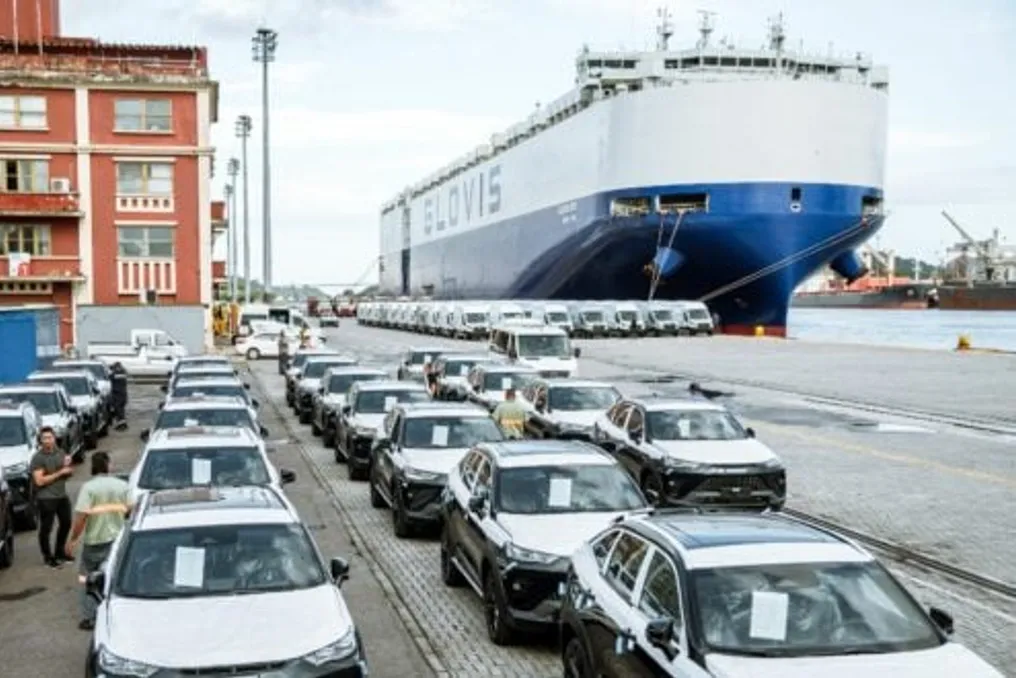
The Chinese automotive sector recorded its tenth consecutive month of decline in domestic sales during July, while exports nearly doubled in the same period. This imbalance is forcing major global manufacturers, such as Toyota, Volkswagen, and Detroit brands, to reassess their strategies, as they historically considered China a major profit generator.
According to the China Passenger Car Association (CPCA), retail sales of passenger cars fell by 20.9% in July compared to July 2025, reaching 1.46 million units. Compared to June, there was an 8.8% reduction. In the cumulative period from January to July, the Chinese market showed a contraction of 20.5%.
In contrast, exports reached 923 thousand vehicles in the month, representing an 88% increase. In the first half of the year, Chinese shipments totaled 5.31 million units, corresponding to a 53% growth compared to the previous year.
Brazil is central to this export movement. According to data from the CPCA released by its Secretary-General, Cui Dongshu, the country received 410,825 Chinese vehicles in the first half, making it the second-largest volume globally, trailing only Russia, which registered 448,157 units. The United Kingdom (255,260) and Australia (237,823) ranked behind these figures.
Low domestic demand is attributed to the combination of high fuel costs and a weak economy. The CPCA justified the rise in oil prices by the closure of the Strait of Hormuz, which increased the maintenance cost of combustion engine cars and boosted the transition to electric and hybrid models. New energy vehicles accounted for 65.1% of total sales in July, although retail sales of these models also decreased by 3.9%, totaling 951 thousand units.
Established companies are under pressure from two fronts. Domestically, in China, brands like Mercedes-Benz, Volkswagen, and BMW are losing market share in a price war for electric vehicles within a shrinking market. General Motors, facing a similar scenario of high investment and falling volume, opted to cease Chevrolet's operations in the country.
Additionally, Chinese overproduction is reaching markets that previously guaranteed the profit margins of these corporations. Geely exemplifies this shift, having shipped about 474 thousand vehicles in the first half, an annual increase of over 150% and a volume already exceeding the total for 2025. The company raised its annual target to approximately 920 thousand units, an advance that European authorities attribute to state support and classify as trade distortion.
Electric vehicles are the main driver of this expansion. Chinese manufacturers exported approximately 2.4 million electric cars in the first half of 2026 alone, a volume comparable to the total expected for 2025.