Although for decades Oropouche fever was seen as a problem restricted to local outbreaks in the Amazon, transmitted by the maruim mosquito (Culicoides paraensis), the situation has changed drastically. This disease, which causes fever, headache, and muscle aches—symptoms similar to dengue, Zika, and chikungunya—can be fatal in rare cases, and currently, there are no specific vaccines or treatments.
Recently, a new viral variant, named OROV BR-2015-2024, has spread throughout Brazil, covering more than 3,000 km starting from the North Region. In 2025, Espírito Santo recorded the highest number of cases, exceeding 6,300, and the disease has reached other Latin American countries, even reaching travelers in Europe.
Estimates from virologist Pedro Vasconcelos, former director of the Evandro Chagas Institute, indicate that more than half a million people have been infected with Oropouche in the Amazon since the 1960s. Felipe Naveca, a virologist at Fiocruz Amazon, points out that the most relevant aspect is the emergence of the virus in regions where it was not expected.
The expansion of Oropouche serves as an example of a broader and more worrying phenomenon: increased deforestation in Brazil can force contact between humans and viruses and bacteria circulating in wildlife, initiating new outbreaks and epidemics.
Natural Barrier
In an intact forest, the circulation of animals such as bats, rodents, primates, insects, and parasites is segmented by habits, schedules, and individual paths, which minimizes the chance of a pathogen jumping from one species to another.
However, when the forest undergoes changes, such as the installation of roads, dams, burnings, pastures, and cities, strips of forest that acted as natural barriers are removed. This leads to coexistence between humans, domestic, and wild animals, promoting the exchange of microbes.
In this proximity between species with little contact history, the phenomenon known as *spillover* occurs: the jump of a virus, bacterium, or parasite from a wild animal to new hosts, including humans.
This contact intensifies in hunting activities, wild animal fairs, and in areas of deforestation and cattle ranching. Animals come into contact with bodily fluids of other species, share water and food resources, and are bitten by the same insects, which is the point of transmission.
Although this dynamic suggests that the forest is a threat, its high biodiversity can act as protection through the so-called 'dilution effect'. In rich ecosystems, viruses and parasites find hosts that cannot perpetuate the infection, given that most pathogens are highly specialized for one type of organism. Some animals are good transmitters, while others act as terminal points for the pathogen cycle.
Spillover Mapping
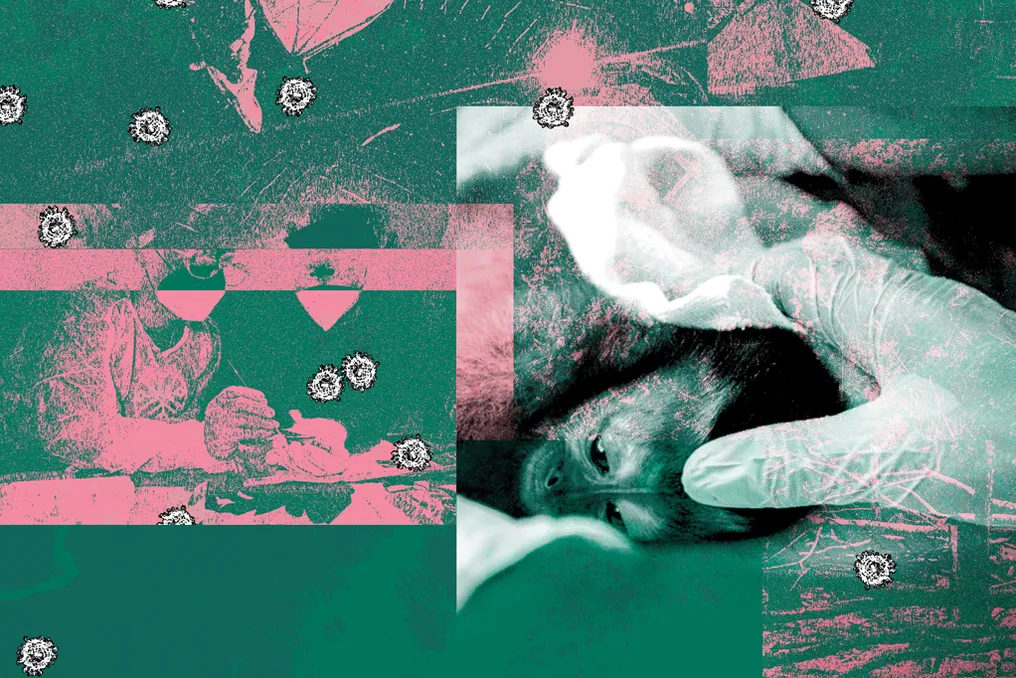
It is questioned how to map *spillover* in a continental biome. One method involves studying animals found injured or displaced—victims of run-overs, burnings, or tree felling. Veterinarian Alessandra Nava, from Fiocruz, investigates clues about viruses and parasites when treating these weakened animals, identifying potential pathogens capable of jumping to humans.
A survey conducted by Fiocruz in 2025 cataloged 1,025 microorganisms in 343 species of wild mammals in Brazil. Scientists determined that 162 of these microorganisms have the potential to transmit to humans.
History of Occupation and Diseases
Encounters between humans, animals, and microorganisms are not recent; they accompany the occupation of the Amazon for more than a hundred years. Historian Rômulo de Paula Andrade, from Fiocruz, observes that authorities have always considered the region a source of wealth to be incorporated into the country. The 'Amazon River Discourse', delivered by Getúlio Vargas in 1940, exemplifies this view, arguing that the lifestyle of rubber tappers and the instability of riverside dwellers should be replaced by fixed agricultural centers.
Subsequently, the diseases typical of the area began to be seen as an 'impediment to progress', according to Andrade. This issue gained prominence during the construction of the Madeira-Mamoré railway, built between 1907 and 1912 to transport Bolivian rubber. The project attracted thousands of workers, but diseases such as malaria and yellow fever, combined with poor working conditions, resulted in the death of at least 30,000 people.
In the 1950s, the Belém-Brasília highway represented a modern version of this challenge. A symbol of national integration, it cut through the forest and opened new fronts of occupation, with malaria again being a major problem during construction.
During the military dictatorship, occupation plans escalated with large projects, such as in Tucuruí, Pará, where the dam of a hydroelectric plant caused explosions of mosquitoes of the genus Mansonia. This territorial expansion also occurred with the opening of the BR-319 highway, which is today the scene of discussions about deforestation and the risk of new epidemics in the Amazon.
BR-319 in the Heart of the Forest
Inaugurated in 1976 to connect Porto Velho to Manaus, the BR-319 spans 885 km and crosses one of the most preserved areas of the Amazon, serving as the only land link between the capital of Amazonas and the rest of the country.
Plans to pave parts that are still unpaved generate controversy due to the potential environmental impact. Although there are renovation and paving works in sections, contracts are in the formalization phase and tenders are ongoing, various environmental issues prevent new developments.
Biologist Lucas Ferrante, from USP, argues that paving the BR-319 would facilitate access to public lands, which could stimulate land grabbing, invasions, and deforestation, bringing humans, animals, and microorganisms closer together. On the other hand, proponents of the work, including authorities and politicians from Amazonas and the federal government, maintain that paving would reduce the state's isolation and optimize regional logistics, promoting development.
Climatologist Carlos Nobre, also from USP, warns that roads in the Amazon often generate the 'fishbone effect'. This occurs when secondary branches leave the main road, opening the way for new invasions, gold mining, and illegal logging in previously isolated areas.
Lucas Ferrante and his team analyzed 61 soil samples along the BR-319 and in potassium mining areas in Autazes (AM), detecting unusual or unprecedented microbes. Some of these microorganisms exhibited characteristics related to resistance to modern antibiotics or toxicity. For the researchers, opening new fronts in the forest could expose people to pathogens still little known to medical science.
Hotter Climate, Greater Risks
The spread of new viruses is not the only danger arising from deforestation. Without tree cover, the Amazon loses its shade and part of its capacity to return moisture to the atmosphere. A 2021 study projected that more than 11 million people in the Brazilian Amazon may face extreme heat with health risks by the end of this century.
This new climatic reality is already felt in the Xingu. Researcher Sandra Hacon, from Fiocruz, reported that indigenous peoples in the region have started using thick socks and sandals to avoid burns on their feet on the hot ground, in addition to umbrellas for sun protection during travel between communal houses.
Ayakanukala Waura, an indigenous leader and researcher of the Wauja people from the Topepeweke village in Paranatinga (MT), expresses the difficulty of living under these conditions: 'It is not easy for us to live here in the Xingu.' The heat harms the elderly and children, alters work routines, and impacts traditional rituals. Drought causes rivers to empty and fish to die, while fire destroys medicinal plants, fruits, and honey.
Increased temperature also favors vector-borne diseases. Pedro Vasconcelos states that heat and humidity accelerate the development of mosquitoes and maruim, increase the frequency of bites, and decrease the time needed for viral transmission.
The expansion of Oropouche in recent years coincides with this new climatic scenario. According to the World Health Organization, climate change, deforestation, and unplanned urbanization may have driven the spread of the disease outside the Amazon.
Heat accelerates viral replication inside the insect, while humid environments rich in organic matter benefit maruim breeding grounds. Simultaneously, droughts modify the patterns of encounters between animals in the forest. When water becomes scarce, animals concentrate in the few remaining humid refuges. This concentration intensifies contact between species and promotes the circulation of microorganisms, as explained by Lucas Ferrante.
The Microscopic World
A 2018 estimate, published in the journal Science by the Global Virome Project, suggests that mammals and birds may host about 1.6 million unknown viruses, up to 827,000 of which could theoretically migrate from animals to humans.
Monitoring viral diversity in the Amazon is complex. The region covers almost 60% of Brazilian territory, hosts approximately 28 million inhabitants, and concentrates a vast range of animals and microorganisms. Vasconcelos criticizes current surveillance, stating: 'Surveillance for these emerging viroses in the Amazon is very flawed. We know nothing [about viral diversity], practically.'
A promising approach is to monitor pathogens in animals before an outbreak reaches hospitals. At Fiocruz Amazon, Alessandra Nava participates in a surveillance system that collects and stores samples of wildlife in a biobank. This collection allows, in the future, to trace the origin of a pathogen, its circulation path, and the moment it began to approach human beings.
However, mapping microorganisms is only part of the solution. It is evident that the Amazon has the potential to generate new epidemics, and this risk increases significantly when the forest is degraded. The only sustainable alternative is its preservation.