According to Olhar Digital, the upper stage of SpaceX's Falcon 9 rocket collided with the Moon on August 5, leaving a new mark on the lunar surface. The collision occurred near the Einstein crater and was recorded by the South Korean probe Danuri. A large cloud of dust, consisting of regolith—the material covering the lunar soil—was lifted by an object weighing about 4 tons.
This incident added another Earth-origin object to the surface of our natural satellite. It is estimated that about 3,000 human-made objects are already scattered on the Moon. Experts believe that the growth of space exploration makes it increasingly necessary to establish rules for preserving the lunar environment.
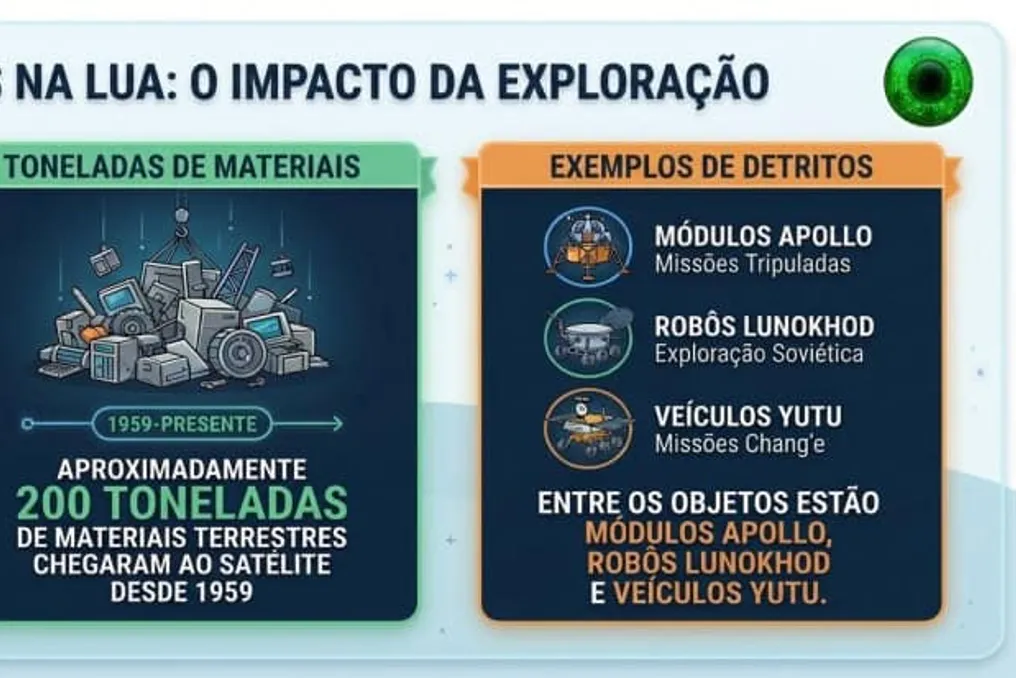
Since the dawn of the space age, about 200 tons of terrestrial materials have been intentionally or accidentally left on the Moon. These objects include the landing modules from six Apollo missions, Soviet 'Lunokhod' rovers sent in the 1970s, and Chinese Yutu 1 and Yutu 2 spacecraft that explored the satellite in the 2010s.
However, the history of human interference in the lunar environment began even before the probes were launched. As explained by Gabriel Hickel, an astrophysicist from the National Institute of Space Research (Inpe), Professor at the Federal University of Itajubá (Unifei), and researcher at the National Astrophysical Laboratory (LNA), there exists a thin extended atmosphere between the Earth and the Moon that facilitates particle exchange. The specialist told Olhar Digital: 'During the 20th century, during open nuclear tests, we contaminated the lunar surface with radioactive particles.'
Hickel emphasizes that since the first human impact, when the Soviet probe Luna II reached the Moon in 1959, 104 cases have been registered where human artifacts were left or collided with the lunar soil. He warns: 'The fall of the second stage of Falcon 9 was the first known instance concerning a rocket stage that delivered a payload to the lunar surface. Since these stages are disposable, and missions will intensify, reflection and caution are necessary.'
Astronomer and space historian Jonathan McDowell explained to Space.com that many rocket stages and other objects left in orbit between the Earth and the Moon from the first lunar missions in the 1960s may have ended up on the lunar surface due to gravitational attraction.
An example occurred four years before the Falcon 9 collision, when part of the Chinese Long March 3C rocket collided with the dark side of the Moon. Such incidents may become more frequent as the number of missions to the satellite increases from governments and private companies.
According to McDowell, lunar exploration is undergoing a transitional period. For decades, missions were conducted primarily by the US and the Soviet Union. Recently, other countries have begun sending probes and landers, and private companies have also started participating in this process.
The problem is that the increase in activity has not been accompanied by the creation of specific international rules. Currently, there is no comprehensive system for coordinating operations, determining disposal sites, or establishing procedures for handling abandoned objects on the Moon.
Lunar activities are governed by the Outer Space Treaty, adopted by the United Nations (UN) in 1967. This document mandates avoiding harmful contamination during space exploration, but it does not clearly define when a change in the lunar environment is considered harmful.
For Marieta Valdivia Lefort, an analyst for the Royal Astronomical Society of Great Britain, the lack of specific regulation means there are no limits on the number of objects left on the satellite or requirements for removing discarded materials.
Civil engineer and astrophotographer Conradu Serodiu stresses that the absence of natural cleaning mechanisms on the Moon makes waste accumulation a constant problem. He explains: 'Unlike Earth, where erosion, the water cycle, or atmospheric processes eventually recycle or erase pollution, there are no such natural cycles on the Moon.'
He adds: 'Any residue or artifact left there will only be erased by the action of wind, sunlight, and micrometeorite impacts over millions or billions of years.'
The concern is not only about the amount of scattered equipment. The Moon has a surface area of about 38 million square kilometers, but its gravity is only 17% of Earth's. Therefore, the dust lifted during the collision can travel long distances before returning to the surface.
This behavior means that the collision is not necessarily a problem confined to the point of impact. The cloud of particles can reach distant areas and potentially interfere with scientific instruments, vehicles, and installations built on the lunar surface in the future.
Hickel notes that the collision debris can even enter lunar orbit and remain there for months or years. From a safety perspective for future missions, the risk is high. 'A dust grain weighing only 0.1 grams, at a typical relative ship speed of about 40,000 km/h, carries twice the energy of a rifle bullet.'
For this reason, the researcher indicates that the first crewed bases on the Moon will likely be located underground or in natural caves, protecting settlements not only from space debris but also from constant bombardment by natural particles.
The risk will be even higher if human presence on the satellite becomes permanent. Bases, scientific equipment, and other structures could be on the Moon for extended periods. In such a scenario, rocket stage collisions could scatter dust across installations and jeopardize observations.
There is also concern related to scientific research. Natural meteorite impacts are part of the Moon's geological history and help researchers study the evolution of the Solar System. However, collisions caused by human equipment add artificial changes to this record.
Terrestrial materials can also alter the physical and chemical characteristics of the soil. In areas of scientific interest, new collisions can destroy, cover, or hinder the identification of yet unexplored evidence.
Despite the warning, Serodiu assesses that scientists can still distinguish natural soil from possible human contamination because the chemical profile of alloys and space components is well known. Nevertheless, he contemplates the future: 'Currently, the change is insignificant compared to the scale of the Moon, but it is crucial to establish preservation zones on the lunar surface before exploration accelerates, ensuring the integrity of sites for technologies and research we cannot even imagine today.'
Space law expert Gregory Radisic from Bond University in Australia believes that the Falcon 9 collision happened at a timely moment because it can stimulate debates about responsible behavior in space before the Moon becomes more active. He stated: 'It was not the result of good planning, that it didn't hit something important. It was pure luck that we are discussing theoretical problems later, and it didn't destroy a multimillion-dollar experiment or an important site of scientific research.'
The Falcon 9 stage was left in a high Earth orbit in January 2025 after helping send the Blue Ghost modules from Firefly Aerospace and Resilience from the Japanese company ispace to the Moon. According to McDowell, the stage's position led to its trajectory being subjected to repeated influences of lunar gravity. These perturbations gradually changed its orbit, leading to a collision trajectory with the surface.
Objects located in the intermediate region between the Earth and the Moon can have unpredictable trajectories. Small gravitational changes accumulate over time, increasing the uncertainty regarding the path traveled by the object.
In light of this unpredictable scenario, experts point out that the disposal of disposable parts must be rethought. For Hickel, traditional solutions such as launching stages into 'deep space' do not completely eliminate long-term risks, as these objects continue to be subject to gravitational perturbations and may eventually return. The astrophysicist argues: 'Unprogrammed collisions must be avoided at all costs, with the introduction of strict rules and legal liability for countries and companies. One of the most suitable alternatives for the responsible disposal of these stages is directing them toward the Sun.'
The Falcon 9 case reinforces the question that will gain central importance with the expansion of lunar exploration: how to advance missions without turning the Moon into a garbage dump.
As Serodiu concludes, exploration is part of our DNA, but waste management must change. 'We cannot and should not deny our nature. Therefore, just like on Earth, we need to find solutions to combat the waste produced by our existence. The first step is not to produce more than necessary waste on the lunar surface. This starts with well-planned missions, the creation of protected zones, and strict disposal rules.'