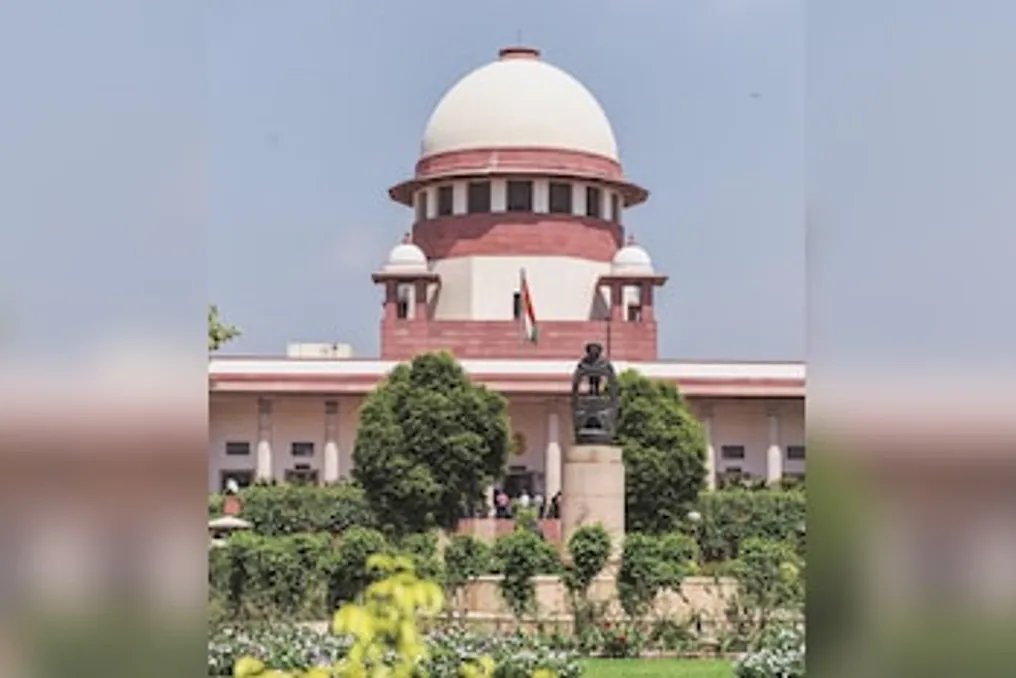
The Supreme Court has ruled that its interpretation of the term 'industry' in the landmark 'Bangalore Water Supply' resolution, dating back nearly 50 years, will not be automatically applied to disputes under the Industrial Relations Code (IRC) 2020.
This decision establishes a distinction between old and new labor disputes. The essence is that while the 1978 ruling broadly defined the concept of 'industry,' this decision allows for a fresh basis for determining this issue, rather than automatically using the old test.
Cases arising under the Industrial Disputes Act of 1947 will continue to be heard using the broad criterion established in 1978. However, courts will have to interpret the definition of 'industry' in the new IRC independently, instead of treating the previous ruling as the starting point.
Position of the Constitutional Bench
The nine-judge Constitutional Bench, headed by Chief Justice of India Justice Surya Kant, delivered a nuanced decision on several aspects of the case.
The question before the bench concerned the meaning of the term 'industry' according to Section 2(j) of the 1947 Act. In the case of Bangalore Water Supply and Sewerage Board versus A Rajappa, a seven-judge bench led by Justice V R Krishna Iyer gave this term a broad scope.
It was established that an activity qualifies as 'industry' if it is organized and systematic, involves cooperation between employers and employees, and produces goods or services to meet human needs. This 'triple test' included institutions such as hospitals, educational institutions, and municipalities, excluding only core sovereign functions like the judiciary, defense, and law enforcement.
The IRC, which came into force last November, has its own definition of 'industry' in Section 2(p). The majority of judges, led by Justice Surya Kant and supported by Justice Satish Chandra Sharma, Justice Alok Arathe, and Justice Vipul M Pancholi, concluded that the interpretation of Section 2(j) cannot serve as the basis for interpreting Section 2(p).
Justice P S Narasimha and Justice Joymalya Bagchi agreed with the majority on this matter. Justice Kant stated: 'The future of 'industry' in Section 2(p) of the IRC is not burdened by the interpretation of 2(j) in the Industrial Disputes Act.'
Nevertheless, this ruling does not affect current or concluded cases under the old legislation. Justice Kant emphasized that proceedings in courts, tribunals, and labour bodies under the 1947 Act must continue according to the Bangalore Water Supply decision.
Indranil D Deshmukh, partner (litigation head) at Cyril Amarchand Mangaldas, noted: 'Current cases, past judgments, and settled settlements continue to be governed by the 1978 test. The real implication concerns the future, as the court stated that the 1978 ruling should not serve as an overarching anchor for the new Code. Thus, employers get a clean slate under the Code, while workers retain the protection they already had.'
However, Deshmukh added that his comments are based on media reports, and full judicial decisions and opinions are awaited. He also noted that 'industry' in Section 2(j) is a specific legislative expression, not just a word in the ordinary sense, since the Supreme Court assigned it a specific legal meaning, so dictionary definitions never held decisive weight.
Impact on Employers and Employees
Rishabh Gandhi, founder of Rishabh Gandhi and Advocates, stated that the immediate effect of the ruling is limited but significant. Ongoing proceedings under the Industrial Disputes Act of 1947 will be subject to the broad test set in Bangalore Water Supply. Employers cannot use this ruling to revive concluded cases or evade liability in current disputes under the old law.
He specifically highlighted that this is relevant for hospitals, educational institutions, charitable organizations, and government bodies whose status as 'industry' has often been contested.
Matuvanti Matavan, partner at Poovayya & Co, believes that the more significant impact is prospective. The Supreme Court has clearly established that the interpretation of 'industry' in the 2020 Labour Code must be conducted independently. The broad interpretation developed under the 1947 Act cannot be automatically transferred to the new Code.
Justice B V Nagarathna held a different view. Along with Justice Dipankar Datta and Justice Ujjal Bhuyan, she considered it unwarranted to refer to the 1978 ruling. She advocated for preserving its broad interpretation to protect workers. Nagarathna also rejected the argument that state involvement automatically makes an activity a sovereign function, noting that liberalization, privatization, and globalization have changed the workplace and made strong labour protection more important.