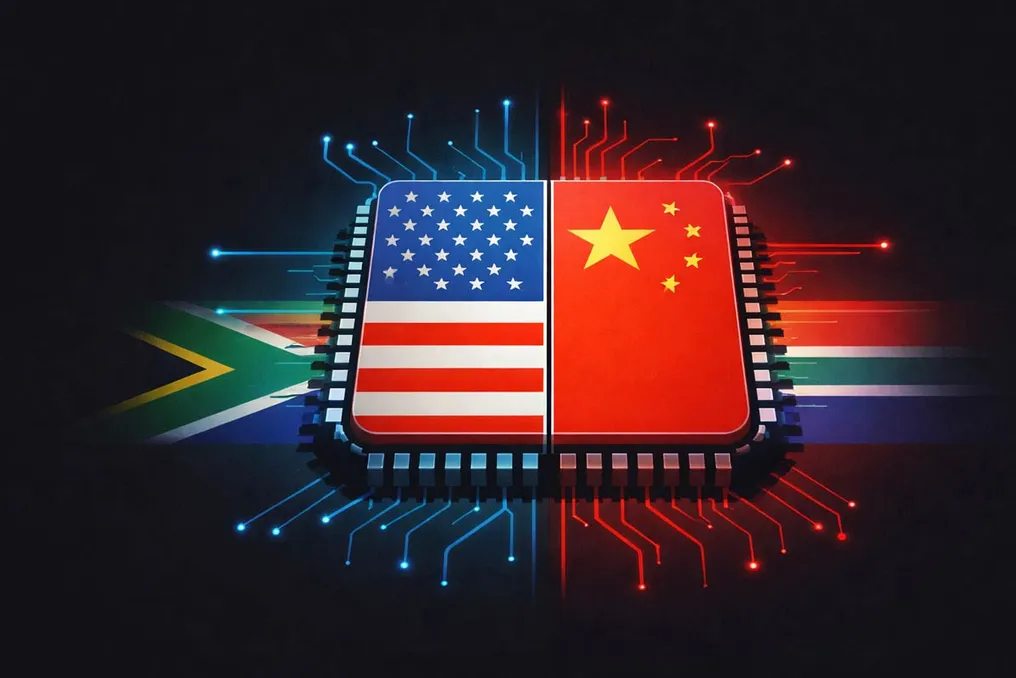
South Africa's Minister of Communications, Sulli Malatsi, told TechCentral that South Africa has not yet been invited to join Pax Silica—an American pact that draws a line in the global AI supply chain. Furthermore, no African country has signed this document.
The Pax Silica Declaration is a key initiative of the US Department of State regarding supply chain and AI security. It was signed in Washington on December 12, 2025, and now includes 24 signatories after the second summit in June, with Taiwan participating as a 'non-signatory participant.' Participants include manufacturers of critical chips, mineral extractors, and capital markets, including Japan, the EU, the UK, Germany, India, the UAE, and Israel.
Emphasizing the importance of computing power and the minerals that fuel it, U.S. Deputy Secretary of State for Economic Growth, Energy, and Environment Jacob Helberg stated on the Pax Silica website that the declaration ensures that coordinated partners will build the future AI ecosystem, encompassing energy, critical minerals, high-tech manufacturing, and models.
Responding to TechCentral, Malatsi declined to confirm any specific position from Pretoria. He stated that if they are asked to consider joining any multilateral pact or cooperation, they will review the request based on its merits and through proper diplomatic procedures.
When asked which ministry guides the government's position and whether Pax Silica was discussed at the cabinet level, he remained noncommittal: 'If we are approached, we will review the request and its delegation at the appropriate level.'
What Lies Beyond Pretoria
Although the text of the pact is not binding, it carries significant weight because it unites three elements essential for AI development: semiconductors, energy, and the recycling of critical minerals. In March, the US Department of State announced plans to allocate $250 million through Congressional work to a fund dedicated to the mining and processing of critical minerals.
This should be a concern for Pretoria. According to the U.S. Geological Survey, South Africa mines about 70% of the world's platinum and approximately 38% of manganese, yet it remains outside the mechanism that determines where investments, licensing, and procurement related to these minerals will be directed.
Malatsi remains steadfast, asserting that investments from global technology companies and South Africa's existing partnerships 'demonstrate confidence in our current strategies' of neutrality and assessment of multilateral agreements on their substance.
When asked how neutrality ensures access to advanced chips if that access is facilitated through trusted partner mechanisms and export licensing, in which South Africa does not participate, he firmly replied: 'Neutrality allows us to consider all issues without geopolitical barriers,' adding that the government will continue to strive to maintain access to the best available technologies.
A leaked draft letter from the US Department of State warns 35 countries that have signed a separate American declaration—the Joint Statement on AI Opportunities—not to join Beijing's competing bloc. South Africa is not on this list.
The American declaration states: 'Being part of everything means being part of nothing.' An American official explained this more directly to Reuters: 'You cannot have both.'
Pretoria is a founder of the China Association for Artificial Intelligence Cooperation (Waico), which the US calls a 'duplicative initiative' that cannot coexist with Pax Silica. Malatsi previously told TechCentral that Waico carries no obligations, and that South Africa 'is not choosing a side.' Kazakhstan is currently the only known country belonging to both blocs, and it has faced criticism from America for this.
Approximately 10 out of 29 Waico founders are African, while no African country has signed Pax Silica. The continent is well represented in one bloc and entirely absent from the other.
The Right to Choose
China has opposed pressure demanding a choice. Chinese Foreign Ministry spokesperson Li Jian stated on August 19 that China 'firmly opposes taking sides and confrontation by camps' in the field of AI, and that 'all countries have the right to choose their cooperation partners in accordance with their national conditions and development needs.'
[