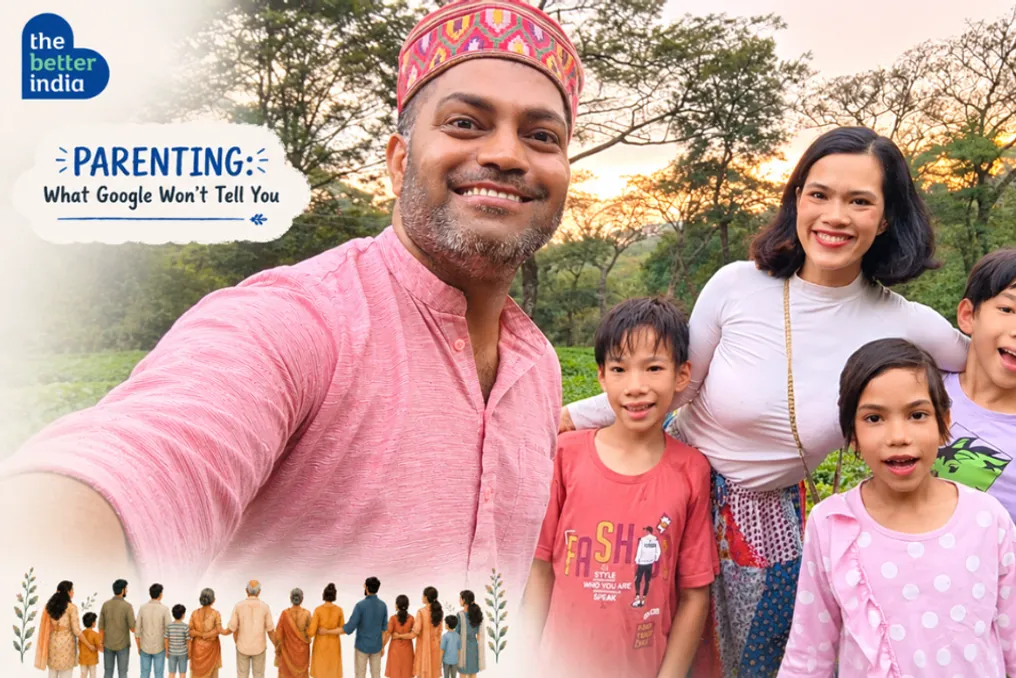
In a small village in the Himachal state of India, where the aroma of simmering broth hangs in the air, the family of Mayur and Joy Sontakke demonstrates an alternative approach to parenting. Their children learn not in a traditional school, but through shared meals, interaction with travelers, culinary experiments, board games, carpentry projects, and long walks in the fresh air.
The Indo-Vietnamese couple built a significant part of their lives around NomadGao—a community for digital nomads that they created. Here, their 13-year-old twins and eight-year-old daughter acquire knowledge by interacting with guests from different parts of the world.
The couple, who also runs the restaurant The Hotpot House in Dharamkot, decided to forgo standard education during the pandemic, adopting a more flexible, child-centered learning method. Their concept of education encompasses kitchens, farms, workshops, books, conversations, and daily life, shaped by curiosity rather than a rigid curriculum.
Building Life Around a Community
Before NomadGao, Mayur already doubted conventional notions of success and education. Having grown up in a middle-class traditional family in Kolapur, he followed the expected path until he felt alienated by the knowledge he was receiving. Failing his Class 12 exams, which many considered a turning point in his life, marked the beginning of his freedom.
After this period, he engaged in various unconventional pursuits: door-to-door sales in villages, odd jobs, remote work, and eventually traveling across India and Southeast Asia as one of the country's early digital nomads. These experiences solidified his belief that the most important life lessons often happen outside the classroom.
Joy's journey was equally transformative. Growing up in Vietnam, she followed the standard path through school, university, and a banking career before meeting Mayur in 2017. After moving to India, she began exploring entirely new fields—from nutrition and health coaching to toy design and restaurant management.
Together, they founded NomadGao as a space where remote workers could live, work, and connect with like-minded individuals. The dream quickly evolved into a thriving community first in Goa, and then in Himachal Pradesh. Their children grew up alongside this community.
Rethinking What Education Can Look Like
Although the pandemic prompted many families to reconsider education, Mayur and Joy were already having these discussions. For Mayur, the reason was the growing sentiment that traditional education is failing to keep pace with a rapidly changing world. He notes that he learned more from traveling and interacting with people than from sitting in a classroom.
The family's situation also played a role. The twins, who moved from Vietnam to India, initially did not speak English, and placing them immediately in a regular school seemed too difficult for them. Furthermore, the family wanted the flexibility to spend time in both India and Vietnam, fully participating in local festivals, traditions, and family life.
Joy first proposed the idea of unschooling. She encountered this concept while reflecting on her own parenting experiences. Observing how her younger daughter developed through a needs-based nutrition approach, she pondered how children learn best. She emphasizes that for her, unschooling is not about avoiding school, but about learning how to learn independently.
This idea became the foundation of their parenting philosophy. Instead of focusing on what children should learn at a certain age, they help them understand how they learn most effectively.
When asked about a typical school day in their home, Mayur laughs and says there is no strict schedule. Learning changes depending on where the family lives and the events taking place. In Vietnam, this might have meant working on farms. When the family was building their house, learning included carpentry and practical construction. Today, in Himachal Pradesh, the children's days combine structured learning and independent exploration.
Mornings are often dedicated to math and English. Afternoons are spent outdoors, reading, drawing, sketching, preparing food, or playing with local children. The family does not follow a rigid curriculum but provides resources and guidance when interests arise. For example, when the boys became interested in baking, the parents found ways to support that interest, and when drawing captured their attention, online art courses were utilized.
Mayur asserts that as long as he provides the resources, the children will manage. Not all experiments are successful. The twins struggled with traditional methods of learning English and math, and textbooks failed to spark interest. Therefore, the family adapted, and now journaling, storytelling, tutoring, and interest-based projects play a larger role.
For Joy, flexibility is key. She believes that success is determined not by the amount of material absorbed, but by how enjoyable the process itself is.
The World Becomes the Classroom
One of the most distinctive aspects of this family's approach is the environment they have created for their children. NomadGao hosts guests from all over the world, each with very different life stories and experiences. Some stay for weeks, others for months, and many become part of the family's daily life.
Instead of spending the whole day with peers, the children regularly interact with entrepreneurs, artists, engineers, travelers, and remote workers from different countries. Mayur notes that when children go to school, they mostly interact with peers, whereas interacting with people of different generations leads to 'explosive' learning.
He recalls an Israeli automation engineer who stayed at NomadGao for several months and spent a lot of time with the children. Through these conversations, they learned about technology, another culture, another country, and a different way of life. Other long-term guests introduced them to board games and strategic thinking, while others shared stories of travel, work, creativity, and personal struggles.
Many visitors are surprised by how easily the children engage with adults.
Lessons from the Kitchen
The family's restaurant, The Hotpot House, has become another unexpected learning space. Although neither parent originally planned to open a restaurant, it has turned into a place where children observe real problem-solving, communication, and responsibility in action. Mayur believes that hospitality teaches lessons that are hard to replicate elsewhere. It simultaneously teaches compassion and patience, as one must serve even difficult guests kindly.
The children sometimes help in the restaurant, observing daily operations and seeing the realities of running a business. More importantly, they see their parents demonstrating teamwork, resilience, and service. Cooking has become a particularly vital life skill. The boys started cooking with Mayur at an early age, often experimenting in the kitchen. Today, preparing dinner often falls to the children themselves.
For the couple, these experiences hold as much weight as academic learning. Mayur insists he does not want his children to grow up without life skills, emphasizing that cooking, cleaning, and taking responsibility are equally important.
The decision for unschooling has brought its challenges. Extended family members continue to question their choice, and friends sometimes express concern. There are also practical difficulties, especially in finding a community of children following similar educational paths. Living in a village, most local children attend regular schools and have limited free time. Mayur admits that 'there is still an issue regarding social life.'
Despite these obstacles, the family remains committed to their chosen path. In their children, they see qualities they highly value: curiosity, independence, confidence in interacting with adults, a love of reading, and a willingness to explore new interests without fear of failure.
As the future of work and learning continues to evolve, they believe one skill is paramount. Mayur concludes: 'Learning is democratized now. If you want to learn something, the resources are available. The important thing is to learn how to learn.'
For parents interested in alternative education but hesitant to take the first step, Mayur's advice is simple: 'Every path carries risk. Traditional school also carries risks. You have to make your own bets.'
Joy offers a gentler reflection: 'I want parents to think about their inner child. What did you want when you were young? Then try creating such an environment for your children.'
Returning to the kitchen, dinner is finally ready. Conversations continue long after the food is served. Stories are shared, questions are asked, and new ideas emerge. Perhaps this is what Mayur and Joy are trying to give their children: the confidence to meet the world with curiosity, and the ability to keep learning from it.