Botswana is known for its wild landscapes, exceptional safari experiences, and vast areas of pristine nature, but the country offers more than just safaris. Two UNESCO World Heritage Sites are located here: the Okavango Delta and Tsodilo.
These two places differ fundamentally from each other. One represents a huge inland wetland formed by water and wildlife, while the other is a cluster of ancient quartzite hills rich in rock art and evidence of human history dating back over one hundred thousand years. Both locations offer travelers the opportunity to see a completely different side of Botswana and deserve inclusion in any itinerary through the country.
Okavango Delta: A Natural Wonder
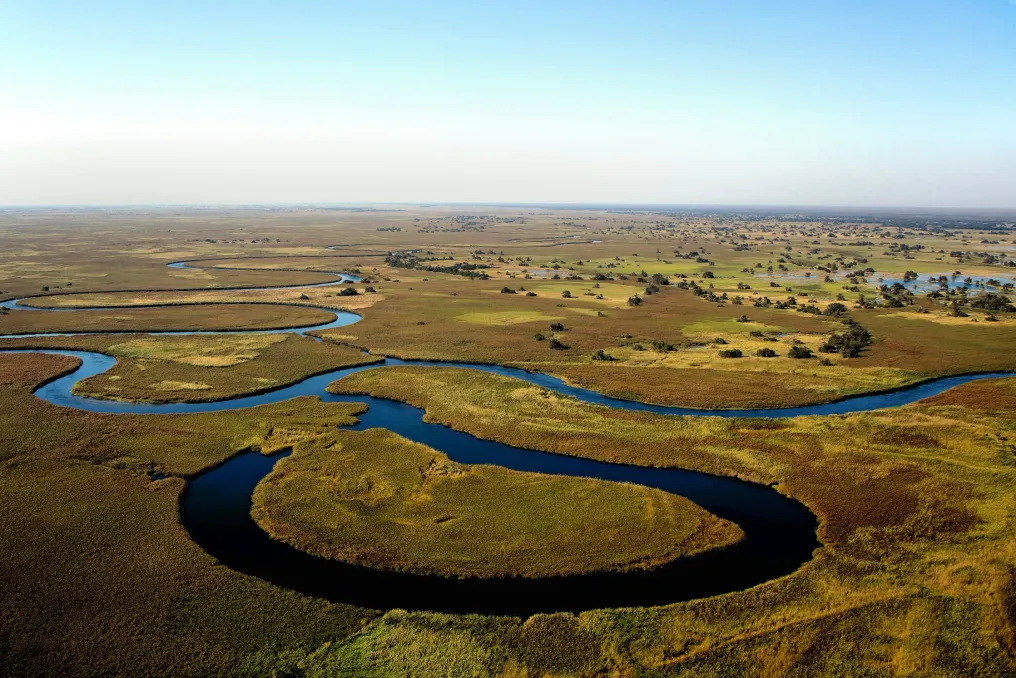
If Botswana's landscapes had a main attraction, it would be the Okavango Delta. Located in the northwest of the country, this giant inland delta is one of the few large delta systems globally that does not flow into the sea. Instead, the waters of the Okavango River drain into the Kalahari basin, creating an impressive network of permanent wetlands, seasonal floodplains, canals, islands, and grasslands.
It is the interaction between the water and the overall arid environment that makes the Okavango so unique. Annual flooding occurs during Botswana's winter dry season, transforming parts of the landscape, especially when water becomes increasingly scarce elsewhere.
The UNESCO World Heritage Site covers an area of over two million hectares, and its remarkable ecosystems support an impressive diversity of wildlife. Among the species found here are elephants, buffalo, zebras, red lechwe, hippos, crocodiles, lions, and wild dogs, and the Delta also serves as an important habitat for endangered species, including cheetahs, as well as black and white rhinos.
Okavango is a place where the journey itself is as important as the animals. A traditional mokoro ride allows quiet movement along the Delta's waterways, guided by a local paddler navigating between reeds and canals. Safaris offer a completely different perspective, while swimming, birdwatching, and hiking provide numerous ways to experience the wetland.
Furthermore, visitors can enjoy typical Botswana moments: watching elephants move through shallow waters, spotting hippos from the water, drifting under palms and papyrus, or sitting outside the camp as the sun sets over the floodplain grasslands. The Delta is also particularly appealing to travelers seeking a less conventional safari. Instead of spending every day in a vehicle, one can explore the landscape from the water, on foot, and from the banks of winding canals.
This site is suitable for wildlife lovers, photographers, birdwatchers, safari enthusiasts, water adventurers, and those seeking the classic Botswana wilderness experience.
Tsodilo: History in Stone
At the opposite end of Botswana's tourism spectrum lies Tsodilo—a dramatic cluster of quartzite hills rising above the Kalahari landscape in the northwest of the country. Due to its exceptional concentration of ancient rock art, it is sometimes called the 'Louvre of the Desert.' UNESCO has documented over 4,500 paintings across an area of only 10 square kilometers. The archaeological record here spans at least 100,000 years, making Tsodilo a prominent site for studying the depth of human history in Southern Africa.
The hills also hold cultural significance. Tsodilo remains a sacred landscape for the local San and Hambukushu communities, who consider the hills, waterholes, and surrounding territory spiritually significant. This is what elevates Tsodilo beyond just a collection of old drawings. The landscape integrates archaeology, spirituality, geology, and living cultural traditions in one remarkably remote location.
Tsodilo is best explored slowly. There are hiking trails through the hills, including the 'Rhino,' 'Lion,' and 'Cliff' trails, where visitors can view the rock art while enjoying the surrounding Kalahari scenery. Excursions involving representatives from nearby communities can also be arranged. The Tsodilo Museum offers another way to understand the history of the area before venturing onto the trails.
While the rock art is undoubtedly the main draw, the landscape itself should not be underestimated. The isolated hills rising above the surrounding scrub create a striking contrast, especially against the backdrop of the vast open Kalahari.
Tsodilo is ideal for history buffs, archaeologists, hikers, rock art enthusiasts, photographers, and those interested in Botswana's cultural heritage.
One of the greatest aspects of visiting Botswana is the immense diversity contained within its landscapes. The Okavango Delta demonstrates an exceptional connection between water, wildlife, and desert, while Tsodilo provides insight into the people who have lived and been connected to this landscape for millennia. Together, they convincingly prove that one should look beyond the standard safari list.
Yes, Botswana is a fantastic place to see elephants, lions, and wild dogs. But it is also a place of ancient rock art, sacred landscapes, extraordinary geology, and ecosystems functioning uniquely almost nowhere else on Earth. Perhaps this is the best reason to include both UNESCO World Heritage Sites in your Botswana travel list. If time permits, consider combining a safari in the Okavango Delta with a visit to Tsodilo for a trip that merges wildlife with history and culture. These two sites offer vastly different experiences, making them a natural choice for travelers wishing to see more than just one side of Botswana. For official visitation information, guides from the Botswana Tourism Organization for the Okavango Delta and Tsodilo Hills are useful.