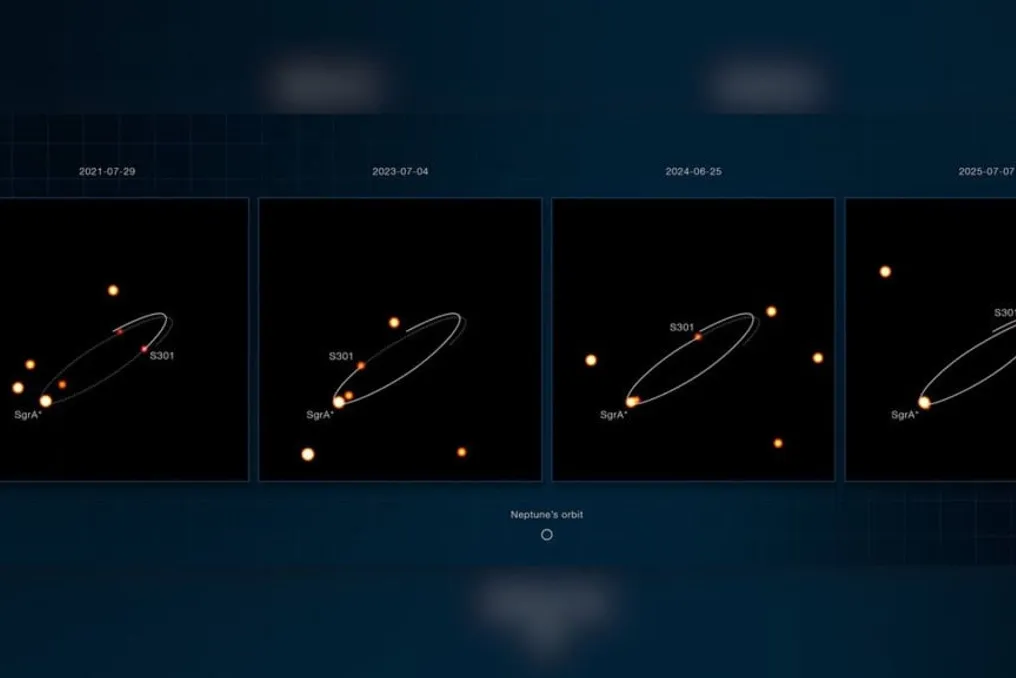
Astronomers have identified the fastest star in the Milky Way, which orbits very close to the supermassive black hole called Sagittarius A*, located at the galaxy's core. This celestial object, designated S301, completes an orbit around the galactic center in 8.7 years, representing the shortest orbital period ever recorded for a star in this area. This discovery was announced by an international team of scientists in the scientific journal Nature on Wednesday (20).
At its point of closest approach, S301 reaches a distance of 1.7 billion kilometers from the black hole, which corresponds to the separation between the Sun and Saturn in our Solar System. During this phase of its trajectory, the star reaches a speed of 25 thousand kilometers per second, which is slightly more than 8% of the speed of light. This unprecedented proximity will allow researchers to measure the rotation rate of the black hole in the coming years.
Supermassive black holes are characterized by rotating on their own axis, which causes the distortion of the surrounding space. This phenomenon influences the movement of any bodies that pass very close to them. Due to S301's extremely close passage to the gravitational center, its orbit is intensely affected by these effects.
By monitoring the star's path, scientists were able to calculate the intensity and rhythm of Sagittarius A*'s rotation, data that had not previously been measured in the Milky Way. Felix Mang, a doctoral student at the Max Planck Institute for Extraterrestrial Physics in Germany, stated in a press release from the European Southern Observatory (ESO): 'What makes this star special is that it orbits Sagittarius A* in a very tight trajectory (...) and approaches the black hole at a distance of only 12 times that separating Earth from the Sun. This is unprecedented.'
The detection of S301 was carried out using equipment from the European Southern Observatory, located in Chile. The astronomers used the GRAVITY instrument, which was connected to the telescopes of the complex. Despite the star having low brightness, which made observation difficult, tracking its light allowed for the mapping of a considerably elongated and oval orbit.
Researchers suggest that S301 did not originate alone in that spatial region. The prevailing theory indicates that it was part of a binary star system. When it approached the galactic center, the gravitational force of the black hole separated the pair: one of the stars was captured into S301's closed orbit, while the other was ejected at high speed.
Currently, operational telescopes cannot accurately determine S301's velocity towards Earth, a measurement essential for detailing all angles of its trajectory. However, it is expected that the next generation of giant telescopes, such as the Extremely Large Telescope, will be able to confirm and expand on this data in the coming years.